During a Green Belt course, a participant asked: “Why do we actually have to improve continuously? If a process is good, then it’s good, isn’t it?” A great question that comes up often. A trainer at Lean Six Sigma Groep explains how he answers it.
Some time in spring I was teaching a Green Belt course to a group of enthusiastic participants. As I introduced the ideas behind Lean and Six Sigma, one of them sighed: “But why do we have to improve continuously? If a process is good, then it’s good, isn’t it?” To answer that, I need to go back to the origins.
The idea behind continuous improvement
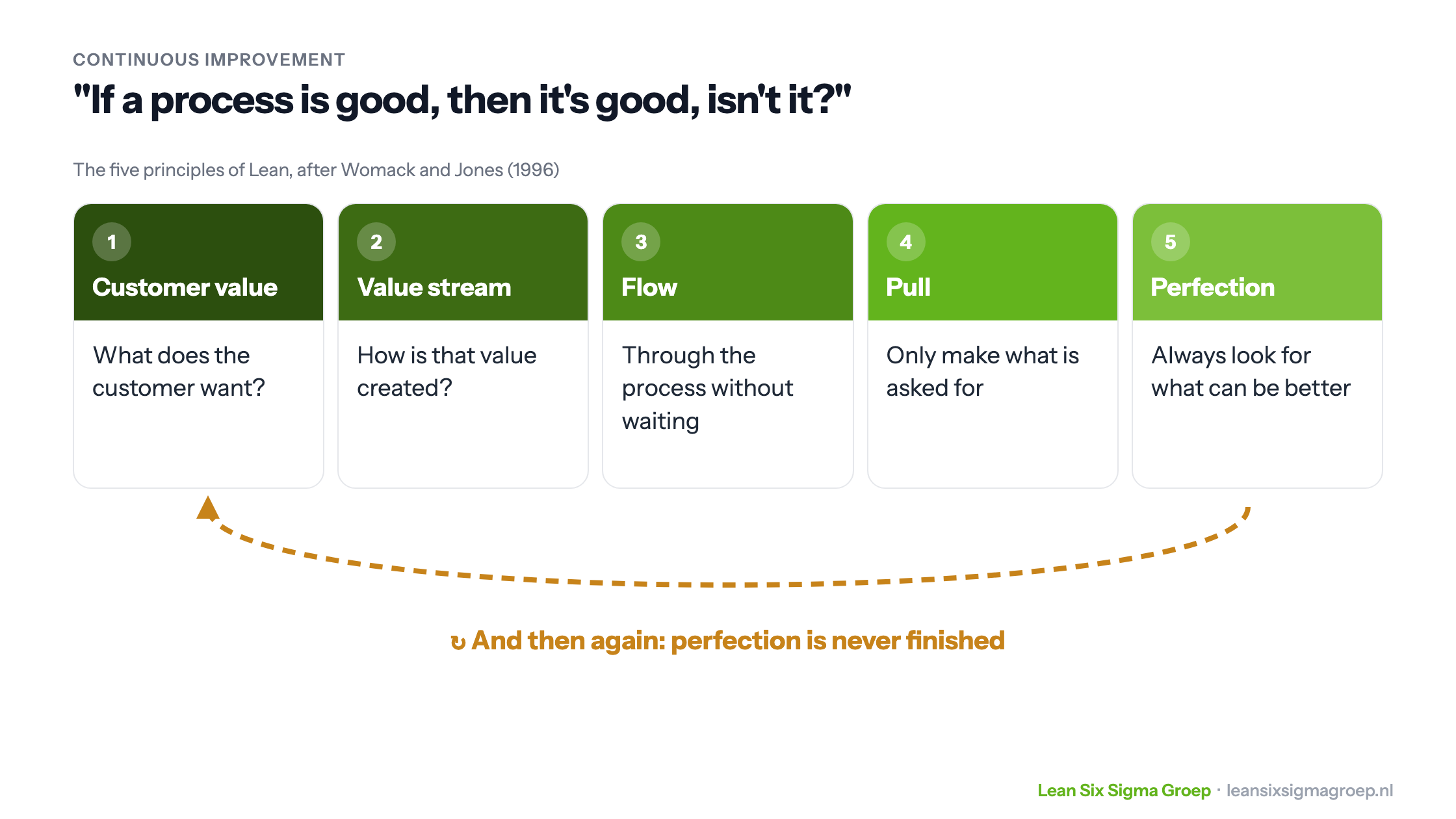
James Womack and Daniel Jones summarised Lean in 1996 in five principles, as shown in the image at the top of this article:
- Customer value: know who your customers are and what they want.
- Value stream: know how that value is created and reaches the customer.
- Flow: let the work flow through the process without obstacles or waiting.
- Pull: only do something when the next step asks for it, starting with the customer.
- Pursue perfection: always look for what can be better.
That last principle, and the continuous improvement that follows from it, is at the heart of Lean. But why?
At Toyota, where Lean comes from, it was pure necessity at first. After the Second World War Japan faced severe shortages, and the country has few raw materials of its own. Waste was simply unaffordable. When that necessity eased, the pursuit of perfection remained. And given the state of the world economy and the environment, eliminating waste may be more relevant than ever.
What does pursuing perfection mean today?
In my view the aim of Lean is not to reach an end state, but a culture in which improvement cycles are repeated again and again, on the way to a perfect state. For that you need a picture of that perfection: what do our company and our processes look like when everything is perfect, and what does that deliver? We call that picture the vision. It gives direction, and starting points for concrete steps.
The perfect state is by definition unattainable. Where in the world do you find the perfect process? That alone is a reason to keep starting again. And Lean doesn’t ask you to reach that perfect state in one go, as shown below.
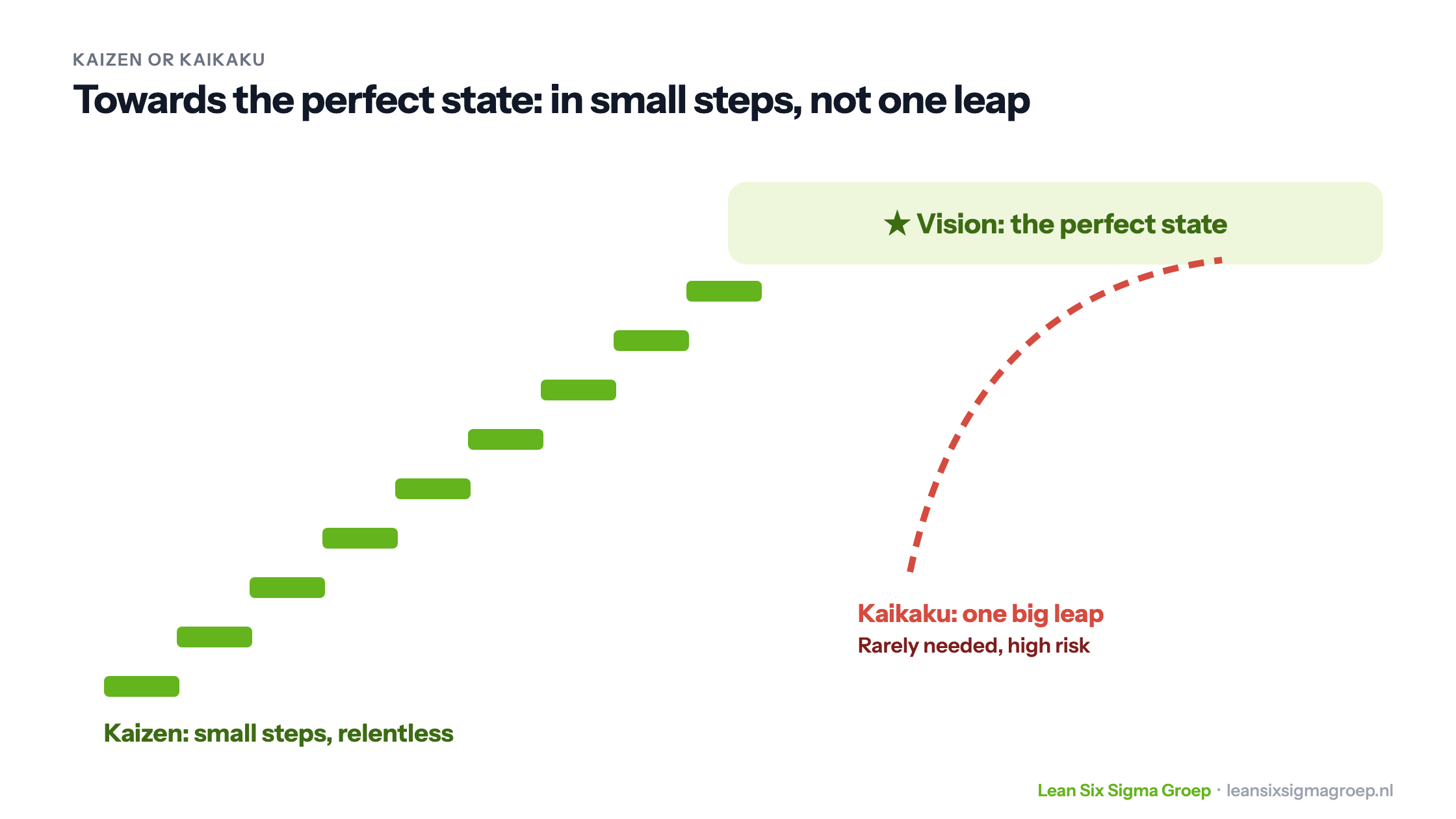
A radical step, Kaikaku in Japanese, in which a whole value stream is overhauled at once, is rare. It asks a lot of the organisation, carries big risks and is only occasionally the only right solution. Lean teaches that small steps, through Kaizen, lead to structural improvement. Mike Rother described in Toyota Kata how Toyota practises this as a daily routine, the Kata: not grand and sweeping, but step by step and relentless.
What it delivers
- Higher efficiency: by removing waste and inefficiency again and again, productivity rises.
- More satisfied customers: better quality and processes that better match what customers need.
- Agility: those used to improving adapt faster when the market or the customer changes.
- Lower costs: less waste means lower costs and a better result.
- Engaged employees: people allowed to improve their own work feel heard and are more engaged.
If a process is good, then it’s good, isn’t it?
That is how I answered my participant’s question. No company ever reaches the perfect state. No process is ever completely perfect, if only because the process’s environment keeps changing. And above all: what the customer values is not fixed, but changes all the time. Every reason, then, to keep improving.
In the Green Belt course you learn to lead Lean Six Sigma projects independently, and how to tackle waste and variation.