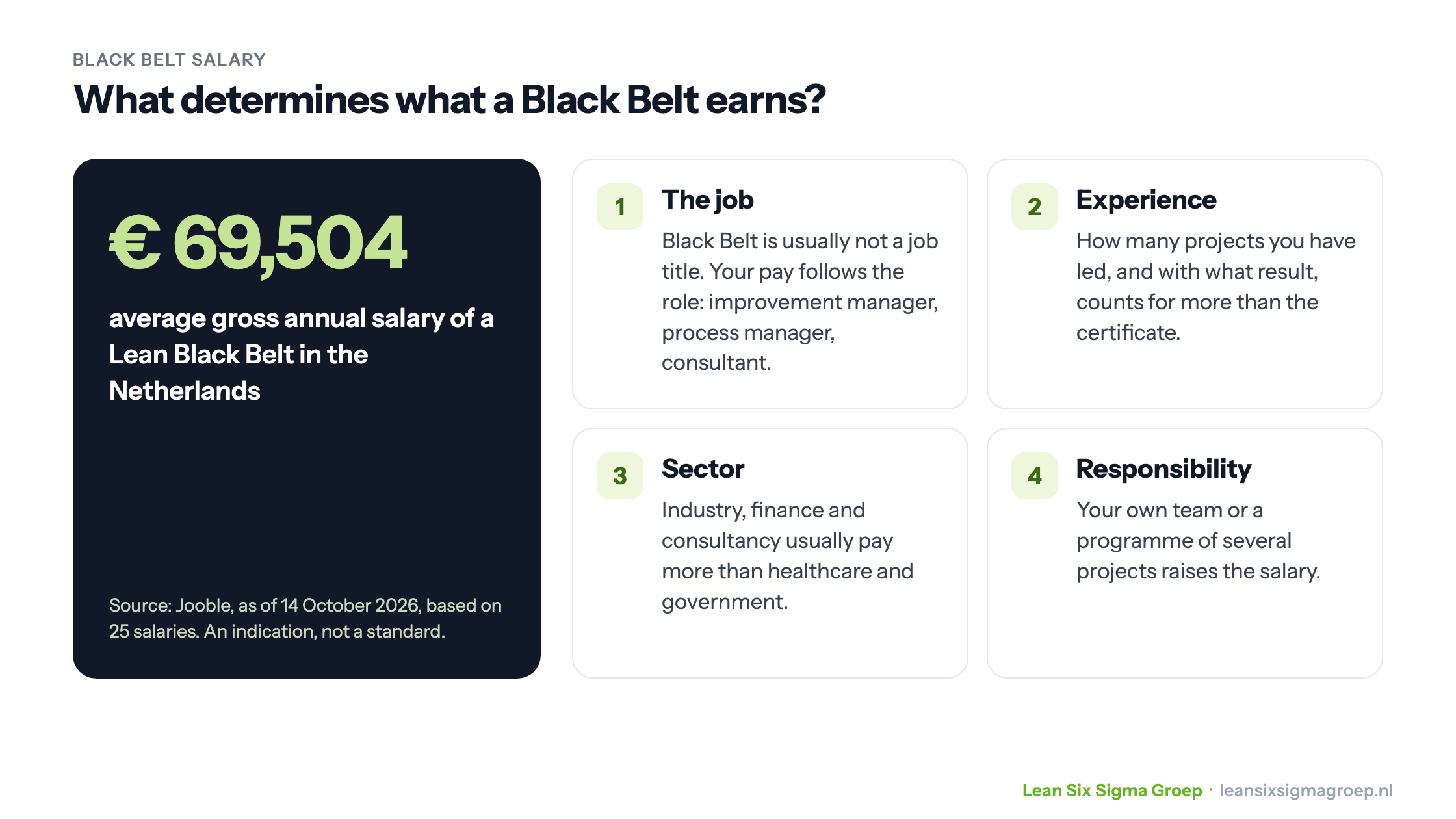
A Lean Six Sigma Black Belt in the Netherlands earns an average of around €69,500 gross per year, according to the salary site Jooble (October 2026). But that is an average over few salaries. What you actually earn depends above all on your job, your experience and the sector you work in.
What do the figures say?
Salary sites give a first indication. On 14 October 2026, Jooble lists an average gross annual salary of €69,504 for a Lean Black Belt, based on 25 salaries. Other sites, such as Glassdoor, come out higher because they include bonuses and other allowances.
Take such figures with a pinch of salt. They are based on a small number of reported salaries, and Black Belt is rarely a job title. Search vacancies for “Black Belt” and you will find improvement managers, process managers and consultants, with very different salaries.
What determines your salary?
The image at the top of this article lists the four main factors:
- The job. The certificate itself does not come with a fixed amount. Your salary follows the role in which you apply your Black Belt knowledge: improvement manager, Continuous Improvement manager, process manager, quality manager or consultant.
- Experience. An employer looks above all at what you have achieved: how many projects you have led, how large they were and what they delivered. A Black Belt with proven results is worth more than a fresh certificate.
- Sector. Salaries in industry, financial services and consultancy are usually higher than in healthcare and government, where collective pay scales apply.
- Responsibility. Leading a team or an improvement programme with several projects pays more than carrying out projects yourself.
What does a Black Belt do?
A Black Belt leads complex improvement projects, often full time, using more extensive statistics than a Green Belt. A Black Belt also coaches the Green Belts in the organisation. That is why employers often look for someone with a few years of work experience, a higher education background and experience with projects or change programmes.
The career path
The belts form a career path, with more responsibility at each step.
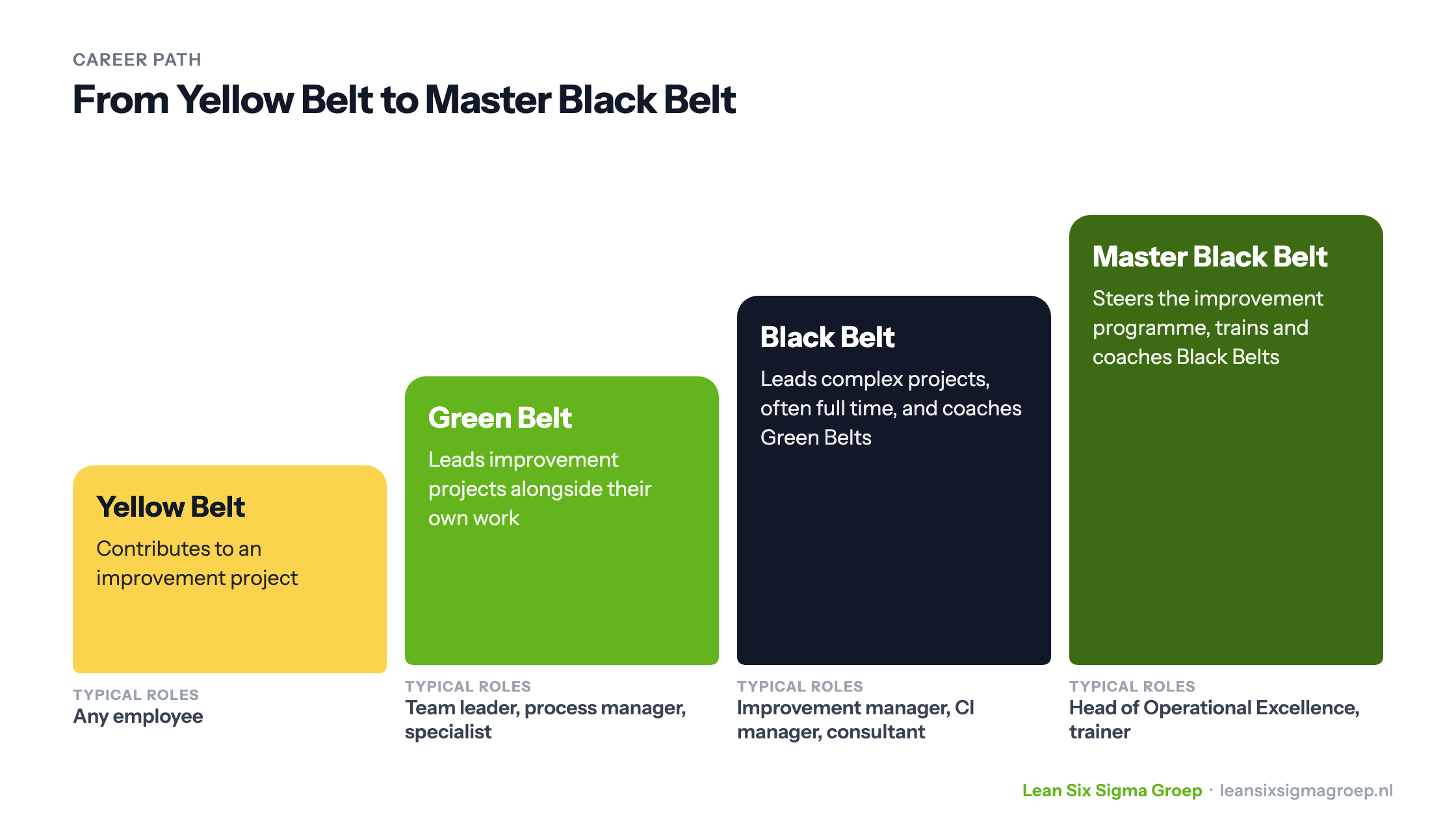
A Green Belt leads improvement projects alongside their own work. A Black Belt does so with larger, more complex projects and coaches others. A Master Black Belt steers the improvement programme of a whole organisation and trains and coaches the Black Belts.
Why do employers invest in Black Belts?
A well-chosen improvement project often delivers many times what it costs, in time, money or customer satisfaction. That is why organisations often pay for the training themselves, and look for people who can deliver on it. A Black Belt certificate shows that you master the method. Your results show that you can do something with it.
Wondering whether the Black Belt is right for you? Take a look at the Black Belt training course.