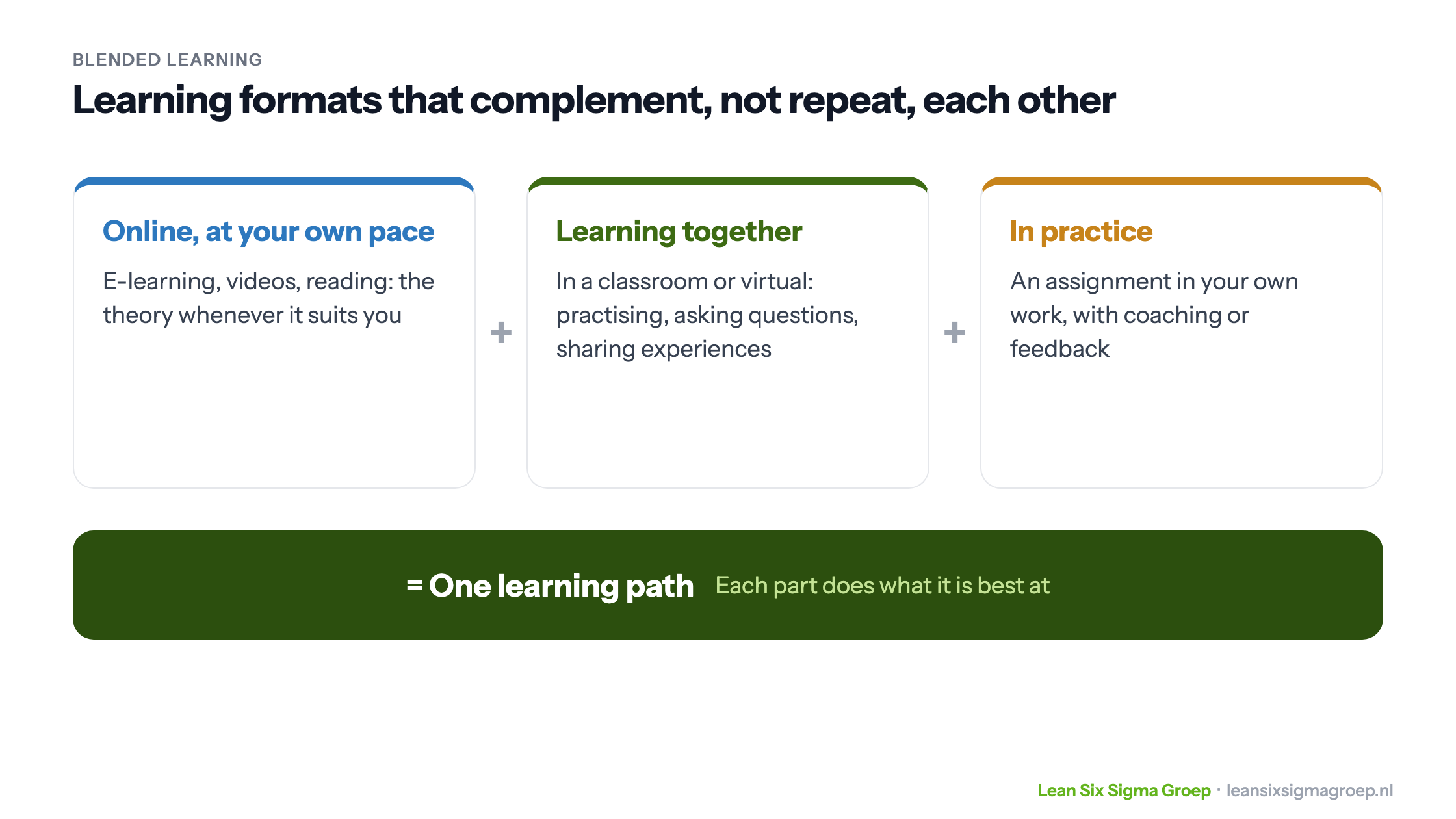
Blended learning is a way of learning that combines online learning with learning together, in a classroom or virtually, and often with learning in practice. It is not a loose mix, but parts that complement each other: each part does what it is best at. The term became popular around 2000; the idea itself is older.
What is blended learning?
A widely used description is that of Charles Graham (2006): blended learning combines face-to-face instruction with computer-mediated instruction. In practice there are three building blocks, as shown in the image at the top of this article:
- Online, at your own pace: e-learning, videos and reading. You decide when and how fast you learn. If you already know something, you move on; if you need more time, you take it.
- Learning together: in a classroom or a virtual class. Here you practise, ask questions and learn from others’ experiences.
- In practice: an assignment in your own work, with coaching or feedback. That is where learning becomes skill.
It is also called hybrid learning. Almost any learning format can have a place: webinars, knowledge sessions, articles like those in this knowledge base, videos or one-to-one coaching.
What it is not
Blended learning doesn’t mean adding a computer to classroom training, nor offering the same content twice, once online and once in class. Precisely because the parts complement each other, together they form one learning path. A common set-up: the theory online in advance, so the time together can be spent entirely on practice. This is also called the flipped classroom.
An example
Our Self-study Plus courses work like this, as shown below.
This is one of the tools you learn to apply in the Green Belt training.
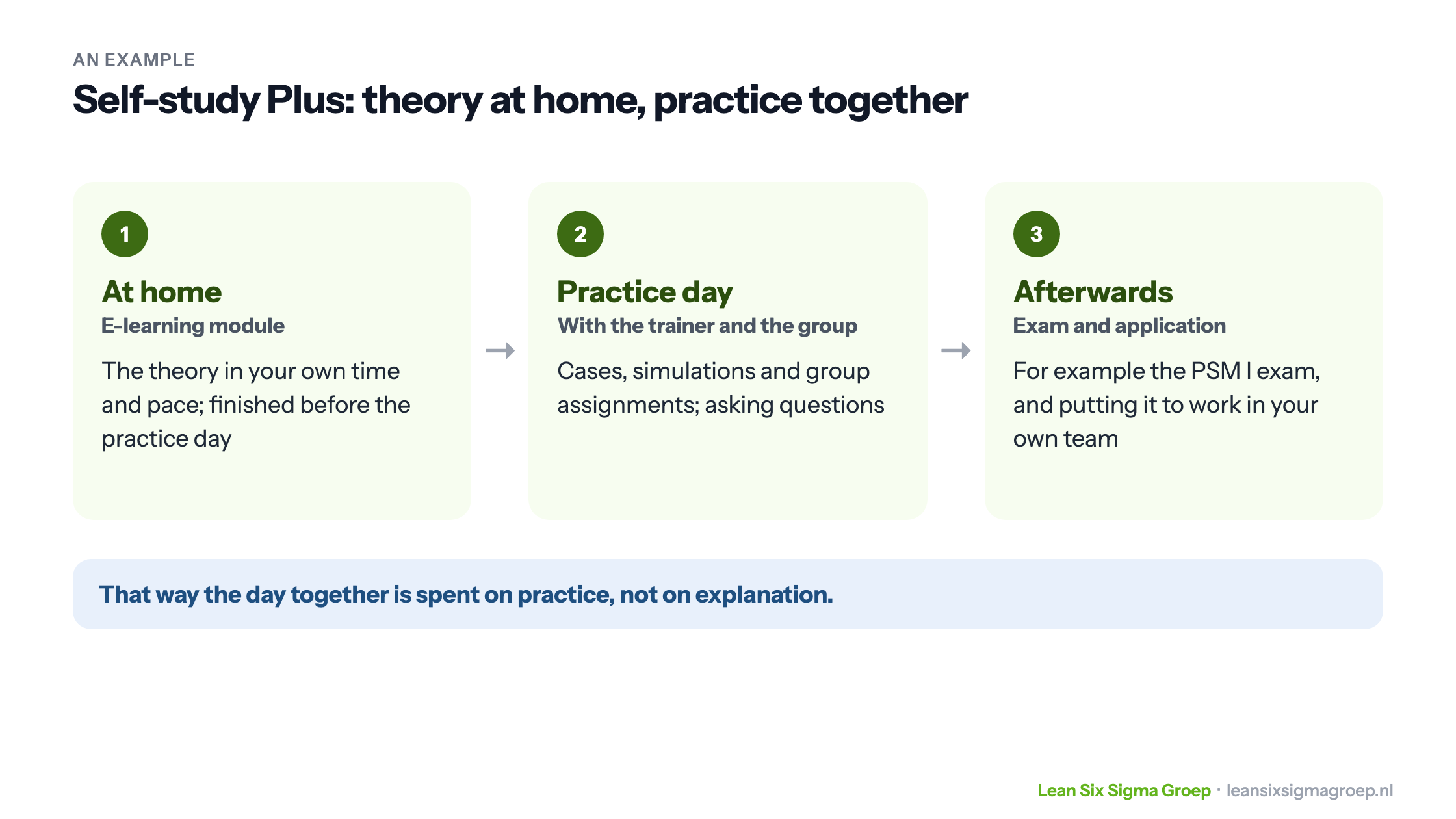
In the Scrum Master Self-study Plus you complete the first day as e-learning, wherever and whenever suits you. You finish it before the practice day. The second day is a practice day with the trainer and the group: cases, simulations and group assignments. After that you are well prepared for the exam and can get to work in your own team.
Why does it work?
- Own pace: everyone can learn the theory in the way and at the pace that suits them.
- More time for practice: when the explanation happens online in advance, the time together goes to what you can only do together: practising, discussing and asking questions.
- Easier to combine with work: fewer days away from work, and applying it in your own practice.
- Learning sticks: those who meet the material in several ways and apply it straight away remember more.
Learning should also be enjoyable. Organisations and employees need to keep developing, and a mix of learning formats makes that feasible and pleasant. See all our training courses.