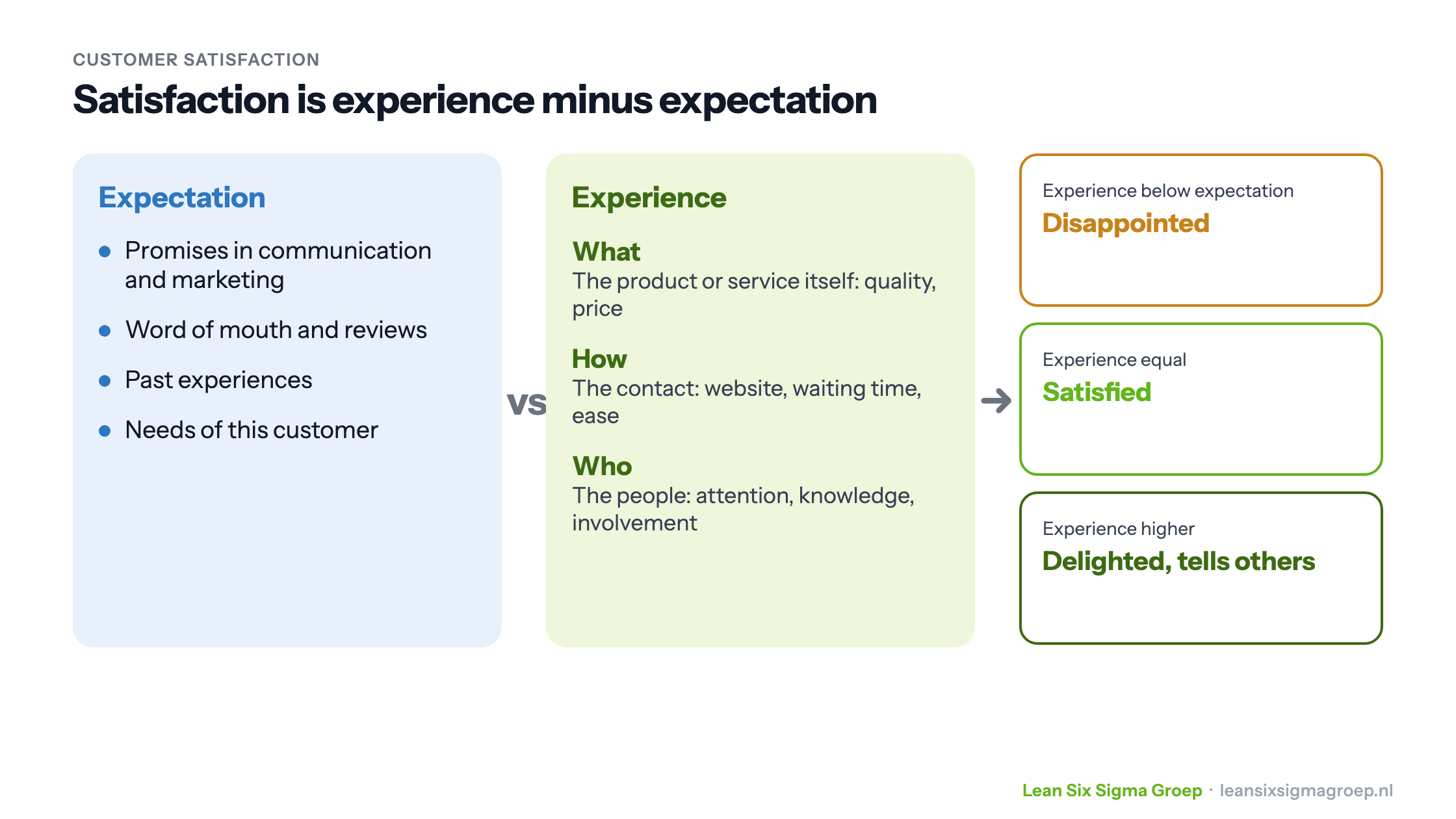
Customer satisfaction is the extent to which customers are satisfied with the product or service they get from you. Satisfied customers come back more often and tell others about their experience. Whether a customer is satisfied depends not only on what you deliver, but above all on what they expected.
Expectation and experience
Satisfaction arises from comparing experience with expectation, as shown in the image at the top of this article. If the experience is better than expected, the customer is delighted. If it is worse, they are disappointed, even if the performance itself was fine.
Suppose you go out for dinner. Everyone says the service in this restaurant is fantastic, so your expectations are high. You are served well, but not fantastically. You go home slightly disappointed and recommend the restaurant to nobody. Had you expected poor service, your expectation would have been exceeded and you would have told glowing stories. The only thing that was different was your expectation.
So to increase satisfaction you can turn two knobs: improve the experience, and make sure the expectation is right.
Where do expectations come from?
Parasuraman, Zeithaml and Berry, the creators of the SERVQUAL model, described four sources of expectations in 1985:
- Communication and marketing: what do you promise? Every promise creates an expectation.
- Word of mouth: what have others said, among friends or in reviews?
- Past experiences: if last time was better than expected, the bar is now higher. So expectations keep moving.
- Personal needs: one DIY store customer just wants to pay quickly, another wants advice. Their expectations differ.
What makes up the experience?
In 1984 Christian Grönroos made a well-known distinction between what the customer receives and how they receive it. In practice it is useful to add a third element:
- What: the product or service itself. Is the quality right, does it work as promised, is the price fair?
- How: the contact with the company. Is the website clear, how long do you wait, how easy is it to arrange something?
- Who: the people. Suppose you walk into a bookshop with a huge choice and beautiful interior, but the employee you ask about a title is uninterested. You still walk out dissatisfied.
The three influence each other. To improve satisfaction, look at all three.
How do you measure customer satisfaction?
There are several ways, each measuring something different. They are shown side by side below.
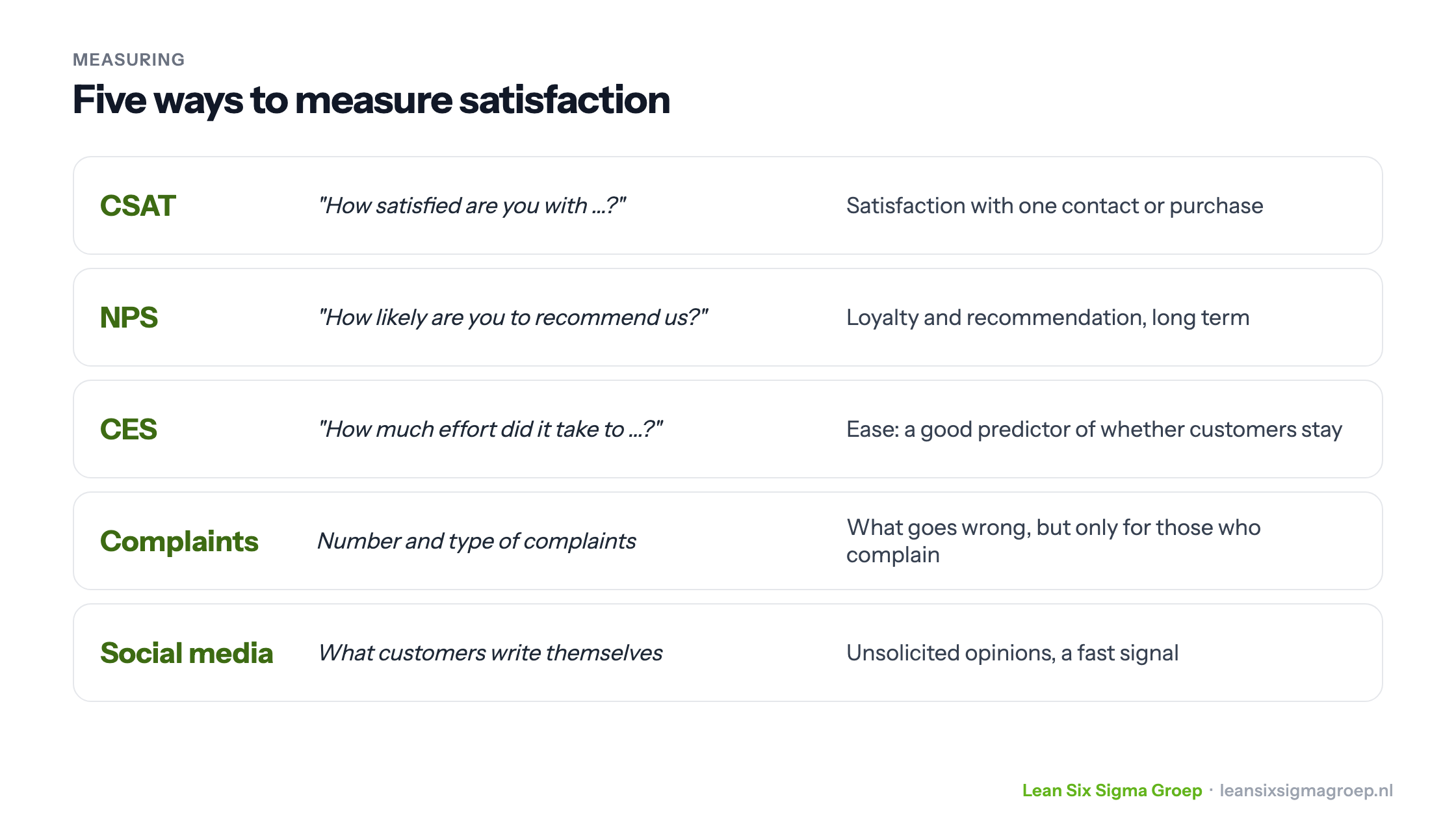
- CSAT (Customer Satisfaction Score): “How satisfied are you with …?”, usually on a scale of 1 to 5. Suitable for measuring satisfaction with one contact or purchase, for example with a short form straight afterwards.
- Net Promoter Score (NPS): “How likely are you to recommend us?” Strictly speaking it measures loyalty and willingness to recommend, not satisfaction.
- CES (Customer Effort Score): “How much effort did it take to arrange this?” Research showed that ease often predicts whether customers stay better than delight does.
- Tracking complaints: the simplest way. It shows what goes wrong and whether it improves, but only for customers who bother to complain. Most dissatisfied customers don’t complain, they leave.
- Following social media and reviews: what customers write of their own accord. A fast signal, and a chance to solve a problem before it grows.
Make it as easy as possible for customers to give their opinion: the shorter and simpler, the more responses. And always ask why: a score says something is going on, the comment says what. Read more about customer analysis.
From measurement to improvement
Measuring alone changes nothing. The real gain lies in finding out why customers are dissatisfied, and improving the process behind it. The Green Belt training course teaches you how to bring out the voice of the customer and improve a process to raise satisfaction.