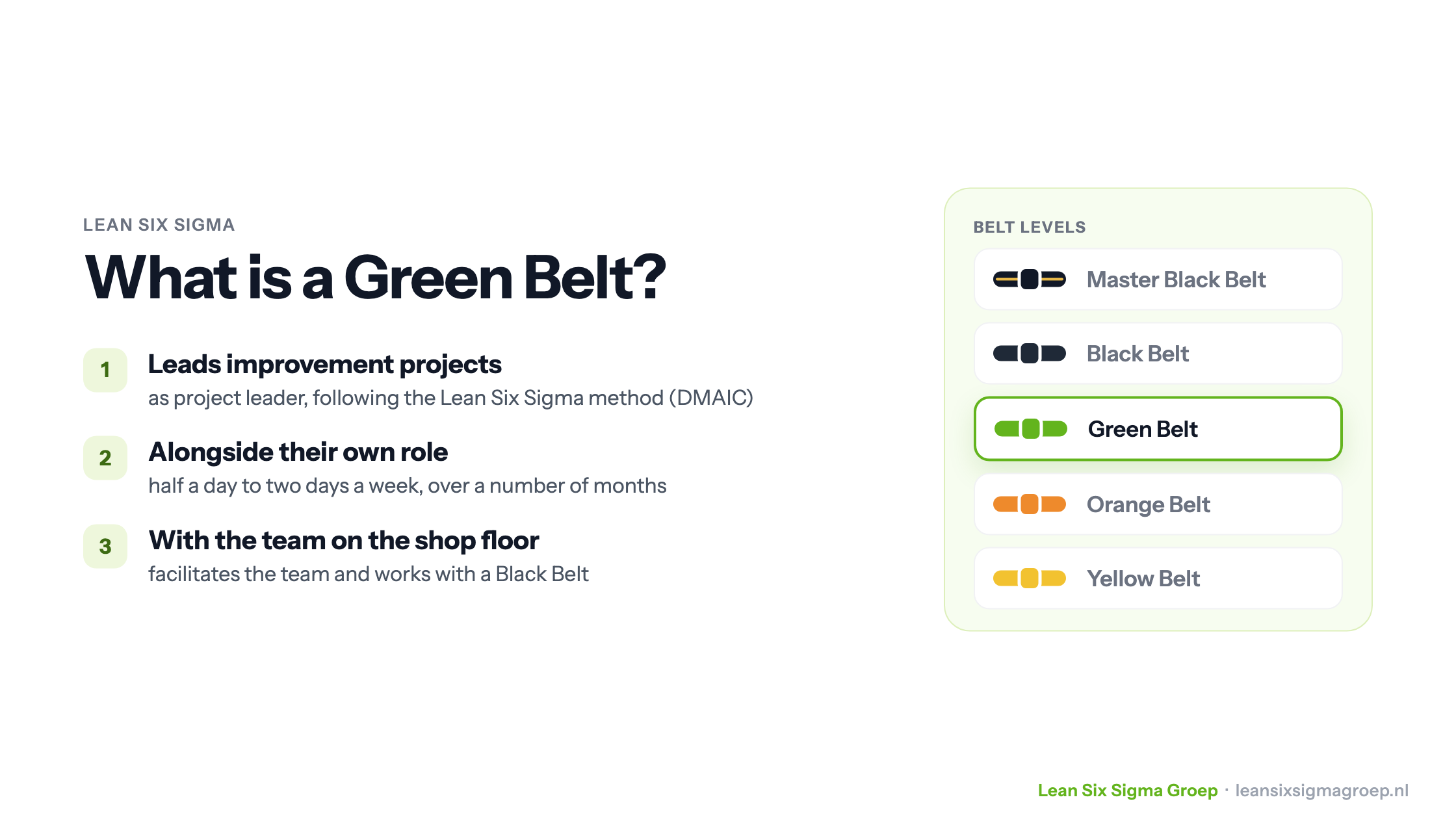
A Green Belt in Lean Six Sigma is someone who can take on improvement projects as a project leader and carry them out according to the Lean Six Sigma method. It is the most popular training programme among aspiring project leaders. Lean Six Sigma Green Belts are people who work on straightforward process improvement projects at departmental level.
Where does the term Green Belt come from?
Some 10 years ago, few people had heard of ‘Lean Six Sigma’. The term ‘Green Belt’ was mostly known from judo.
Lately the Lean Six Sigma method has become more and more familiar, and more and more people are ‘Green Belts’ and ‘Black Belts’. Lean Six Sigma is a method for continuous improvement that originally consists of 2 methods: Lean and Six Sigma.
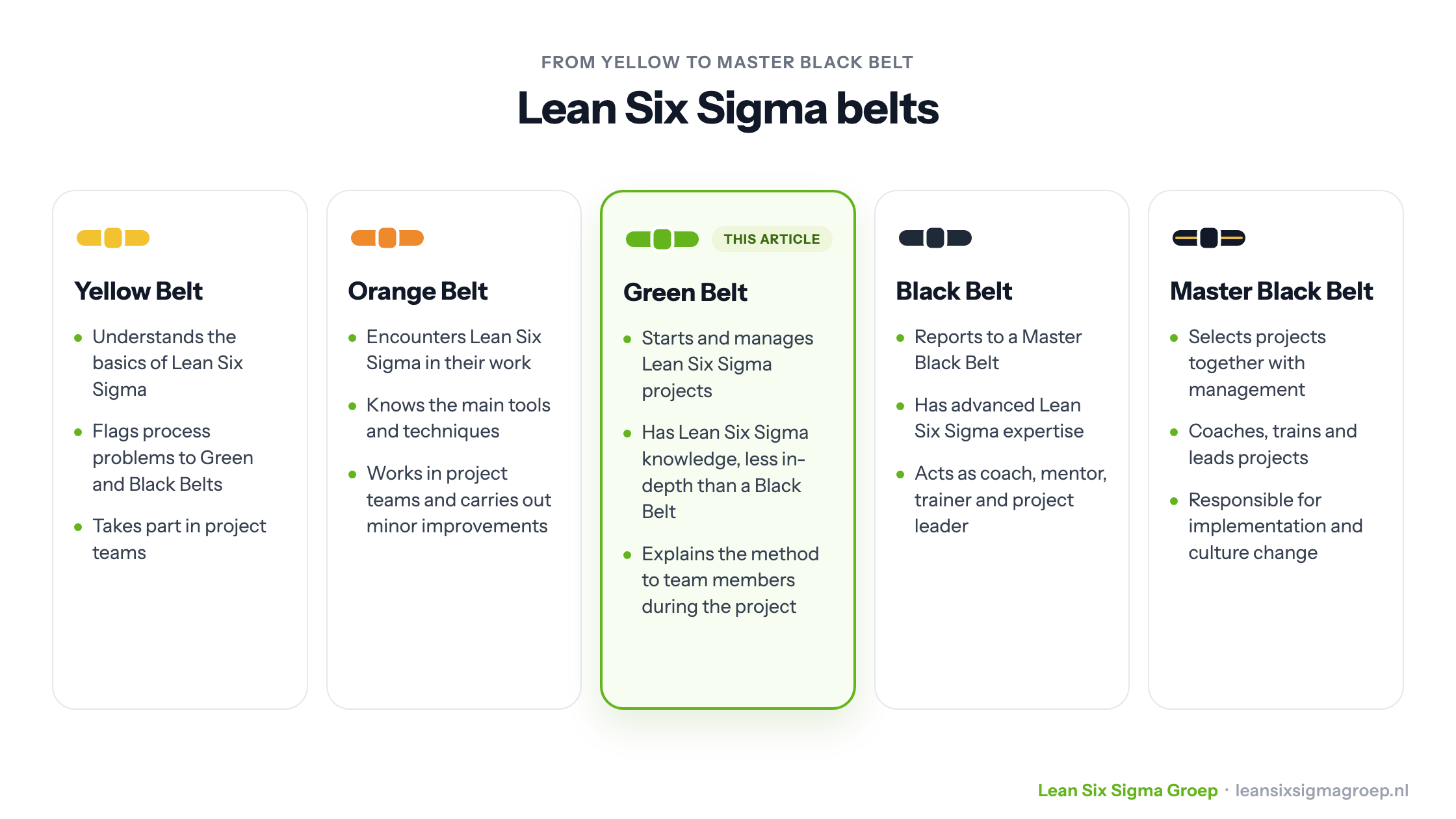
Within the Six Sigma method, the level of knowledge and application was indicated with ‘belts’, just as it is in judo. The levels, running from Yellow Belt to Master Black Belt, therefore show how much knowledge and experience people have of Lean Six Sigma.
What is a Green Belt in Lean Six Sigma?
The most widely used term is ‘Green Belt’. It stands for someone who can take on improvement projects as a project leader and carry them out according to the Lean Six Sigma method.
Green Belts usually start with a Green Belt training programme and then begin an ‘improvement project’, in which they can apply what they learned in the training straight away in practice. This improvement project usually goes through the 5 phases of the method: Define, Measure, Analyze, Improve and Control, or DMAIC.
Sometimes a so-called A3 is used, working from a problem via the root cause to a solution. When starting an improvement project, it is especially important that there is no ready-made solution for it yet. It is also good when the project genuinely contributes to the organisation’s goals, for example by linking it to a performance indicator.
Together with a team from the shop floor, the problem is explored in depth and solutions are devised. These are implemented jointly, and the result is a more satisfied customer. The Green Belt facilitates this process: he or she plans the project and guides the team in arriving at solutions themselves.
So the Lean Six Sigma Green Belt is certainly not the one who comes up with the solutions. The strength of Lean Six Sigma is precisely that solutions are devised by the shop floor itself.
In many cases a Green Belt is someone who applies the method alongside his or her ‘normal’ job, spending half a day to 2 days a week on it over a period of several months.
What knowledge does a Green Belt have?
A certified Green Belt has independently taken on one or two improvement projects, has completed the Green Belt training and has passed the theory exam.
What does a Green Belt do?
Green Belts are employees who spend part of their time on process improvement teams. They analyse and solve quality problems and are involved in Six Sigma, Lean or other quality improvement projects.
Green Belts are employees of an organisation who have been trained in the Six Sigma improvement methodology and who will lead a process improvement team as part of their full-time job. More of their time goes into the decision-making and strategy-building components of key elements in the Six Sigma project planning process.
What is a Green Belt certificate?
Six Sigma Green Belt certification requires three years of work experience in one or more areas of the Six Sigma Green Belt body of knowledge. Candidates must have worked full-time and in paid employment. A paid internship, co-op placement or other coursework cannot be counted towards the required work experience.
How do you become a Green Belt?
Want to become a Green Belt? The first step is usually to follow a Green Belt training programme. There is no such thing as a quick course: the emphasis is on applying it in practice, not just on the knowledge.
You can do this with various trainers throughout the Netherlands. Green Belt training is offered by UPD, Bureau Tromp and many others. We at Lean Six Sigma Groep offer the training at various locations and in various formats.
To become a certified Green Belt, the next step is to apply the theory in practice. We can support you in this through the coaching sessions included in the training. Sparring often helps to get through this process faster, and we are happy to do so.
For more information, you can of course also contact us via the form or at [email protected]
► See our range of Green Belt training courses here
What does the Green Belt training look like?
The first step towards becoming a certified Green Belt is following a Green Belt training programme. There you learn to improve processes with Lean tools and techniques. You then carry out an improvement project (your practical assignment) in which you put the theory into practice, and you finish with the Green Belt exam.
You can also choose to do only the training, or the training and the exam.
At Lean Six Sigma Groep, the Green Belt training takes:
- 5 consecutive days in the Green Belt Bootcamp, or
- 7 days in the regular programme, delivered in three blocks of 2 to 3 days with time in between to work on your practical assignment.
What do you learn in the Green Belt training?
The foundation of the training is a phased approach to get from problem to root cause to solution. Usually that is the DMAIC approach (Define, Measure, Analyze, Improve and Control).
Each phase has its own tools, and you learn how to choose and use them through simulations and exercises that match the type of organisation you work in as closely as possible.
A Green Belt tackles a problem together with the people in the process, so that the solution is widely supported. That is why change management is covered too: without change there is no improvement.
► See the programme and dates of the Green Belt training.
From theory to practice
Learn to apply this in practice
Topics like Green Belt are applied directly to an improvement project from your own organisation in the Green Belt training.
Next start dates
Lean Six Sigma Green Belt training →Not ready for a training yet?