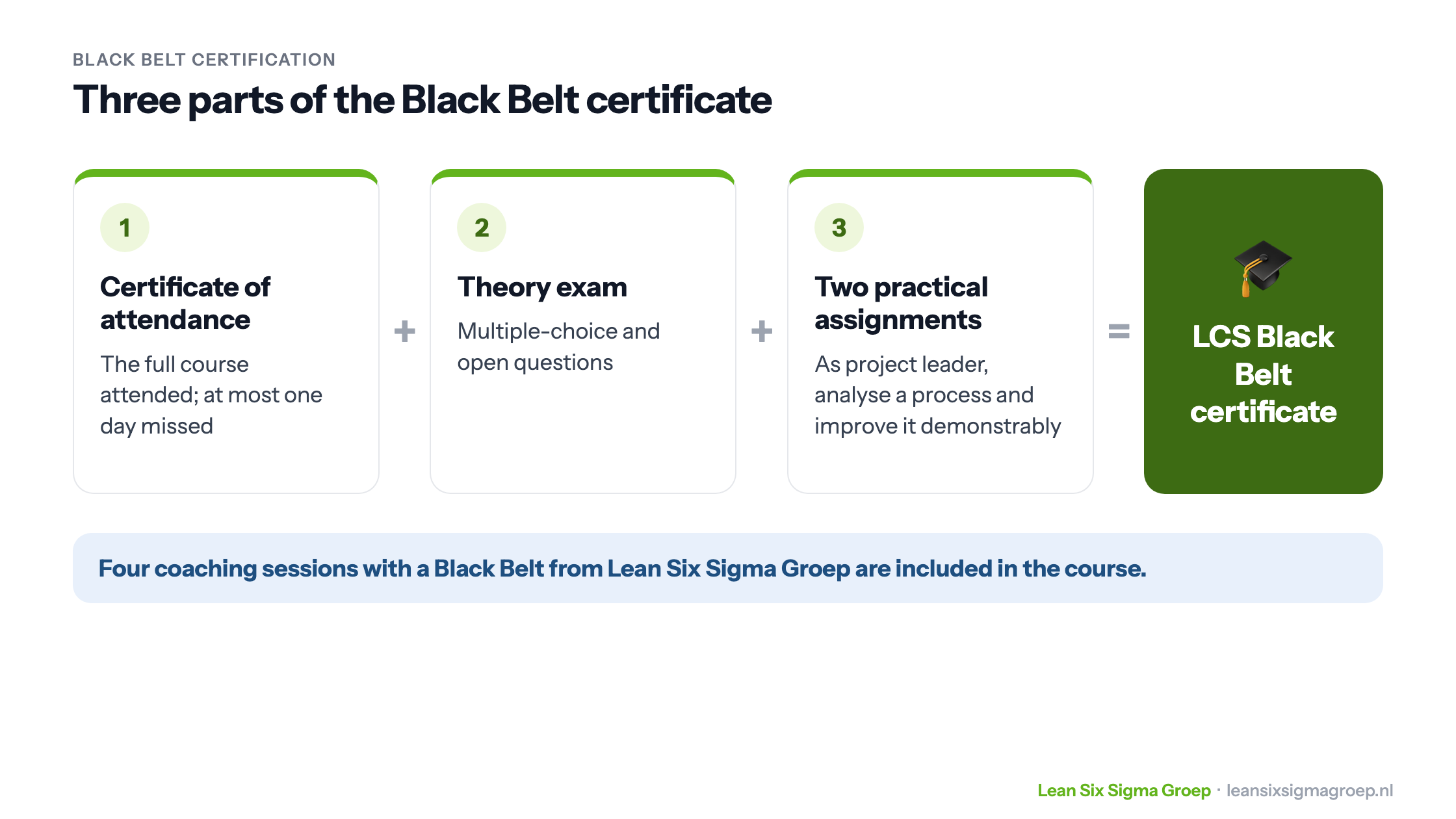
Anyone who wants the full Black Belt certificate after the Black Belt course shows in practice what they have learned. That takes two practical assignments. This article explains the requirements for a practical assignment, what such an assignment looks like, and the tips our trainers give.
Three parts of the certificate
At Lean Six Sigma Groep, Black Belt certification consists of three parts, as shown in the image at the top of this article:
- The certificate of attendance. You attended the full course and missed at most one day.
- The theory exam, with multiple-choice and open questions. Read more about the Black Belt exam.
- Two practical assignments, in which you, as project leader of an improvement team, analyse a process and demonstrably improve it.
Those who complete all three receive the LCS Lean Six Sigma Groep Black Belt certificate.
Requirements for the practical assignment
- You lead the assignment yourself, as project leader of an improvement team. Usually within your own organisation; an assignment elsewhere is possible in consultation with your trainer.
- You show that you can analyse a process, using the steps of DMAIC.
- You demonstrably implement improvements, with a measurable result.
- You work in the workbook you receive during the course. Your own format is also allowed, in consultation with the trainer.
- A Black Belt from Lean Six Sigma Groep assesses the assignment.
- At the end, the sponsor and the trainer sign off together.
Four coaching sessions are included in the course. In them a Black Belt from Lean Six Sigma Groep discusses your progress and workbook with you, and helps you if you get stuck.
Example of a practical assignment
A Black Belt in training works at a medium-sized Dutch bank. Before she starts, she does an extensive Gemba walk: she goes to see where the work happens. The problem she wants to solve: the long lead time in the business debtors department. The image below summarises the assignment.
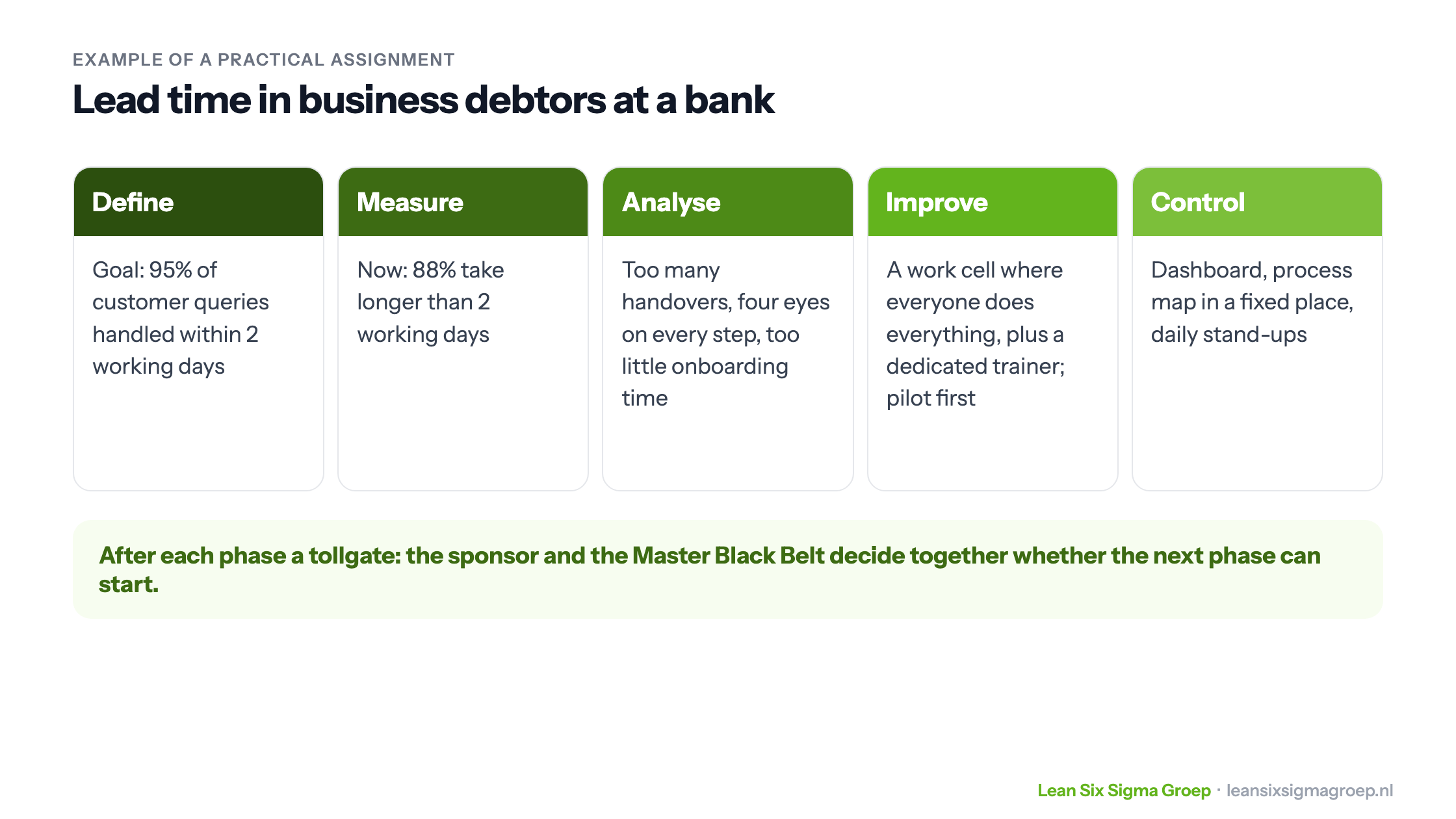
- Define. Research among customers, business owners in this case, shows they can live with a handling time of two working days. The project goal becomes: 95% of all customer queries handled within two working days. She records this in a project charter.
- Measure. She maps the process with the people who work in it. It has many branches, and at the moment no less than 88% of customer queries take longer than two working days.
- Analyse. She looks for the root causes, first creatively, then critically. Process and data analysis, but above all asking why, produce three causes. There are many unnecessary handovers, because everyone is a specialist and nobody a generalist. Every step is checked by a second person. And new staff get too little time to be trained properly. They make mistakes, which the checks find but don’t feed back. All those checks take time, and the customer waits.
- Improve. Brainstorming with the department produces many ideas. The choice falls on a work cell, in which everyone does everything, and on an experienced colleague freed up to train new staff. A pilot with everyone who works in the process shows a significant improvement. Then the change is rolled out.
- Control. She builds a dashboard, so the process performance can be followed after the assignment. The map of the new process gets a fixed place everyone can access. And she introduces daily stand-ups to discuss the figures and adjust where needed.
Both the sponsor and the Master Black Belt, who coached her along the way and attended every tollgate, are satisfied. The certification is celebrated with drinks and a dinner, with all the staff who work the new way.
Tips for your practical assignment
- Scope! Think the problem is too small? Then you are nearly there. Just a bit smaller, and you can get started.
- Choose something within your influence. Especially for your first assignment, it helps if solving the problem lies within your sphere of influence.
- Don’t get lost in data. First make charts that show possible relationships between the Xs (the causes) and the Y (the problem), before diving into hypothesis tests.
- Involve the people in the process. They know the work best, and they are the ones who will work the new way.
Need more help? Besides the four coaching sessions in the course, extra coaching is available. Contact us at [email protected]. Already a Green Belt? Then join the Green Belt to Black Belt course directly. And what a Black Belt earns is covered in Black Belt salary.