
If you are thinking about starting an improvement project, it is essential to put together a solid project charter (plan of approach). This document completes the Define phase, the first of the five phases of DMAIC: the improvement approach of Lean Six Sigma.
The project charter contains the project background, scope, planning, team composition and, above all, a cost-benefit analysis. In this article we focus specifically on the importance of the cost-benefit analysis within Lean.
Cost-benefit analysis: essential for Lean improvement projects
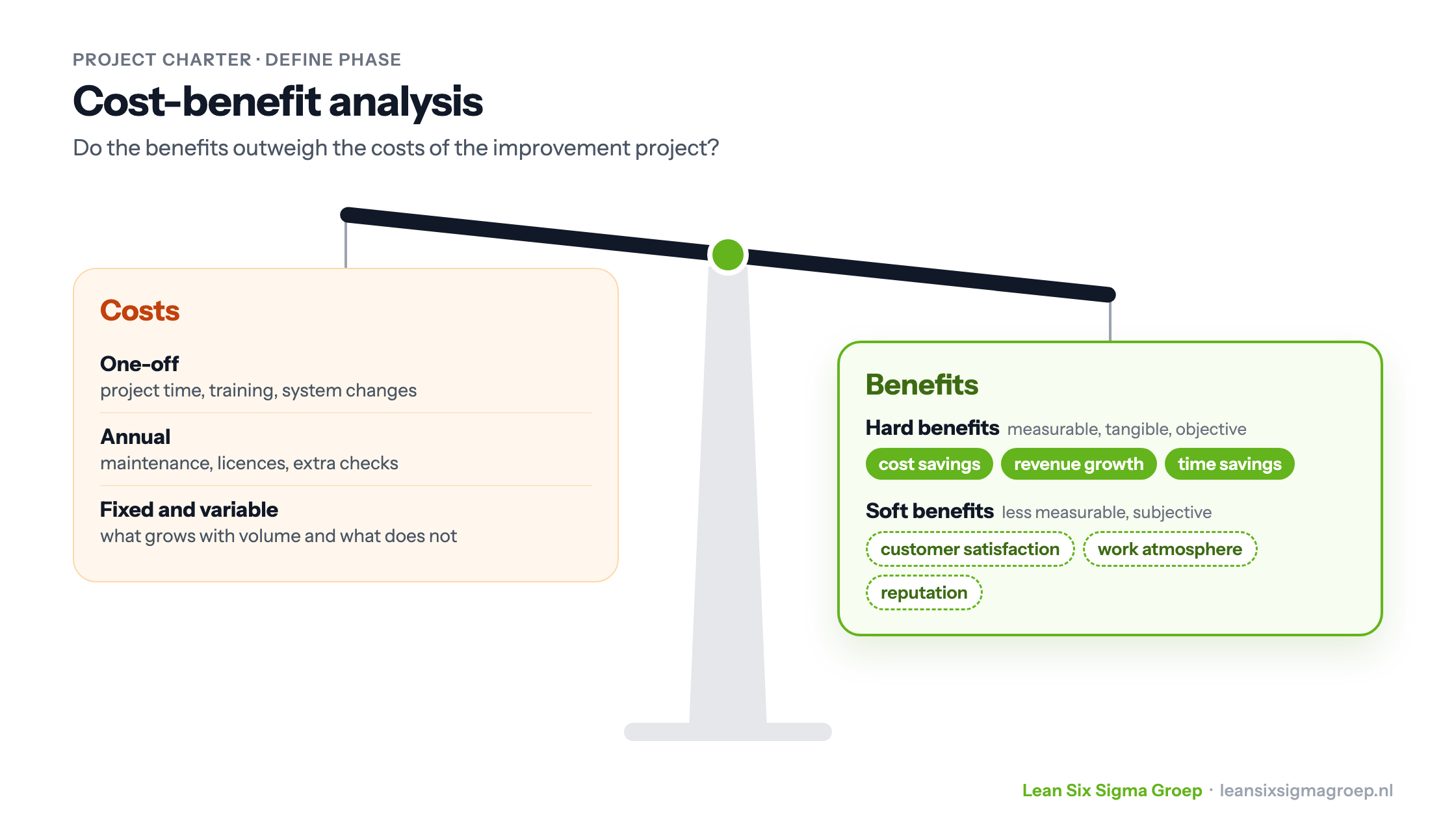
A cost-benefit analysis (CBA) is a structured method for weighing the costs of an (improvement) project against its expected returns. This matters most where efficiency and value creation are central.
A cost-benefit analysis is often carried out within a project charter, as part of the project’s financial evaluation. As you probably know, Lean is all about optimising processes by reducing waste. That makes it all the more important to assess the financial impact of projects carefully.
A cost-benefit analysis helps to:
- Minimise costs: a thorough analysis of the costs reveals unnecessary spending so it can be cut.
- Increase efficiency: it keeps projects focused on optimising processes and reducing waste.
- Add value: it assesses whether the expected benefits genuinely add value for the organisation and its customers.
- Support decision making: it provides a solid basis for decisions about projects.
How do you carry out a cost-benefit analysis?
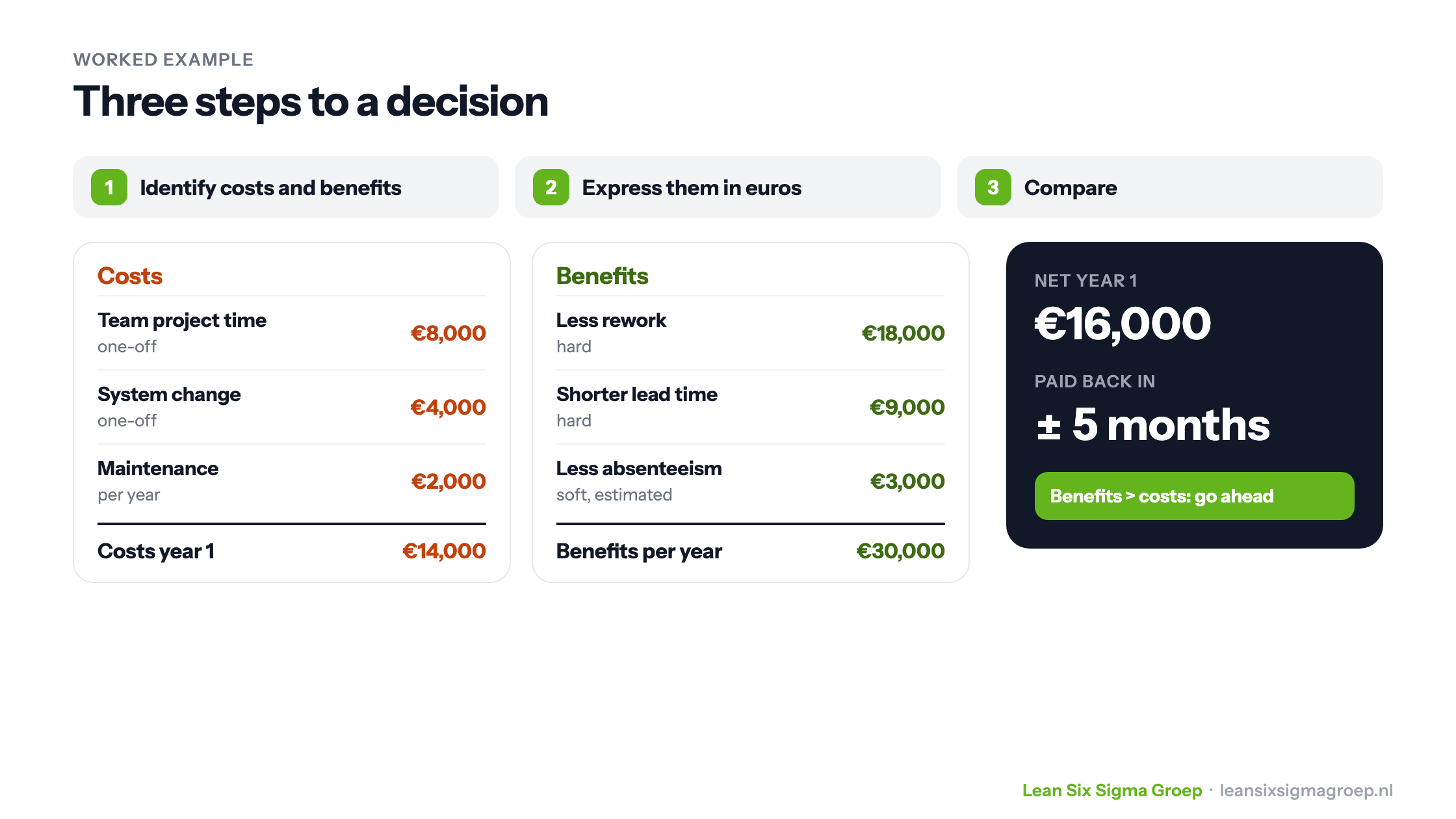
A cost-benefit analysis within Lean follows a structured approach in three steps.
Step 1: Determine the expected costs and benefits of the project
- Map out the costs that belong to the project, both fixed and variable.
- Investigate the expected benefits, both hard and soft.
- Look at the time frame: is the saving one-off, or does it come back every year?
Step 2: Express costs and benefits in the same unit
- Costs and benefits can only be compared when they are in the same unit, usually euros per year.
- Also put a financial value on benefits such as a better reputation, expected growth, environmental impact and employee satisfaction. Controllers in the finance department can often help a great deal here.
Step 3: Compare costs and benefits
Set the total costs against the total benefits to determine whether the benefits justify the costs of the project. Useful measures are the net benefit (benefits minus costs) and the payback period: how long does it take for the benefits to earn back the investment?
This is one of the tools you learn to apply in the Green Belt training.
Hard and soft benefits: what is the difference?
When carrying out a cost-benefit analysis, it is important to consider both hard and soft benefits. Hard benefits are easier to measure and often deliver a direct financial gain. Soft benefits are a valuable addition, because they give a broader picture of the impact a project or change has on the organisation.
People often find it hard to tell hard and soft benefits apart. Yet naming both gives a more complete picture, and that contributes to a well-considered decision. Involving stakeholders in identifying and valuing the benefits helps enormously here.
It also increases acceptance of the project and its outcome by the organisation, the team and the individual employees. Think of the formula E = Q × A: the effect of a change is the quality of the solution multiplied by its acceptance.
The difference between hard and soft benefits at a glance:
Hard benefits
- Measurable: hard benefits can be expressed in concrete figures, such as amounts of money, percentages or other units of measurement.
- Tangible: they are physically or financially tangible and can be observed directly, such as cost savings, revenue growth or time savings.
- Objective: hard benefits can be established objectively and are usually backed by factual data.
Soft benefits
- Less measurable: soft benefits are harder to quantify. They are often more subjective in nature and are not expressed directly in concrete figures.
- Intangible: these benefits are not physically or financially tangible. Think of a better working atmosphere, customer satisfaction or employee satisfaction.
- Subjective: soft benefits depend more on perception and interpretation and can vary from person to person.
Conclusion
In a Lean improvement project, a solid cost-benefit analysis is crucial. It helps organisations minimise costs, increase efficiency and add value, and so makes well-considered decisions possible.
Take both hard and soft benefits into account: distinguishing and naming them gives you a more complete picture and a better chance of a successful project. That makes the cost-benefit analysis an essential step towards process optimisation and value creation.