Project management is the planned preparation, execution and control of a project, so that it delivers the intended result within the agreed time, cost and quality. It is the application of knowledge, skills, methods and experience to achieve project goals.
What is a project?
A project is a unique, temporary effort with a clear goal. It has a beginning and an end, its own team and its own budget. That distinguishes a project from ordinary, ongoing work. A project succeeds if the result meets the agreed requirements, within the agreed time and budget.
The building blocks of project management
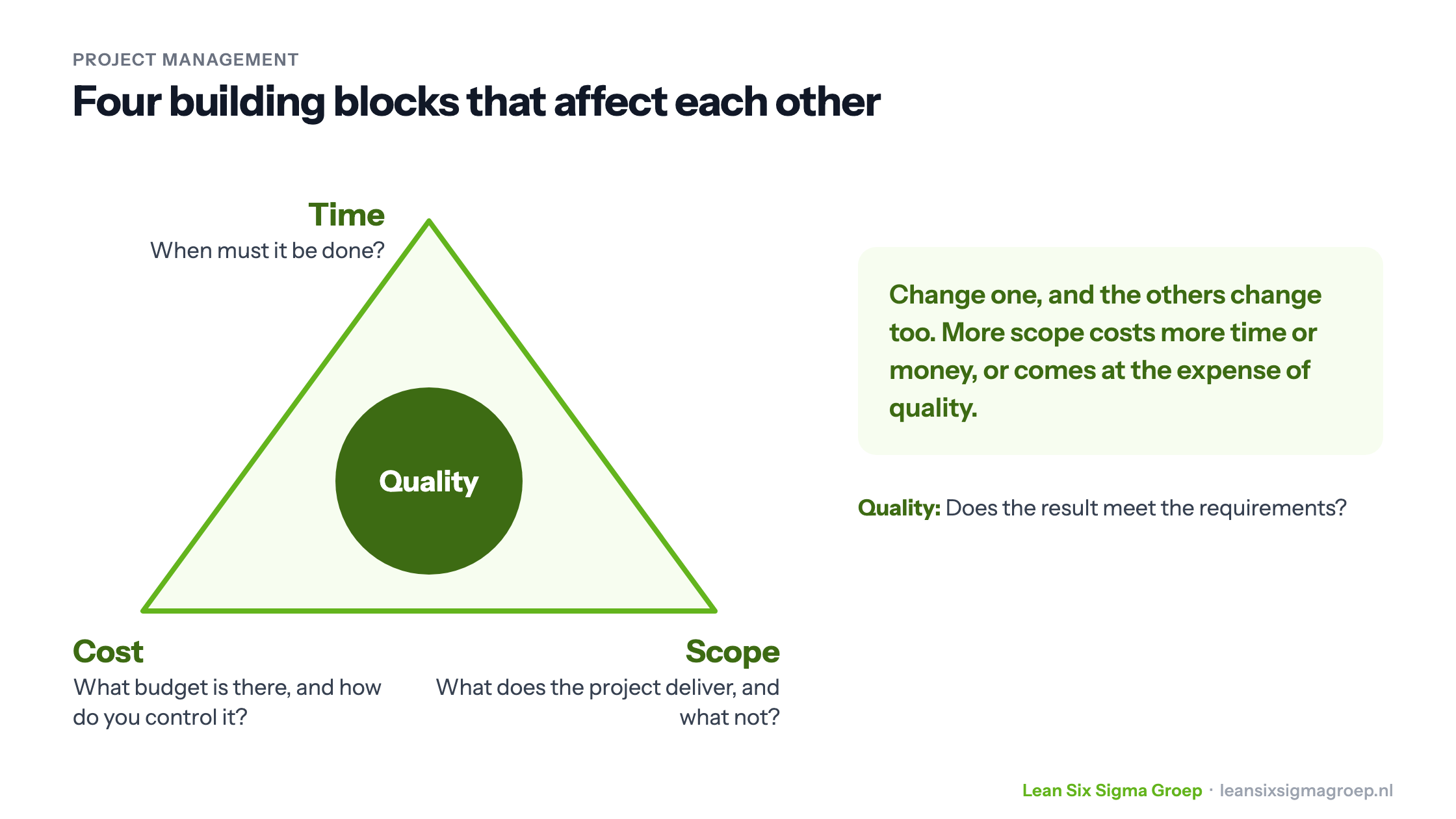
Time, cost, scope and quality are the building blocks of every project, as shown in the image at the top of this article:
- Time: when must the project be finished, and which milestones lead there?
- Cost: what budget is there, and how do you control it?
- Scope: what does the project deliver, and above all what doesn’t it?
- Quality: does the result meet the requirements of the sponsor and the users?
They are linked. If the sponsor wants more scope halfway through, that costs time or money, or comes at the expense of quality. A good project manager makes those choices visible and open to discussion.
The phases of a project
There are many methods, but most projects go through the same phases:
This is one of the tools you learn to apply in the Green Belt training.
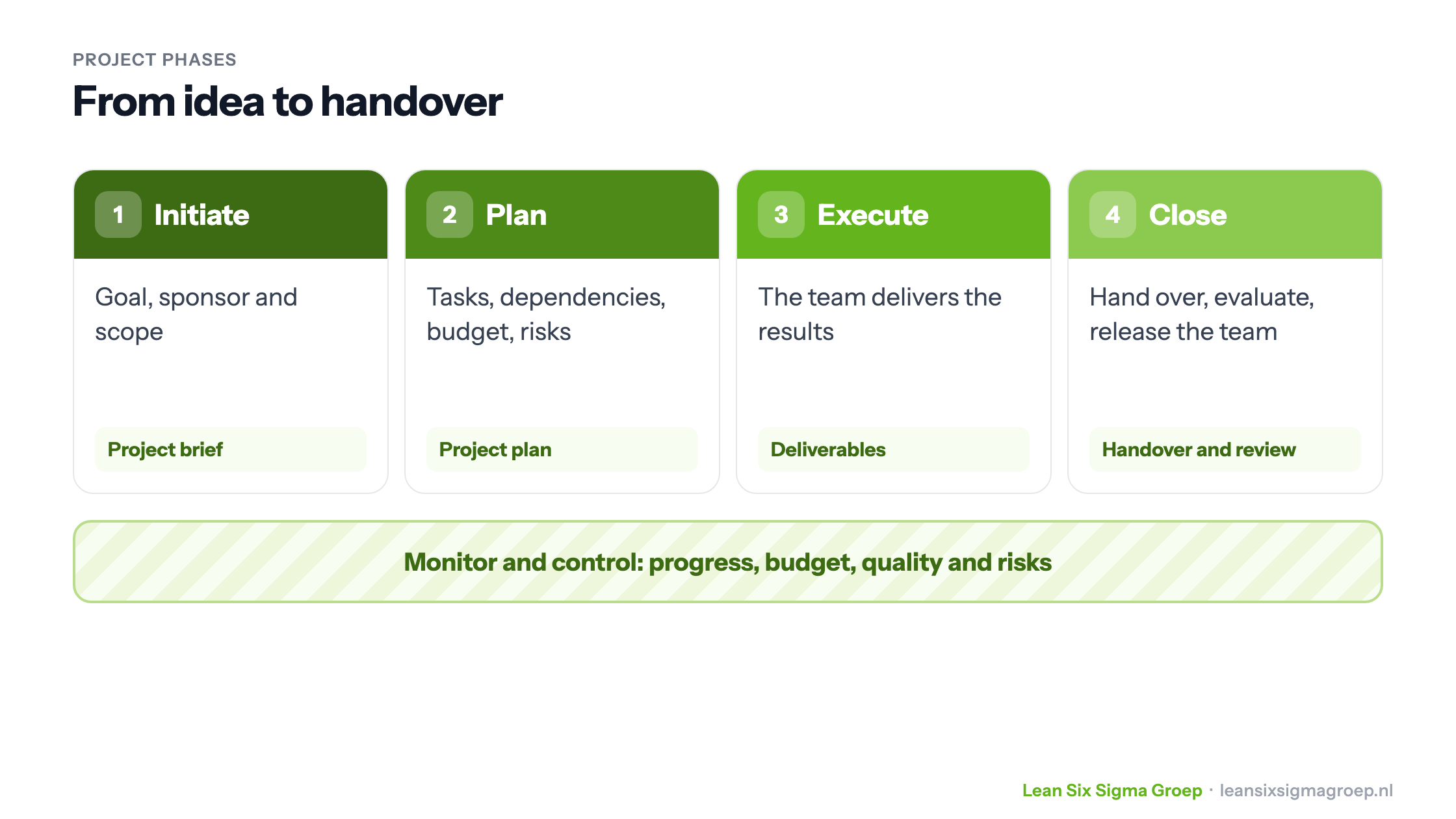
- Initiate: together with the sponsor and the stakeholders, you record what the project must deliver, why, and what is out of scope. The result is a project brief.
- Plan: you list the tasks, dependencies, people, budget and risks, for example in a Gantt chart. A RACI matrix makes clear who is responsible for what.
- Execute: the team gets to work and delivers the results.
- Monitor and control: this runs through the whole project. You track progress, budget, quality and risks, and adjust where needed.
- Close: you hand the result over to the organisation, review what went well and what could be better, and release the team.
A Lean Six Sigma improvement project is also a project. It follows the DMAIC cycle, with a project charter in the Define phase and the handover to the process owner in the Control phase.
What does a project manager do?
The project manager is responsible for achieving the project result within the agreed time, cost and quality. They plan, organise, monitor and adjust, and are the point of contact for the sponsor and stakeholders.
That takes many skills: communicating clearly, both verbally and in writing, leading without always being the boss, planning, solving problems, negotiating and managing time well. Increasingly, a project manager is also expected to understand the customer and the organisation well, and not just carry out the plan.
Project management methods
- Traditional or waterfall, for example with PRINCE2® or the PMBOK guidelines: plan fully first, then execute. Suitable when requirements are well known in advance.
- Agile, for example with Scrum or Kanban: work in short cycles and keep adjusting based on customer feedback. Suitable when requirements are still changing.
- Combinations, in which a project is planned at a high level and carried out in short cycles.
How do you become a project manager?
Lean Six Sigma Groep offers training courses at every level for (aspiring) project leaders. With Lean Six Sigma you learn to lead improvement projects: Lean brings flow and value for the customer, Six Sigma stable, predictable processes. We also offer Agile training and the combination of Lean and Agile.