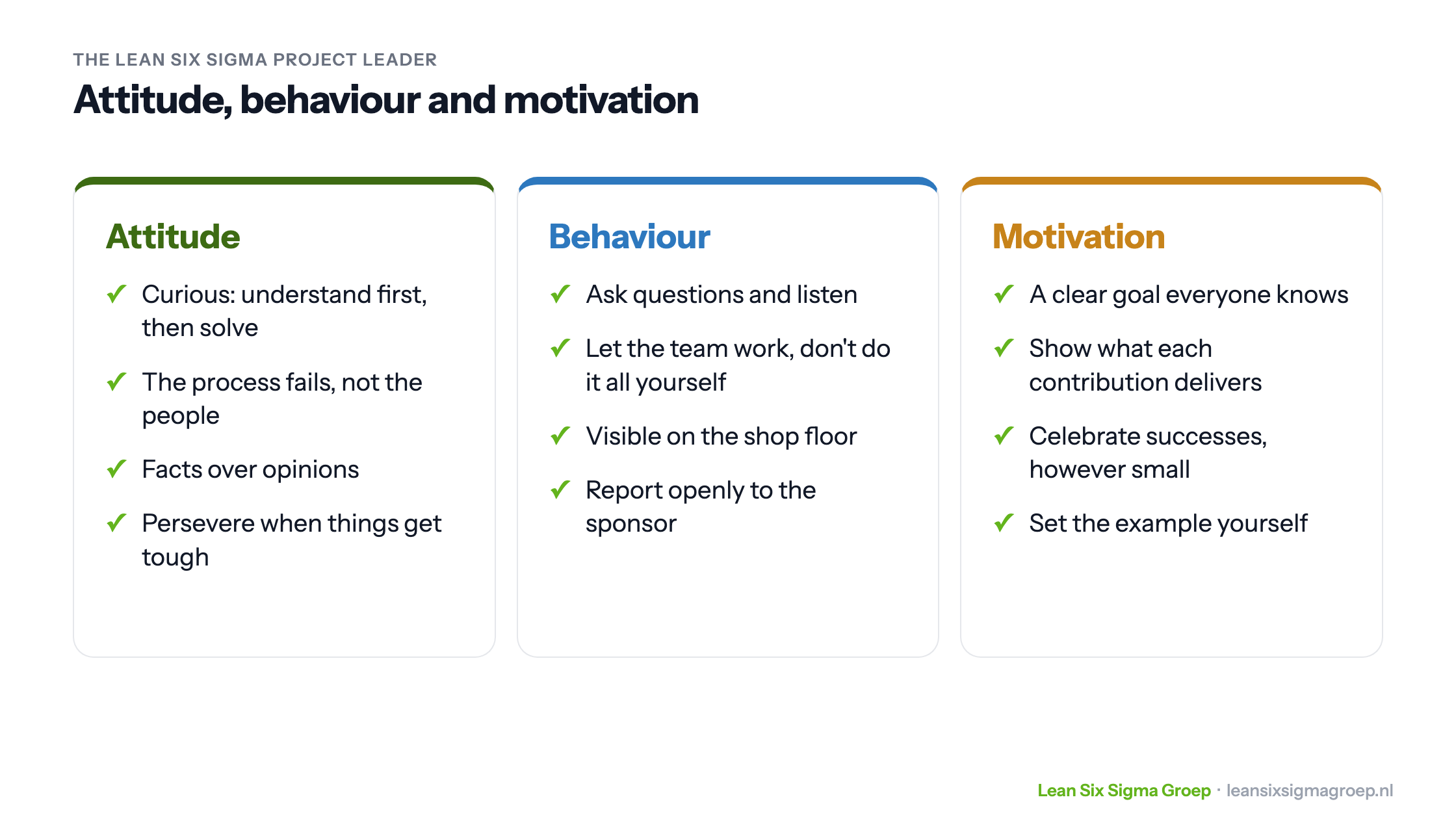
Whether a Lean Six Sigma project succeeds depends only partly on the techniques. At least as important is the project leader: how they look at the problem, how they work with the team, and how they keep the energy up. This article covers those three sides, attitude, behaviour and motivation, as shown in the image at the top.
Attitude
- Curious. A good project leader wants to understand first and only then solve. If you think you already know the solution, you stop asking good questions.
- The process fails, not the people. Problems usually arise from how the work is organised, not because people aren’t trying. Looking at it this way earns openness in return.
- Facts over opinions. Lean Six Sigma asks you to measure first and prove causes. That also applies to the project leader’s own opinions.
- Perseverance. Improvement takes time, and there will be setbacks. A project leader stays on course and keeps the team motivated, even when things get tough.
Behaviour
- Ask questions and listen. The people in the process know most about their work. A good project leader draws out that knowledge, instead of doing the talking.
- Let the team work. The project leader facilitates: they let the team measure, analyse and devise solutions, and divide the work according to everyone’s knowledge and skills. Those who do everything themselves end up with a solution that belongs to nobody else.
- Visible on the shop floor. Going to see where the work happens, the Gemba, yields more than reading reports.
- Communicate openly. With the team, the stakeholders and the sponsor. Also when things go wrong: a problem raised in time can still be solved.
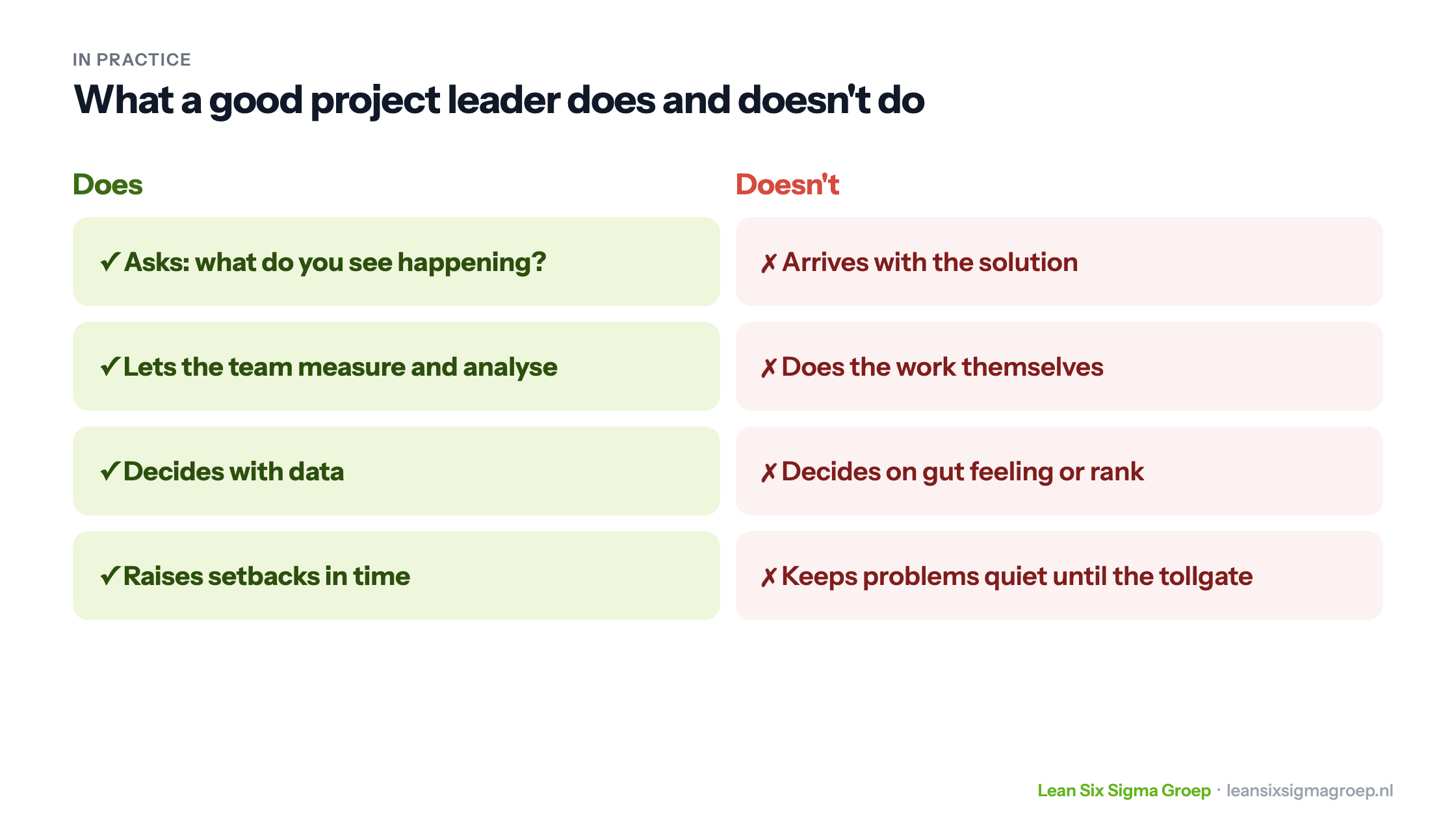
The overview below shows what that looks like in practice.
Motivation
- A clear goal. Everyone on the team knows what the project must deliver and why it matters. Record it in a project charter.
- Show what each contribution delivers. People commit more when they see how their work fits into the whole.
- Celebrate successes. A completed phase, a first measurement that is better: however small, it keeps the energy up.
- Set the example. A project leader who is engaged and curious inspires others.
Growing as a project leader
Nobody has all of this naturally. Most project leaders learn it by doing, with a Black Belt coaching them, as described in the role of the Black Belt in four chapters. If you want to grow as a leader in an improvement culture, read more in Lean leadership. And how to start a project well is covered in starting a Lean improvement project.
In the Green Belt course you learn not only the techniques, but also how to lead a team through an improvement project as project leader.