Where does the term come from?
Some 10 years ago, few people had heard of ‘Lean Six Sigma‘. The terms ‘Green Belt’ and ‘Black Belt’ were mostly known from judo. Lately the Lean Six Sigma method has become more and more familiar, and more and more people are ‘Green Belts’ and ‘Black Belts’.
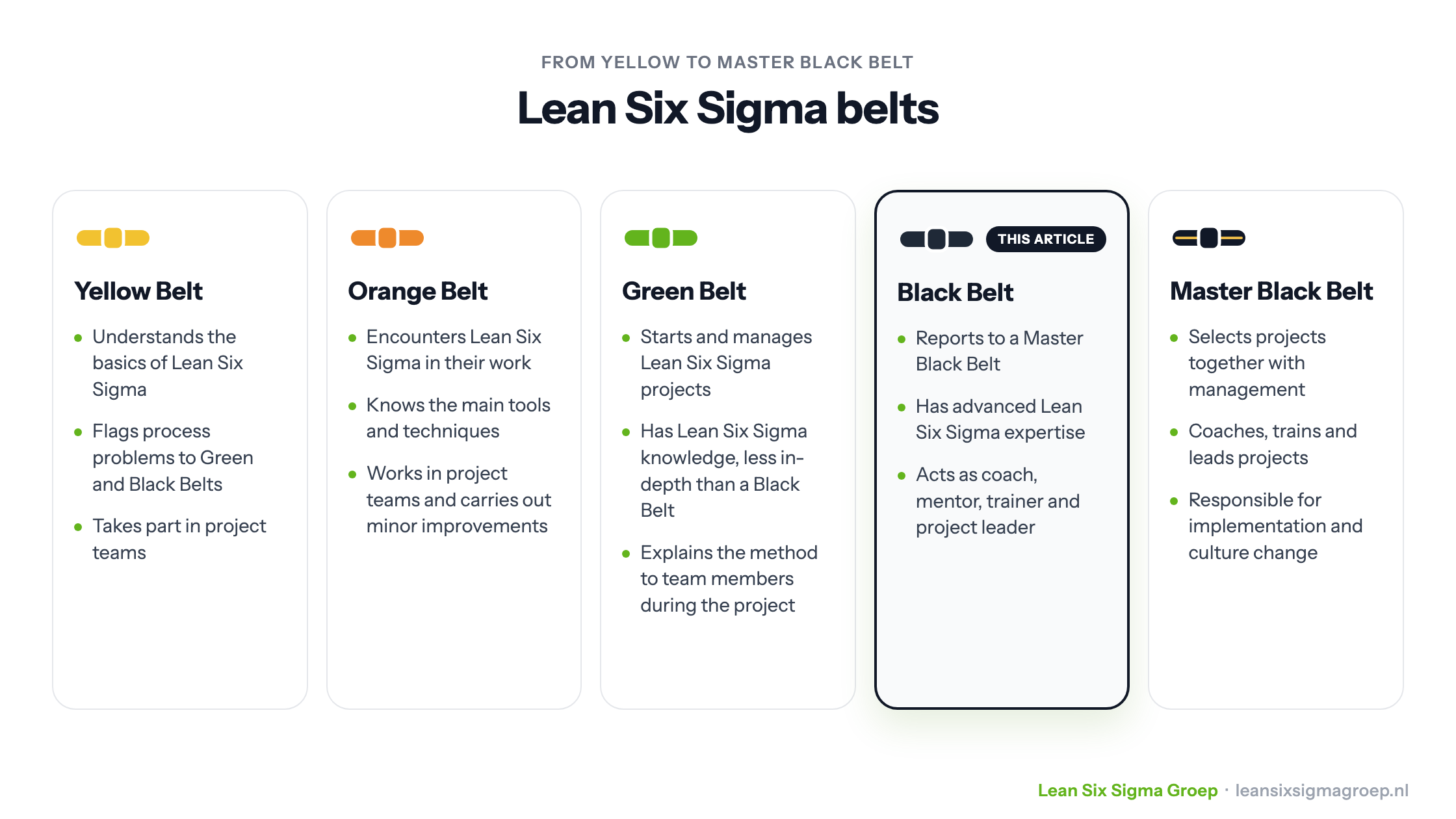
Lean Six Sigma is a method for continuous improvement that originally consists of 2 methods: Lean and Six Sigma. Within the Six Sigma method, the level of knowledge and application was indicated with ‘belts’, just as it is in judo.
The levels, running from Yellow Belt to Master Black Belt, show how much knowledge and experience people have of Lean Six Sigma.
What is a Black Belt?
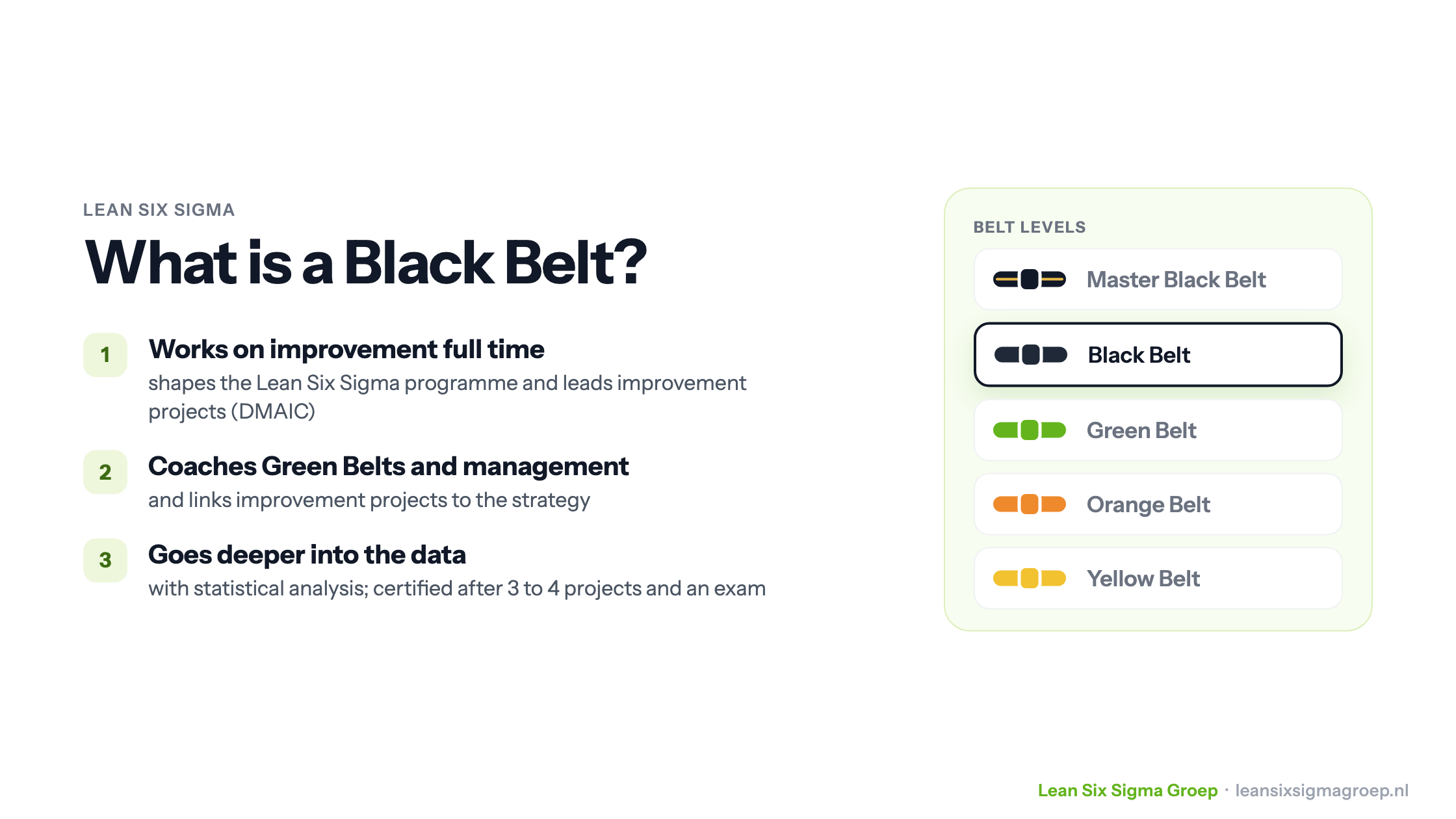
A Black Belt is someone who works full-time with Lean Six Sigma: shaping the Lean Six Sigma programme, coaching Green Belts, running improvement projects and helping management link the vision to improvement projects. It is the next step after Green Belt, and at General Electric (the company that made Six Sigma famous) it is positioned as a career move.
As part of the management development programme, managers spend two years as full-time improvers/Black Belts before moving on to their next management position. That way management knows the improvement method too, and it becomes more and more part of the company.
Different roles
Lately you see Black Belts taking on different roles, from project leader to improvement programme manager. This depends on how far the company has come in applying Lean Six Sigma, on the company itself and on the person.
A company that is further along with Lean Six Sigma often has a number of internal Black Belts who work as internal consultants on improving processes. They safeguard the link with the KPIs, and some form of Operational Management is often used.
The Black Belt is often management’s sparring partner in shaping process improvement and safeguarding the link with the strategy.
Black Belt methods
When leading projects, a Black Belt uses the same method as the Green Belt and usually works through the 5 phases: Define, Measure, Analyse, Improve and Control, or DMAIC. Sometimes an A3 is used as well, working from a problem via the root cause to a solution.
A Black Belt project usually involves deeper data analysis and makes use of statistical analysis.
Working together
For a Black Belt it also matters to improve processes together with the people who do the work; they hold the key to good solutions. Together with a team from the shop floor, the problem is explored in depth and solutions are devised. These are then implemented together, with a more satisfied customer as the result.
The Black Belt facilitates this process, often together with one or more Green Belts.
What knowledge does a Black Belt have?
A certified Black Belt has independently taken on three to four improvement projects, has completed the Black Belt training and has passed the theory exam.
How do you become a Black Belt?
Want to become a Black Belt? You get there by taking a training course combined with gaining practical experience. After the Green Belt training you can go on to the Green Belt to Black Belt training.
You can also go straight into the Black Belt programme. Lean Six Sigma Groep offers this at various locations and in various formats.
To get certified, the next step is to apply the theory in projects. We can support you in practice through the coaching sessions included in the training. Sparring often helps you get through this process faster, and we’re happy to do it.
For a no-obligation conversation, you can of course also get in touch with us via the form or at [email protected]
► View our range of Black Belt training courses here