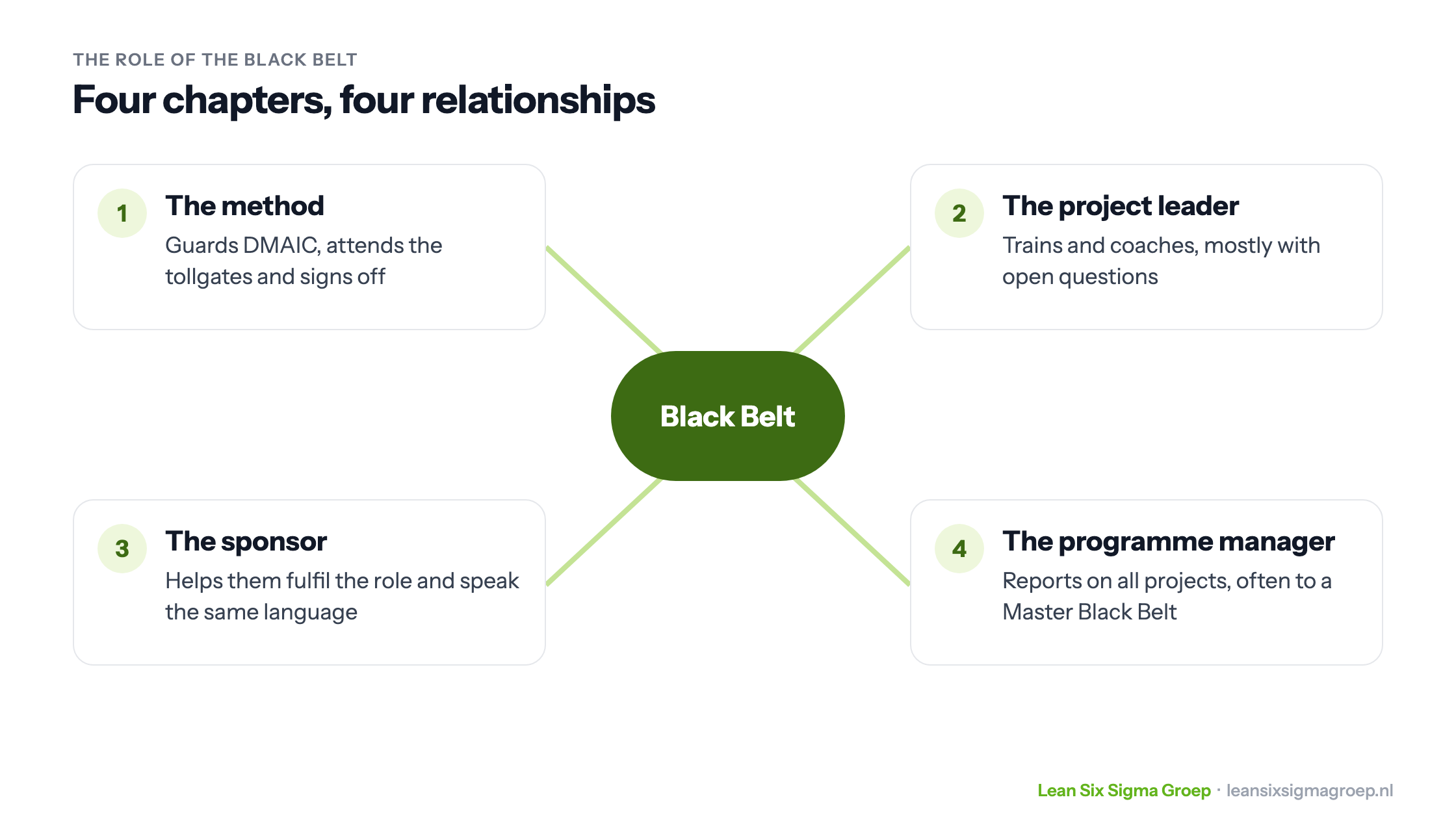
What does a Black Belt actually do, besides leading projects? A trainer at Lean Six Sigma Groep looks back on his first years as a Black Belt, and sums up the role in four chapters: the method, the project leader, the sponsor and the programme manager.
After a Green Belt and Black Belt course, I got to work at an insurer. Well, got to work: I had already worked there for ten years, in a different role, so people could expect me to know my way around.
Because a colleague and I were the first Black Belts, it was mostly a matter of finding our way at first. I had learned how to lead a project, and I was even quite good at it, but the course had paid more attention to statistics than to the role of the Black Belt.
It was a great time, partly because we set out on a voyage of discovery without a travel guide. We inevitably took detours, sometimes through dark alleys full of resistance, time-wasters and people who say yes but do no. Knowing what I know now, I would have liked to know more about the role of the Black Belt back then. Without claiming to be complete: that role fits in a book with four chapters, as shown in the image at the top of this article.
Chapter 1: the method
The Black Belt ensures that a project follows the Lean Six Sigma roadmap, DMAIC, and that the steps are carried out properly. That way they contribute to the integrity of the method. In essence the project leader, often a Green Belt, moves from the problem to the root causes to the solutions.
To follow progress, the Black Belt attends the tollgates: the moments at the end of each DMAIC phase when the team checks whether the project leader is on track, or whether an intervention is needed.
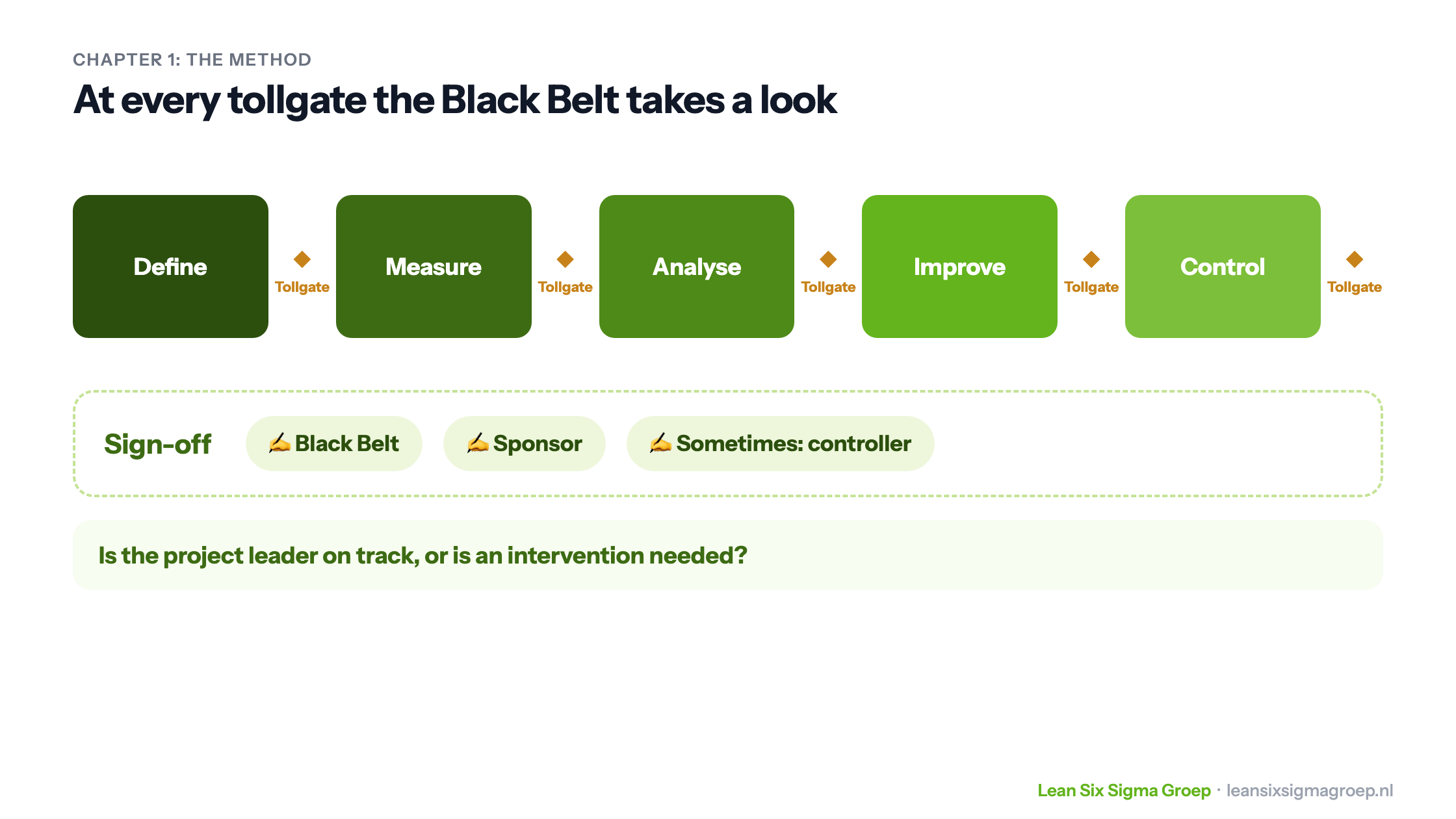
At the end, after the Control phase, the Black Belt signs to confirm that the method has been applied properly. This is called sign-off. The Black Belt doesn’t sign alone: the sponsor signs too, and in some organisations a controller.
Chapter 2: the project leader
The Black Belt trains the project leader in the skills needed, and coaches them in their daily work, including between tollgates. In practice that coaching mostly comes down to open questions, without judgement. How is your project going? What is the problem? Why is that a problem? What is the consequence? Why tackle it right now? Who suffers from it?
Chapter 3: the sponsor
The Black Belt helps the sponsor fulfil that role as well as possible. My experience is that this coaching is often less about content and more about behaviour and ways of working. The Black Belt also teaches the sponsor the essential Lean Six Sigma knowledge. It helps enormously when sponsor and project leader speak the same language.
Chapter 4: the programme manager
Usually several projects run at the same time, with different project leaders. So the Black Belt has several irons in the fire, and reports to the manager of the Lean Six Sigma programme, often a Master Black Belt. That keeps the overview and allows timely adjustment there too. Discussing those reports in a kind of steering group has almost always been instructive and valuable in my experience.
Read more about the role in what is a Black Belt?, and about certification in the practical assignment for Black Belt certification.
Does this sound like something for you? Take a look at the Black Belt course, or email us at [email protected].