Policy Deployment, also called Hoshin Kanri or strategy deployment, is a way to translate an organisation’s strategy into what every department and team does this month. It brings focus: a few big goals, a limited number of improvement initiatives, and everyone knowing what their contribution is.
Where does it come from?
Hoshin Kanri arose in Japan in the 1960s, as an extension of quality thinking to strategy. Companies such as Bridgestone and Toyota applied it early on. Hoshin means something like compass or direction, kanri means management. Through American companies it later became known worldwide, often under the name Policy Deployment.
The idea is simple. Many organisations have a fine strategy, but on the shop floor nobody knows what it means for today’s work. At the same time dozens of improvement projects are running that have little to do with the strategy. Policy Deployment connects the two.
The X-matrix
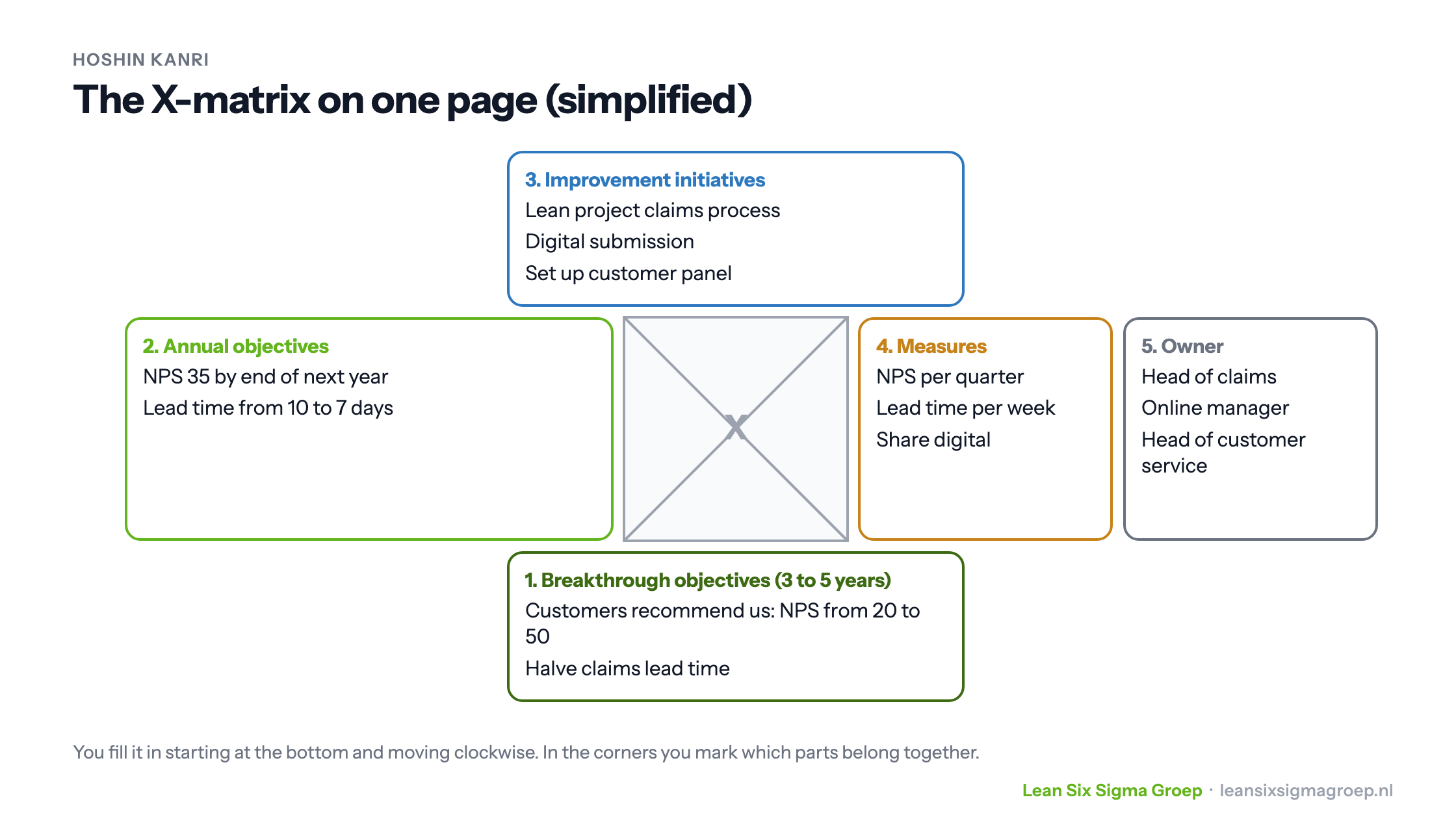
The best-known tool is the X-matrix: all goals, initiatives, measures and owners on one page, with a cross in the middle. A simplified version for a fictional insurer is shown in the image at the top of this article. You fill it in starting at the bottom and moving clockwise:
- Breakthrough objectives for three to five years: where do you want to go? Choose three to five at most.
- Annual objectives: what must be achieved this year to stay on course?
- Improvement initiatives: which projects and actions are needed to reach those annual objectives?
- Measures: which figures show that it is working? For example KPIs per week or month.
- Owners: who is responsible?
In the corners of the matrix you mark which parts belong together: which initiative contributes to which annual objective, and which figure shows it. That shows at a glance whether every initiative serves a goal, and whether every goal has enough initiatives. Projects that contribute to nothing stand out and can be stopped.
In a larger organisation each level makes its own X-matrix, connected to the one above it.
Catchball: goals go back and forth
The most important part of Policy Deployment can’t be seen on paper. Goals are not just imposed from above, but tossed back and forth between levels, like a ball. That is called catchball.
This is one of the tools you learn to apply in the Green Belt training.
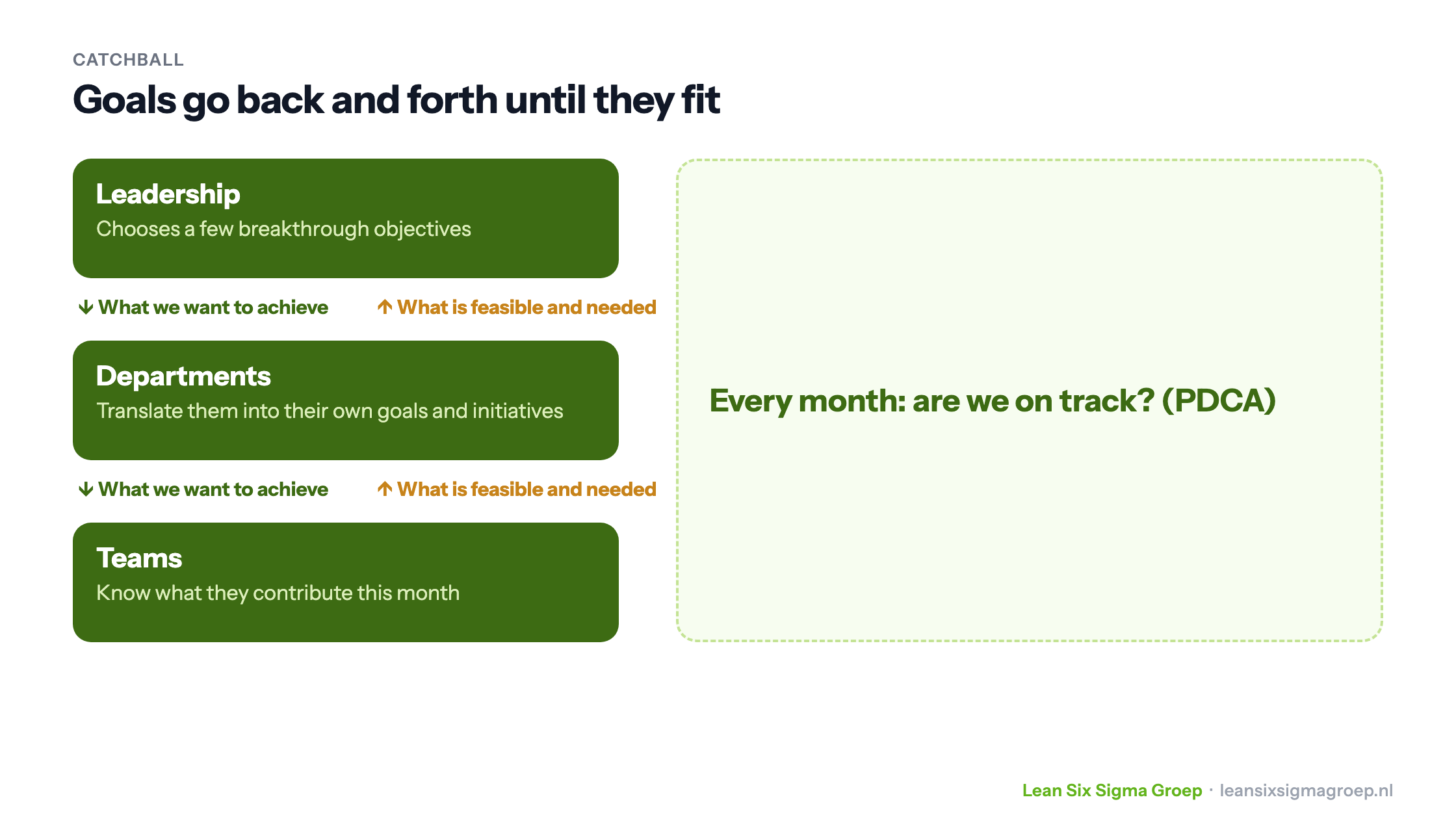
Leadership says what it wants to achieve. Departments translate that into their own goals and initiatives, and come back with what is feasible and what they need for it. This goes back and forth until the goals fit. It takes more time than imposing goals, but it produces goals people stand behind, and a strategy that is understood on the shop floor.
How to introduce it
- Start with the vision and choose a few breakthrough objectives for three to five years. Less is more: whoever has ten priorities has none.
- Translate them into annual objectives and then, level by level, into goals per month or week, using catchball.
- Choose the initiatives that contribute most, and stop projects that contribute to nothing.
- Review every month whether you are on course, with the figures at hand. If you are behind, find out why and adjust. That is the PDCA cycle, applied to strategy.
- Evaluate at the end of the year what worked and what didn’t, and start the next cycle.
Policy Deployment fits well with Operational Excellence and with methods such as OGSM and OKR, which also link goals and actions. The big difference lies in catchball and in the link with daily improvement.
Want to learn how to connect strategy and improvement? Take a look at the Black Belt training course.