Turnaround management is turning the tide in an organisation in trouble: a retail chain losing customers, a factory making losses, a hospital with growing waiting lists. The aim is first to survive, and then to continue in good health. This article explains how such a turnaround works, which strategies there are and what Lean Six Sigma can contribute.
It starts with recognition
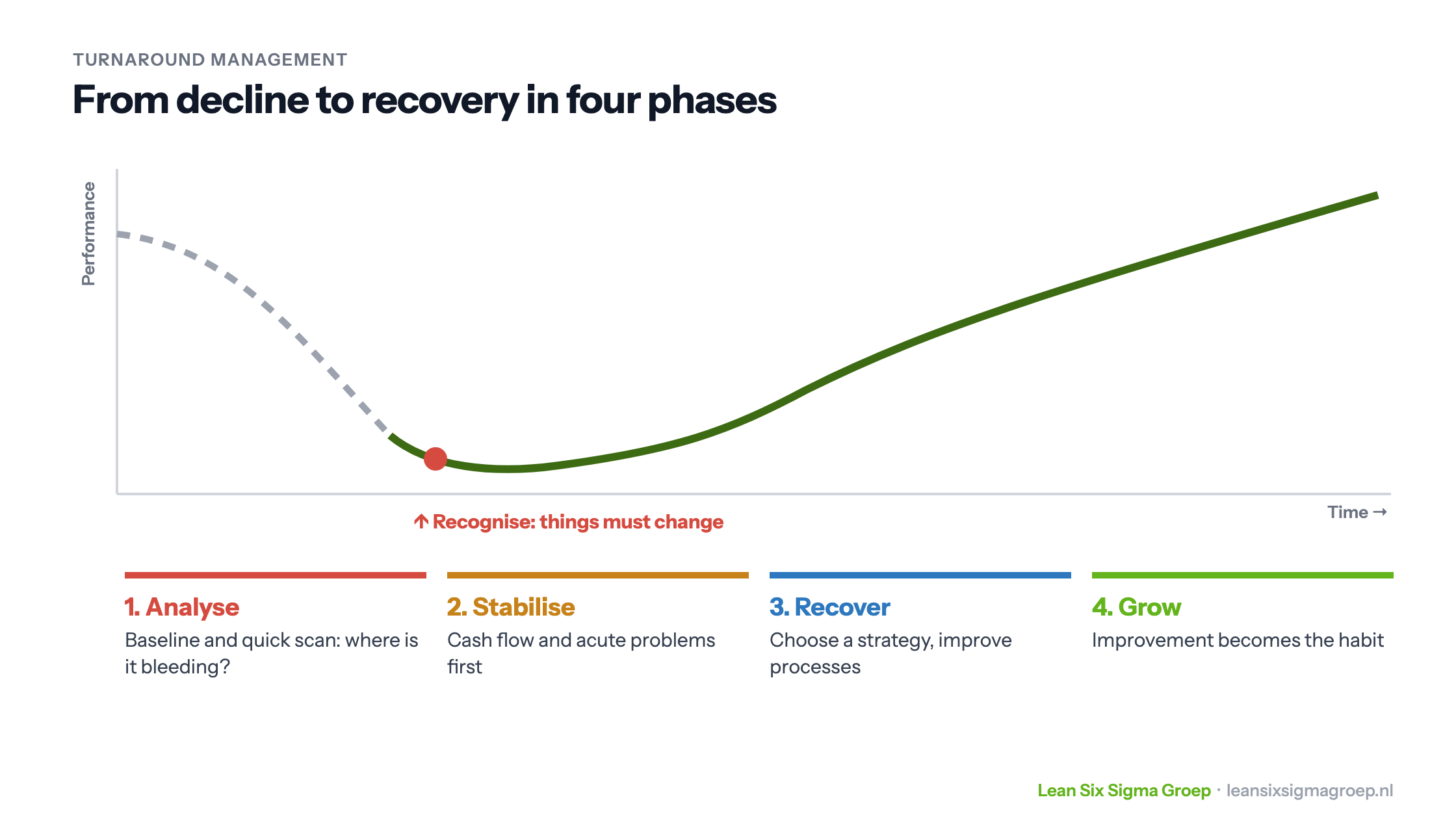
The first step seems obvious, but often isn’t: recognising that things are not going well and that something must change. “It has always worked out” is a dangerous thought. Those who correct course too late have less money, less time and less trust left to make the turnaround. A sense of urgency is therefore the start of every turnaround, just as with any other change process.
The four phases of a turnaround
A turnaround usually runs in four phases, as shown in the image at the top of this article:
- Analyse. Where does the organisation stand, and where is it bleeding? A quick scan gives a fast view of the biggest pain points. Together with a baseline measurement of the key figures, that is the starting point.
- Stabilise. First stop the bleeding: get cash flow under control, stop loss-making activities, solve acute problems. That sometimes requires painful choices. They are needed to buy time for the rest.
- Recover. Choose a strategy for the future and improve the processes, so the organisation delivers value again at a healthy cost.
- Grow. Improvement becomes the habit, and the organisation builds on its future.
Three strategies
For the recovery, the organisation usually chooses from three strategies, or a combination:
This is one of the tools you learn to apply in the Green Belt training.
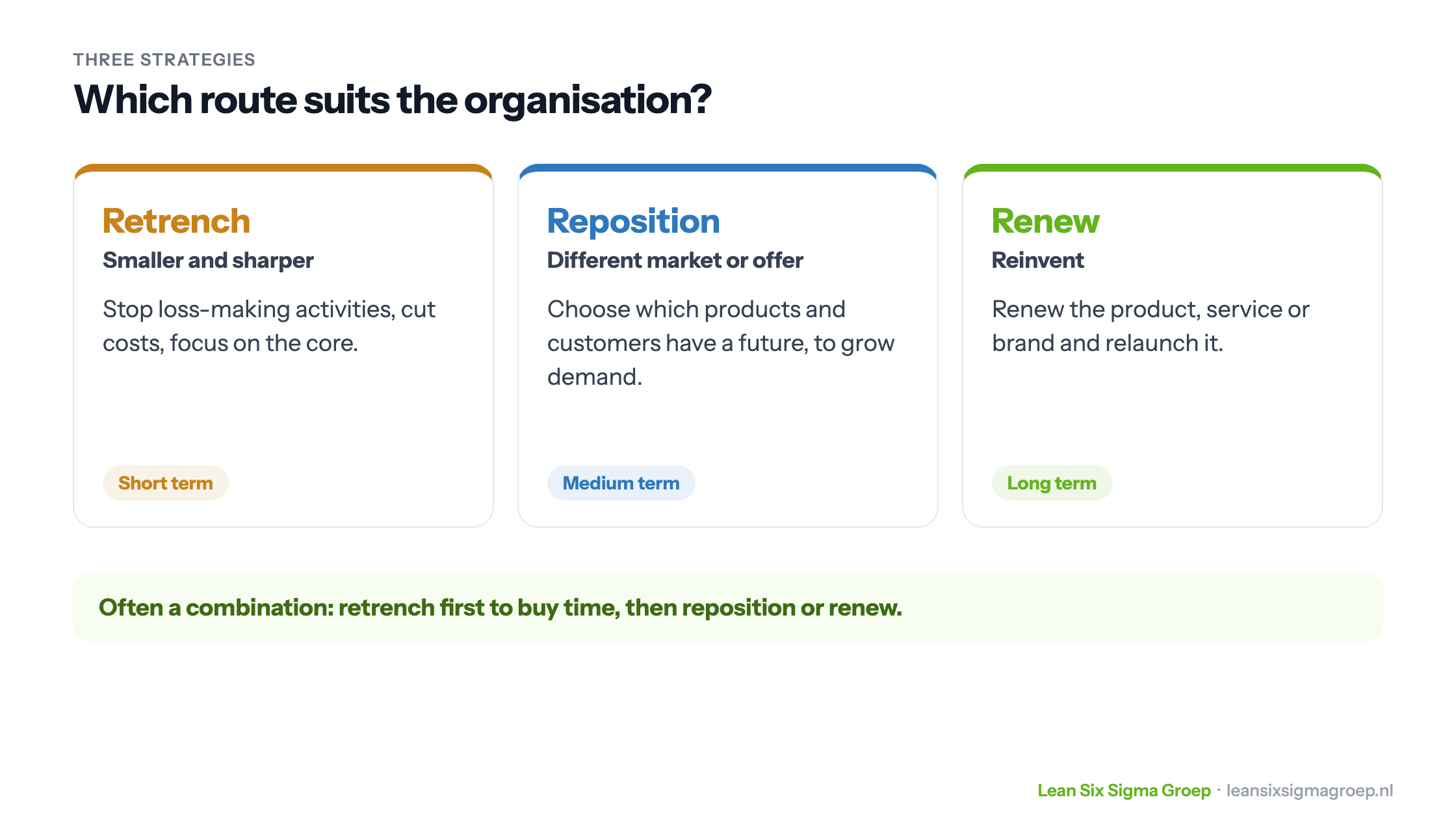
- Retrench: become smaller and sharper. Stop what makes a loss, cut costs and focus on the core. This works in the short term and buys time.
- Reposition: decide which products and markets have a future, so demand grows again.
- Renew: reinvent the product, service or brand and relaunch it. This takes the longest, but can produce the biggest leap.
Retrenchment alone is rarely enough: an organisation cannot cut its way to growth. That is why retrenchment is almost always followed by repositioning or renewal.
The turnaround manager
A turnaround is often led by a turnaround manager: an experienced interim manager with a strong operational focus, often with a Black Belt background. They bring pace, look with fresh eyes and can take decisions that are hard to take from within.
A good tool at the start is a change map: one overview of where the organisation is now, where it wants to be in a few years, and which steps lie in between. It is the roadmap management steers by, and the story that brings the rest of the organisation along.
What Lean Six Sigma contributes
- Facts instead of opinions. In a crisis the temptation to decide on gut feeling is strong. Lean Six Sigma forces you to measure first and find the real causes.
- Fast results. Removing waste lowers cost without the customer losing anything. That is a healthier saving than cutting across the board.
- Grip for management. An Obeya brings the goals, figures and actions of the turnaround together in one room, so the management team can steer in a focused and fast way.
- Lasting improvement. Teaching the organisation to improve prevents it from sliding back after the turnaround. That is the step towards operational excellence.
Don’t forget the people
A turnaround is hard on staff: uncertainty, cutbacks, sometimes redundancies. Steering only on figures risks the best people leaving and the rest ending up in a negative spiral. So be honest about what is going on, show where the organisation wants to go, and involve staff in the improvement. In the projects we support, we see positivity return as soon as the first results become visible.
Want to know how Lean Six Sigma Groep can help with a turnaround? Email [email protected].