VUCA stands for Volatility, Uncertainty, Complexity and Ambiguity. The term comes from the US military (US Army War College, late 1980s) and has since been widely adopted by organisations. But what exactly do the four terms mean, and how do you use them in a world that seems to change ever faster?
A framework for strategic choices
VUCA is a framework. It helps organisations choose the right actions when something changes, often suddenly, in the market or the environment. By first determining what kind of change you are facing, you can respond faster and more precisely. The link with Agile working is easily made.
Bennett and Lemoine worked this out in Harvard Business Review in 2014. They placed the four types of challenge along two questions, as shown in the image at the top of this article:
- How much do you know about the situation?
- How well can you predict the results of your actions?
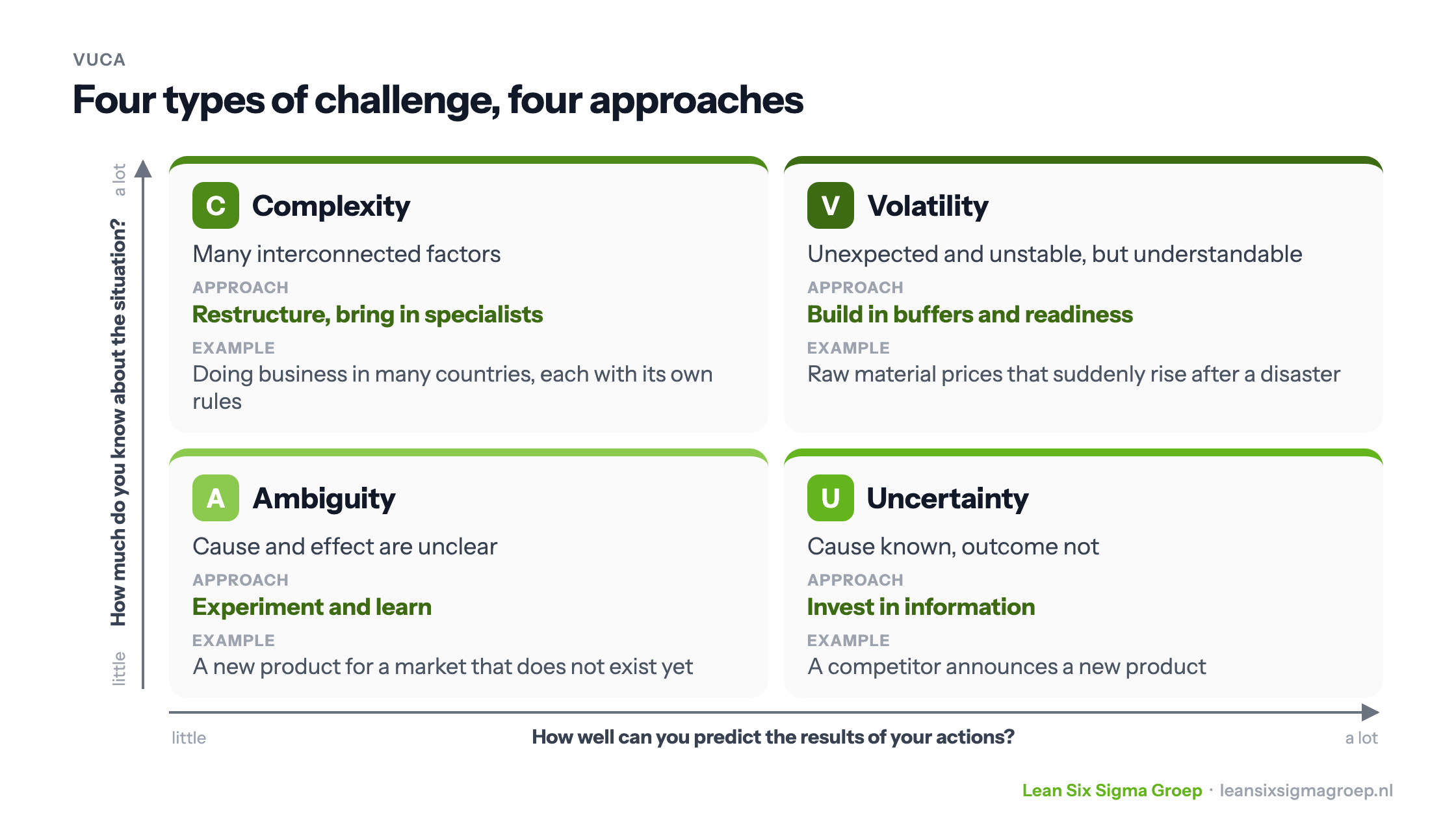
The four elements of VUCA
Volatility
Characteristics: the situation is unexpected or unstable, and it is unknown how long it will last. Yet it isn’t hard to understand: knowledge about it is usually available.
Approach: build in buffers and readiness, for example extra stock or spare capacity. That costs money, so make sure the investment matches the risk.
Example: the price of a raw material shoots up after a natural disaster or because of a war, like the gas price in 2022. An organisation with stock or fixed contracts is less affected.
Uncertainty
Characteristics: the cause and effect of the event are known, but information is missing. Change is possible, but not a given.
Approach: invest in information: collecting, interpreting and sharing it.
Example: a competitor announces a new product. You don’t know how the market will react, but market research and conversations with customers reduce the uncertainty.
Complexity
Characteristics: the situation consists of many interconnected factors. There is often enough information, but the volume is so large that it is hard to oversee.
Approach: restructure, bring in specialists and build the knowledge and resources to deal with the complexity.
Example: doing business in many countries, each with its own laws, taxes and customs.
Ambiguity
Characteristics: cause and effect are completely unclear, and there is no precedent. You don’t know what you don’t know.
Approach: experiment. Understanding comes from testing. Design experiments so you learn from them, and apply what works more widely.
Example: an organisation enters an emerging market or launches a product outside its core competencies. Nokia started as a paper mill in Finland and grew into the market leader in mobile phones, a step that could not have been predicted beforehand.
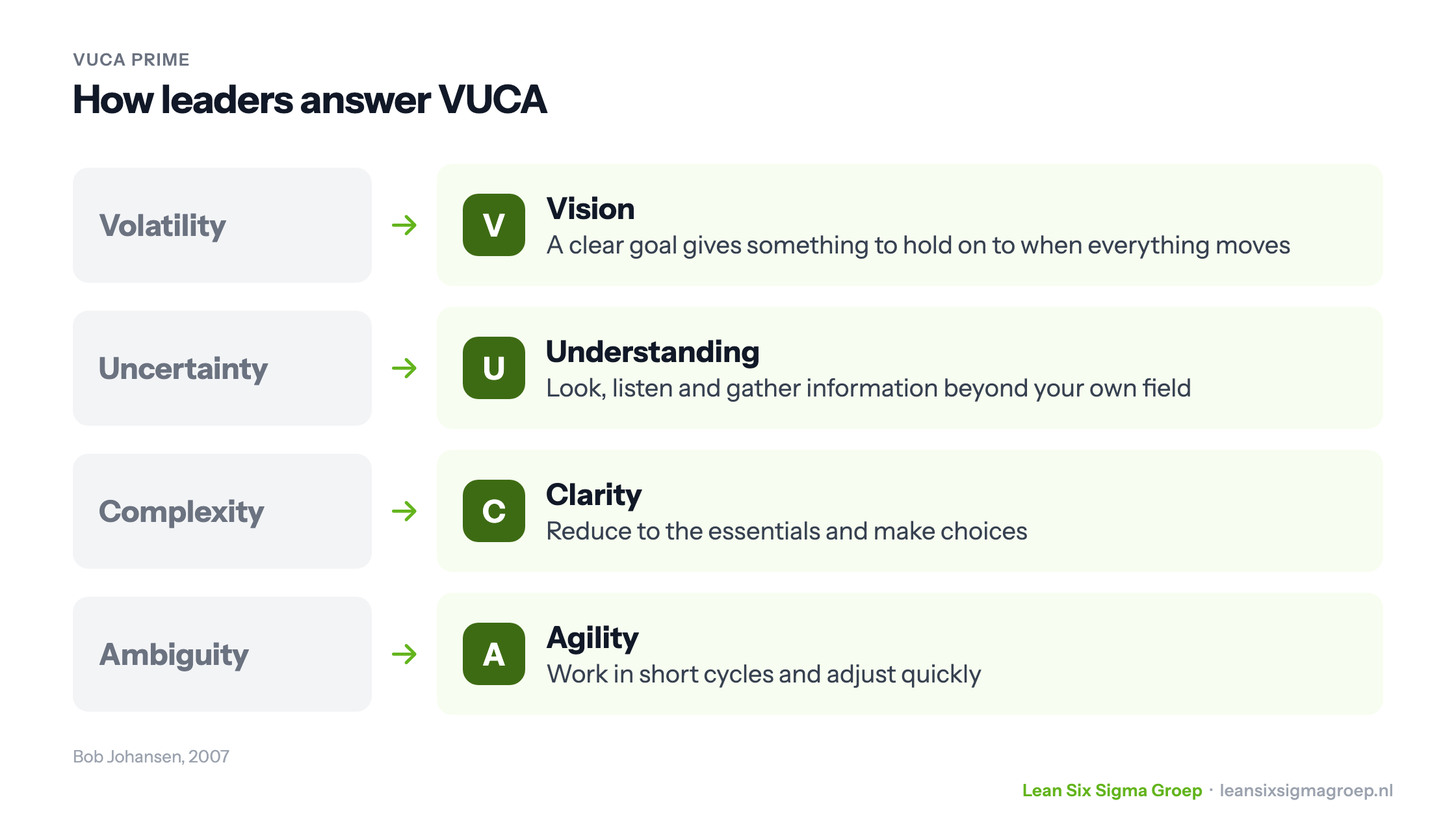
VUCA Prime: how leaders respond
Bob Johansen turned the concept around into VUCA Prime: four capabilities that help leaders cope with a VUCA world. Against volatility you set a clear vision, against uncertainty understanding, against complexity clarity and against ambiguity agility.
Insight gives direction
VUCA is a framework for strategic challenges. By being clear about what you know about a situation, and how well you can predict the results of your actions, you make better decisions. That way you avoid, for example, spending a lot on information when what you really need is buffers, or analysing for a long time when experimenting would lead to insight faster.
The video with this article explains how to respond effectively in a VUCA environment.
Want to learn how to tackle improvement in your organisation? Read more about the Green Belt or Black Belt training course.
From theory to practice
Learn to apply this in practice
Topics like VUCA are applied directly to an improvement project from your own organisation in the Green Belt training.
Next start dates
Lean Six Sigma Green Belt training →Not ready for a training yet?