Publicatie
KPIs: what they are, how to set them and how to use them
Key performance indicators (KPIs) are essential for any organisation that wants to succeed. Learn here how to set up and apply KPIs to take your organisation to the next level.
 André HoogstadBlack Belt Consultant
Published 6 min read
What are KPIs?
KPIs are measurable indicators that show how an organisation is performing. They give insight into process performance and help you evaluate your own results. KPIs show where continuous improvement is possible and/or necessary, which is why they are defined at the start of an improvement project. KPIs are an essential part of process management and process control. They provide an objective basis for decision-making and help focus the organisation’s efforts on the performance areas that matter most.
KPI or PI?
The difference between key performance indicators (KPIs) and performance indicators (PIs) lies in the word ‘key’. KPIs are indicators of crucial performance that is vital to the organisation. If the KPIs are not met, the very existence of the organisation is at risk. PIs, on the other hand, measure general performance, but are not necessarily crucial to the organisation’s survival. It is important to make this distinction so that the focus stays on the performance that really matters.
How many KPIs are there?
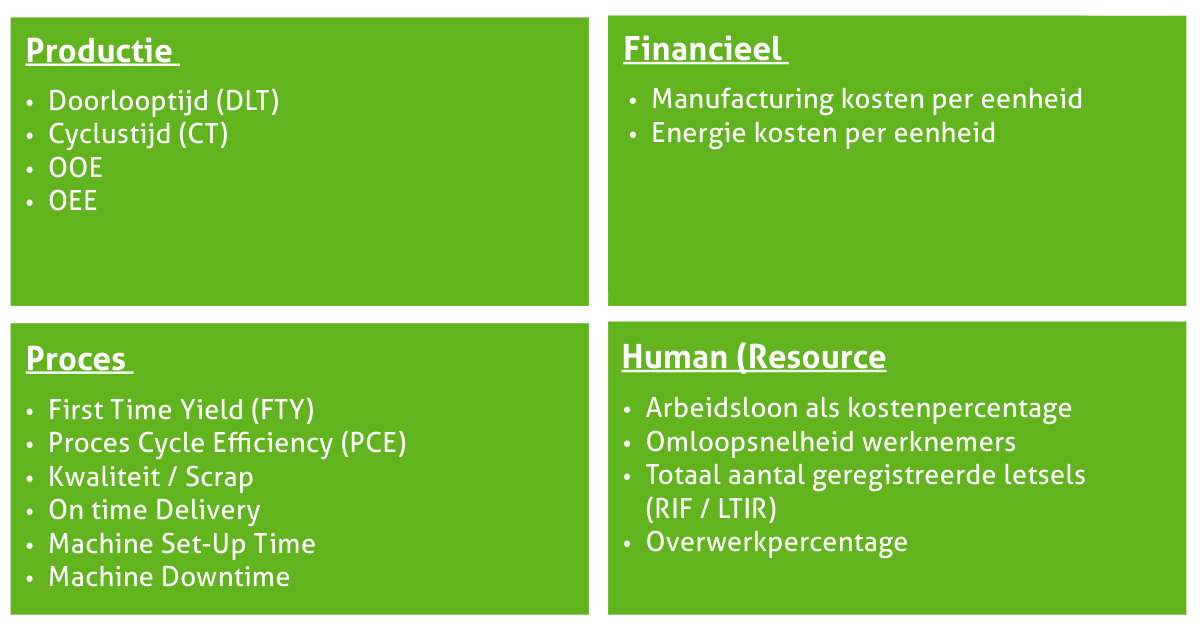
The 4 marketing KPI categories are General, Financial, HR and Sales. These categories cover the main aspects of marketing performance and offer a broad basis for measuring success. The 4 Lean categories for KPIs are: Production, Financial, HR and Process. These categories focus more on the internal processes and efficiency of the organisation. By defining KPIs in these categories, an organisation gets a comprehensive picture of its performance and its opportunities for improvement.
This is one of the tools you learn to apply in the Green Belt training.
How do you set KPIs?
In their book OGSM, Bakker and Schulten describe how indicators are used to monitor progress while the plan is being carried out. The indicator(s) make very concrete which (interim) results are expected within a strategic choice. These are the steps for setting KPIs:
- Define the ambition
- Define the objectives and formulate them in terms of timeliness, quality or cost.
- For each objective, choose 1 or more Lean KPI categories
- Make every KPI quantifiable and measurable by a …..
- Formulate every chosen Lean KPI SMART: Specific, Measurable, Achievable, Relevant and Time-bound.
It is crucial to go through these steps carefully, so that the KPIs are effective and actually contribute to improving the organisation’s performance.
How do you use KPIs?
You use KPIs by integrating them into your work process. Make them part of daily work by doing the following:
- Objectives and KPIs can be translated into short-cycle KPIs (daily or weekly insight)
- Objectives can be realised (executed)
- The results can be evaluated daily or weekly
Once a KPI has been set, it has to become part of the work process. You do that by setting up a measurement system. The employee or the team works towards the objective, after which the output is evaluated. That evaluation answers ‘Are we doing the right things?’ and ‘Are we doing things right?’. If the answer to both questions is ‘Yes’, we are on track and we stay in the execution loop. If the answer to one or both questions is ‘No’, we have a trigger to start improving and we move to the improvement loop.
The step towards a measurable problem, in other words insight into whether we are doing the right things, is what we call ‘operationalising’. This process ensures that KPIs are not only measured, but actually lead to action and improvement.
Why setting KPIs is a team effort
Do not set up the measurement system for the KPIs on your own, but together with the people who know the process from the inside. It is important to reach consensus and to measure the right thing, because that increases acceptance and prevents stagnation. Stagnation sets in when the results of a measurement are dismissed as ‘untrue’ and nothing is done with them.
Steps for setting up a measurement system:
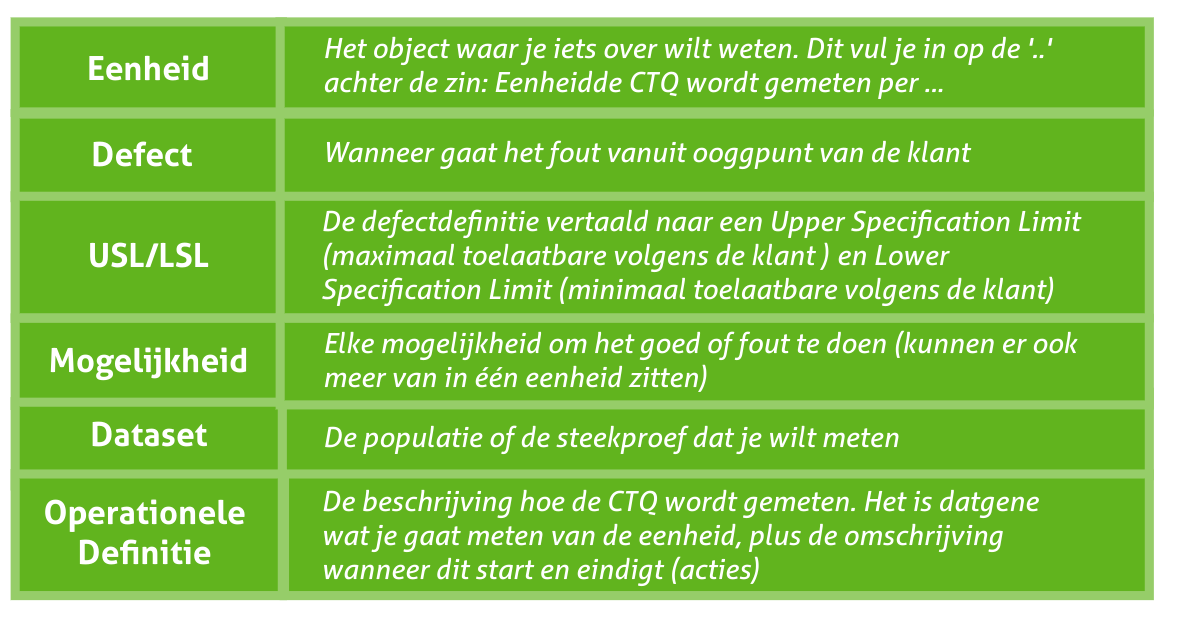
- Identify the flow unit: the key component that flows through the process.
- Define the system boundaries: where does the measurement start and where does it end?
- Set the standard: when are we doing well and when are we not? Express this in measurable values such as Critical to Quality (CTQ), Upper Specification Limit (USL) and/or Lower Specification Limit (LSL).
Elements of a good KPI system
The overview below describes the elements needed to decide properly what we are going to measure in a Lean Six Sigma project. They can help when setting up the KPIs:
- Objectives: what do we want to achieve?
- Measurements: how are we going to measure it?
- Standards: what is the desired result?
- Actions: what do we do if we do not meet the standards?
KPIs and communication
It is important that the KPIs are visible and accessible to every employee, and that everyone actually wants to work with them. Watch out for management jargon too, and above all keep it simple. A KPI is a tool, not an end in itself. It is like a spirit level or a tape measure for a carpenter: without these tools it is not clear whether the work has been done correctly.
Monitoring KPIs and visual management
Monitoring KPIs is an ongoing process that calls for regular evaluation and adjustment. Visual management plays a crucial role here. Visual management uses visual aids such as dashboards, charts and scorecards to make the performance on the KPIs clear at a glance. By presenting KPIs visually, employees can quickly and easily see how the organisation is performing and where any bottlenecks are. This raises awareness of and commitment to the objectives. A good visual management system makes it possible to spot trends and deviations immediately, so that you can intervene faster and more effectively. It also promotes transparency and a culture of continuous improvement, because everyone has access to the same, up-to-date information.
Pitfalls when working with KPIs
In practice there are several pitfalls when working with KPIs. A common mistake is choosing too many KPIs, which dilutes the focus and lets the most important objectives slip out of sight. KPIs can also be formulated in such a complex way that they cause confusion and lack support among employees. There is also the risk of putting too much emphasis on quantitative data while overlooking qualitative insights. Another pitfall is measuring things that are easy to measure but contribute little to the organisation’s real goals. Finally, a lack of regular evaluation and adjustment can lead to a situation in which KPIs lose their relevance and no longer contribute to improving performance. It is therefore essential to keep looking critically at the chosen KPIs and to adapt them where necessary to changing circumstances and objectives.
Conclusion
KPIs are not an end in themselves, but a means of achieving our ambition and objectives efficiently and effectively. By knowing what to measure, measuring it, and then evaluating the results daily or weekly, we know whether we are doing the right things and doing things right. If that is not yet the case, we can improve quickly, effectively and together. KPIs help us gain insight, improve in a focused way and ultimately be more successful in what we do. Visual management strengthens this process by making KPIs clear and accessible, which contributes to a transparent and engaged working environment. But be aware of the pitfalls when working with KPIs, and make sure the chosen indicators really contribute to the organisation’s objectives.
From theory to practice
Learn to apply this in practice
Topics like KPIs: what they are, how to set them and how to use them are applied directly to an improvement project from your own organisation in the Green Belt training.
Next start dates · Lean Six Sigma Green Belt training
Not ready for a training yet? Or .