The EFQM Model and Lean Six Sigma both help organisations improve structurally, but at different levels. EFQM is a strategic framework for the whole organisation. Lean Six Sigma is an approach for improving processes. Together they form a strong foundation: EFQM shows where you need to improve, Lean Six Sigma helps you do it.
What is the EFQM Model?
EFQM stands for European Foundation for Quality Management, a European organisation founded in 1988. The EFQM Model is a management model that organisations use to assess and improve their performance. It looks at the organisation as a whole: from strategy and culture to the results for customers, employees and society.
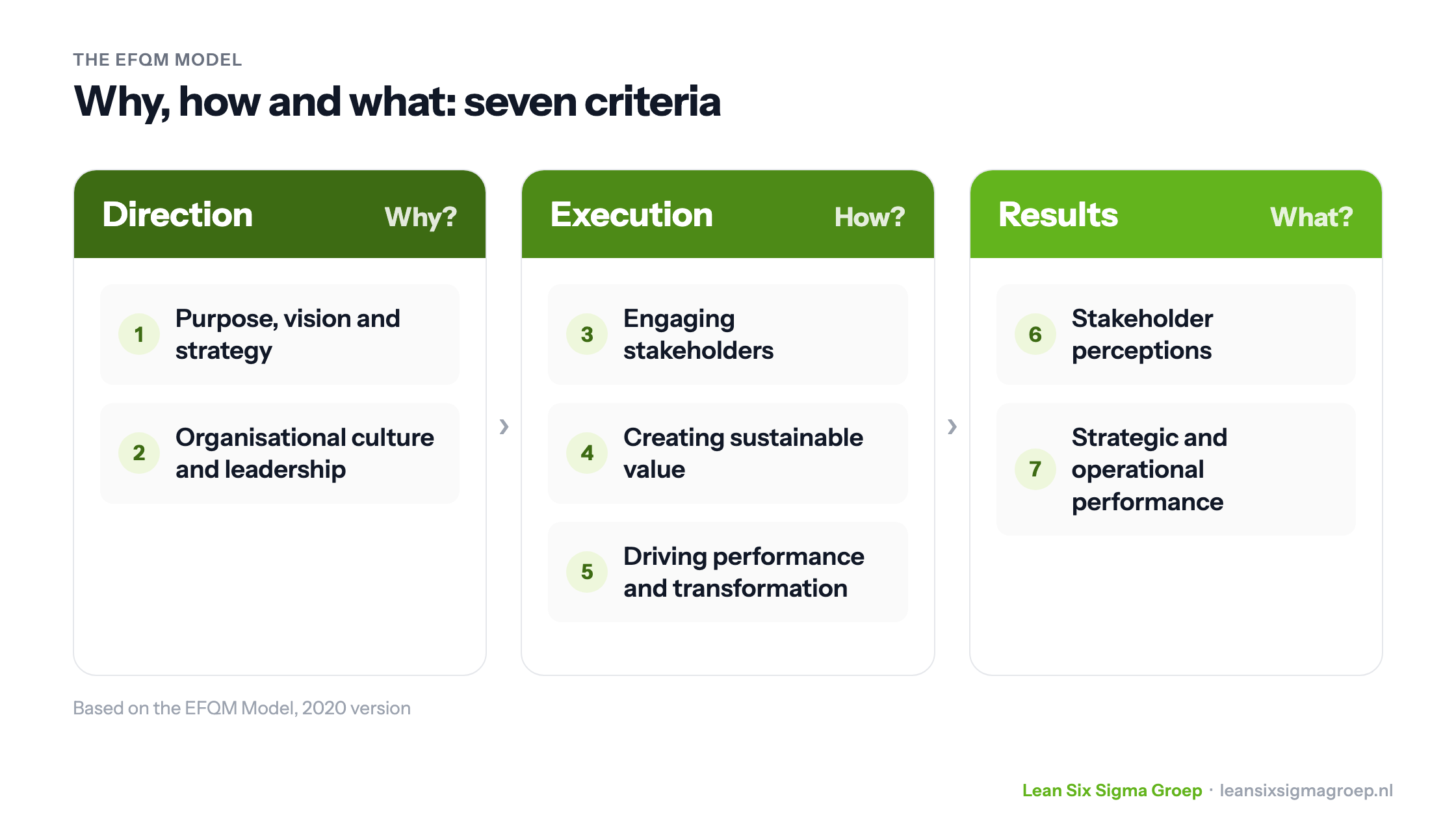
Since the 2020 version, the model has been built around three questions, as shown in the image at the top of this article:
- Why does the organisation exist, and what strategy does it follow? This is direction.
- How does it turn that strategy into action? This is execution.
- What does that achieve? These are the results.
Underneath are seven criteria:
Direction
- Purpose, vision and strategy: why does the organisation exist, where does it want to go and how will it get there?
- Organisational culture and leadership: how do leaders give direction and build a culture that supports the strategy?
Execution
- Engaging stakeholders: how does the organisation involve customers, employees, partners and society?
- Creating sustainable value: how does it design and deliver value for its stakeholders?
- Driving performance and transformation: how does it ensure good performance today, and change and innovation for the future?
Results
- Stakeholder perceptions: how do customers, employees and others experience the organisation?
- Strategic and operational performance: does the organisation achieve its goals?
Organisations use the model to assess themselves, often with the RADAR logic: which results do you want, which approach do you choose, how do you deploy it, and how do you assess and refine it?
EFQM and Lean Six Sigma reinforce each other
- EFQM focuses on developing the whole organisation, Lean Six Sigma on improving specific processes.
- EFQM provides a strategic framework, Lean Six Sigma helps carry out improvements.
- EFQM encourages continuous improvement, Lean Six Sigma provides the concrete approach and tools, such as the DMAIC cycle, the fishbone diagram and 5 whys.
This is one of the tools you learn to apply in the Green Belt training.
From strategy to execution
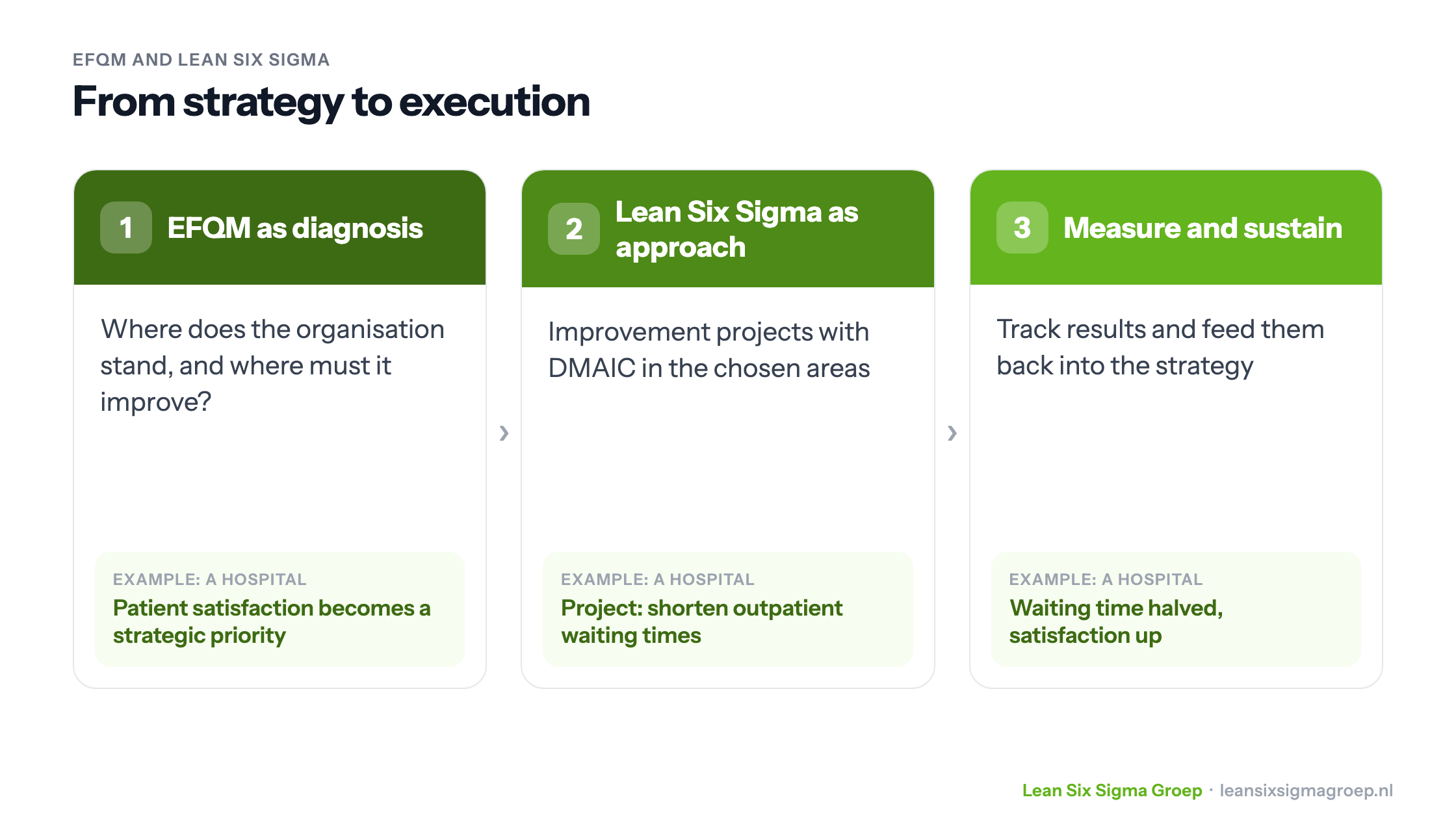
To link EFQM and Lean Six Sigma well, you translate the strategic goals from the EFQM Model into concrete improvement projects:
- Use EFQM as a diagnosis to determine where the organisation stands and which areas most need improvement.
- Use Lean Six Sigma to solve problems in a structured way within those areas.
- Measure and sustain the results, and feed them back into the strategy, so improvement becomes a continuous process.
An example: based on an EFQM assessment, a hospital makes patient satisfaction a strategic priority. It then uses Lean Six Sigma to tackle waiting times at the outpatient clinic. That results not only in more satisfied patients, but also in more efficient care processes and lower costs.
Conclusion
Together, EFQM and Lean Six Sigma offer a complete approach to improving both strategically and operationally: EFQM as a guide for developing the organisation, Lean Six Sigma as a practical approach for process improvement.
Want to get started with Lean Six Sigma yourself? Take a look at our training courses or get in touch.