Lean, Scrum, Lean Six Sigma, self-managing teams: there are plenty of methods to make an organisation more agile and customer-focused. But whichever method you choose, it only works if the behaviour of managers changes too. Lean leadership is leading in a way that makes continuous improvement possible: not giving the solutions yourself, but helping people solve problems themselves.
You can’t capture culture in a picture
What actually is a culture of continuous improvement? If only there were a blueprint, a photo or a video of what it looks like once it has succeeded. Unfortunately there isn’t. Culture is about behaviour: what people do and say, or don’t do and don’t say.
That behaviour is driven by what lies beneath the surface. Edgar Schein described culture in three layers: what you see (behaviour, habits, what the office looks like), the values people express, and underneath the taken-for-granted beliefs about “how things work here”. An improvement culture only emerges when that deepest layer changes: when people truly believe that reporting mistakes is good and that improving is part of their work. And that happens above all through what managers do every day.
The two pillars
Toyota sums up its way of working in two pillars: continuous improvement and respect for people. They belong together. Improvement without respect becomes an efficiency drive that turns people against it; respect without improvement becomes comfortable standing still. Read more about Lean principles in Lean management.
Four steps to Lean leadership
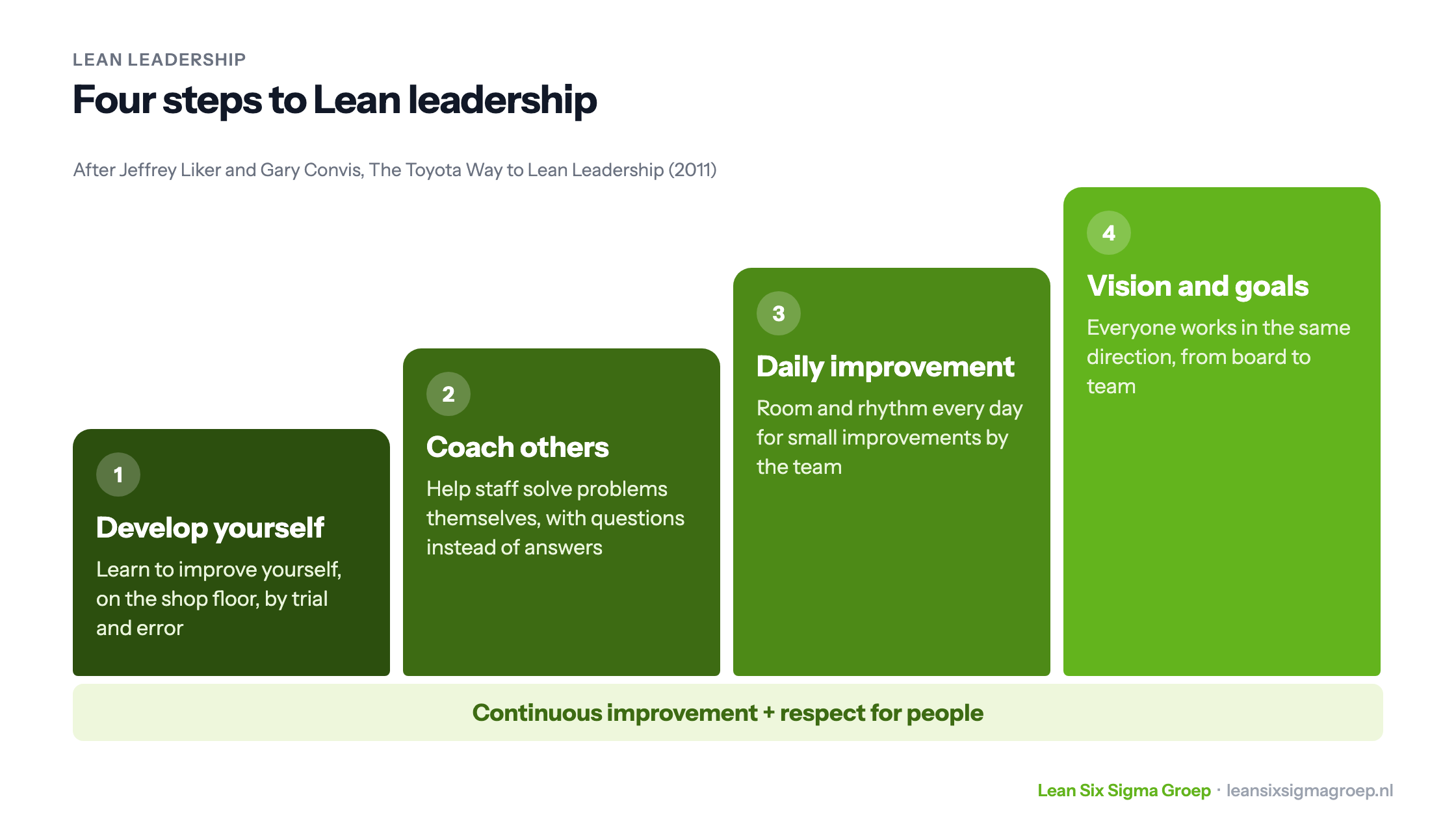
Jeffrey Liker and Gary Convis, who worked at Toyota for years, described in The Toyota Way to Lean Leadership (2011) how Toyota develops leaders. That happens in four steps, as shown in the image at the top of this article:
- Develop yourself. A Lean leader first learns to improve, on the shop floor, by trial and error. If you can’t do it yourself, you can’t coach it.
- Coach and develop others. The leader helps staff solve problems themselves, with questions instead of answers.
- Support daily improvement. The leader provides room and rhythm, so teams can make small improvements every day.
- Create vision and align goals. Everyone, from board to team, works in the same direction.
This is one of the tools you learn to apply in the Green Belt training.
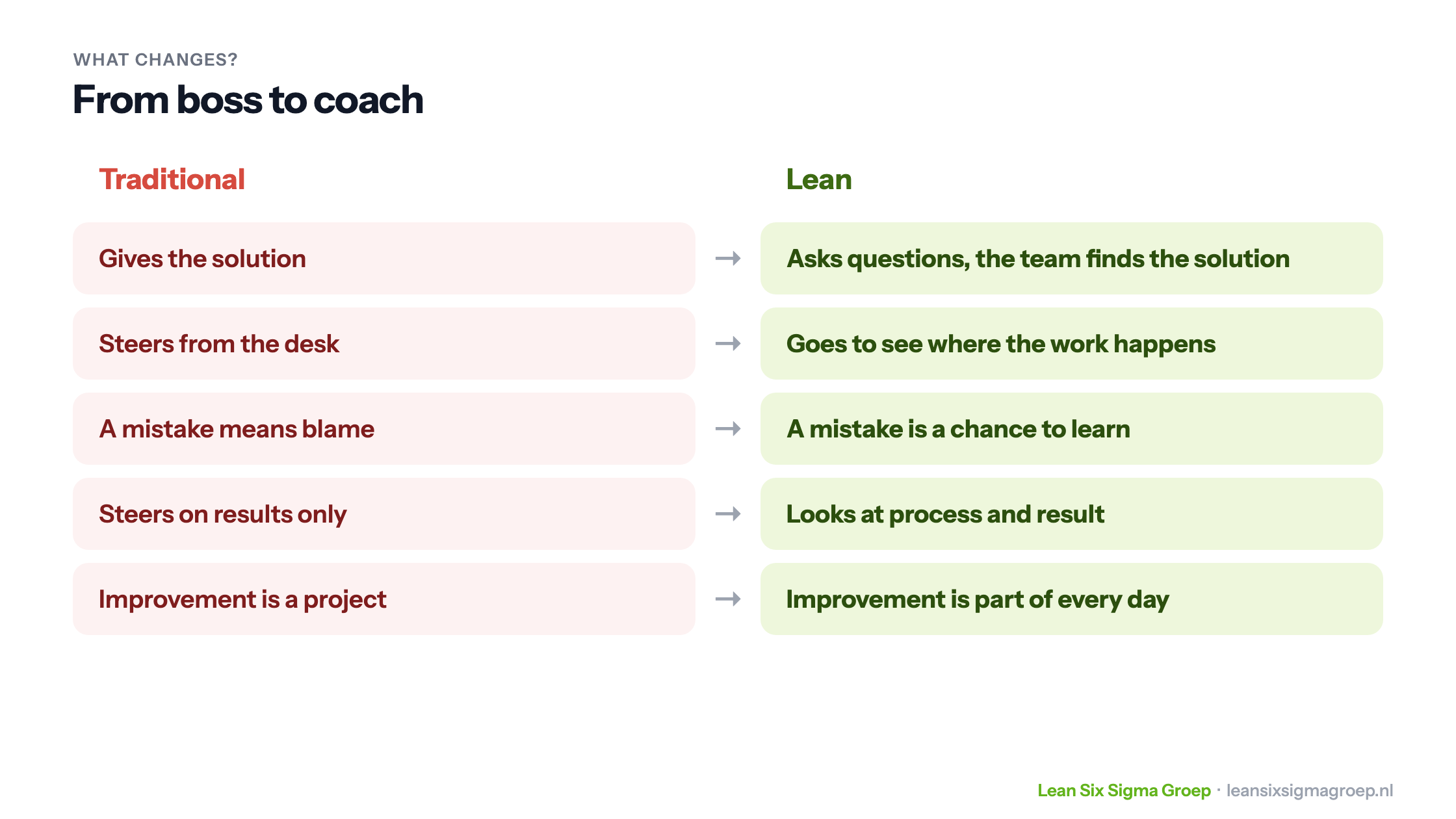
From boss to coach
For many managers this means a considerable change in how they work, as the overview above shows. The essence: a Lean leader is less the person with the answers, and more the person with the right questions.
Start with yourself
Want to know what your staff need to improve? Look at yourself first. What do you need to keep improving in your own work? Which obstacles need to go, and who do you expect to remove them? Chances are your staff feel the same.
Start the conversation
Ask your team which obstacles they see, and which they can’t remove themselves. That conversation isn’t always easy. Continuous improvement means mistakes may be reported, and that things sometimes go differently than agreed, even when that gets in the way of short-term goals. Yet that conversation is the first step towards servant leadership: leading by removing obstacles for your people. A Gemba walk, going to see where the work happens, is a powerful tool for this.
Coach with Kata
Mike Rother described in Toyota Kata how Toyota managers practise this coaching every day. The employee works step by step towards a goal with the Improvement Kata; the manager asks five fixed questions with the Coaching Kata, such as “What is the next obstacle?” and “What is your next step?”. Read more in the article on Kata.
An improvement culture belongs to the whole organisation
Continuous improvement is not the business of one team. It only works when the whole organisation lives it, from team leader to director. That requires every manager to look at their own behaviour, at what the organisation’s strategy and culture encourage or hold back, and at what they still have to learn. How to match your style to what an employee needs is covered in situational leadership.
Are you a manager in an organisation that works, or is starting to work, with Lean, Lean Six Sigma or Scrum, and do you want to take focused steps towards a culture of continuous improvement? We offer Lean leadership programmes, also in-company. Contact us.