Operational Excellence means excelling in execution: delivering products or services reliably, quickly and at the lowest possible cost, day after day. It is not a single method or project, but a way of working in which the whole organisation keeps improving.
One of three value disciplines
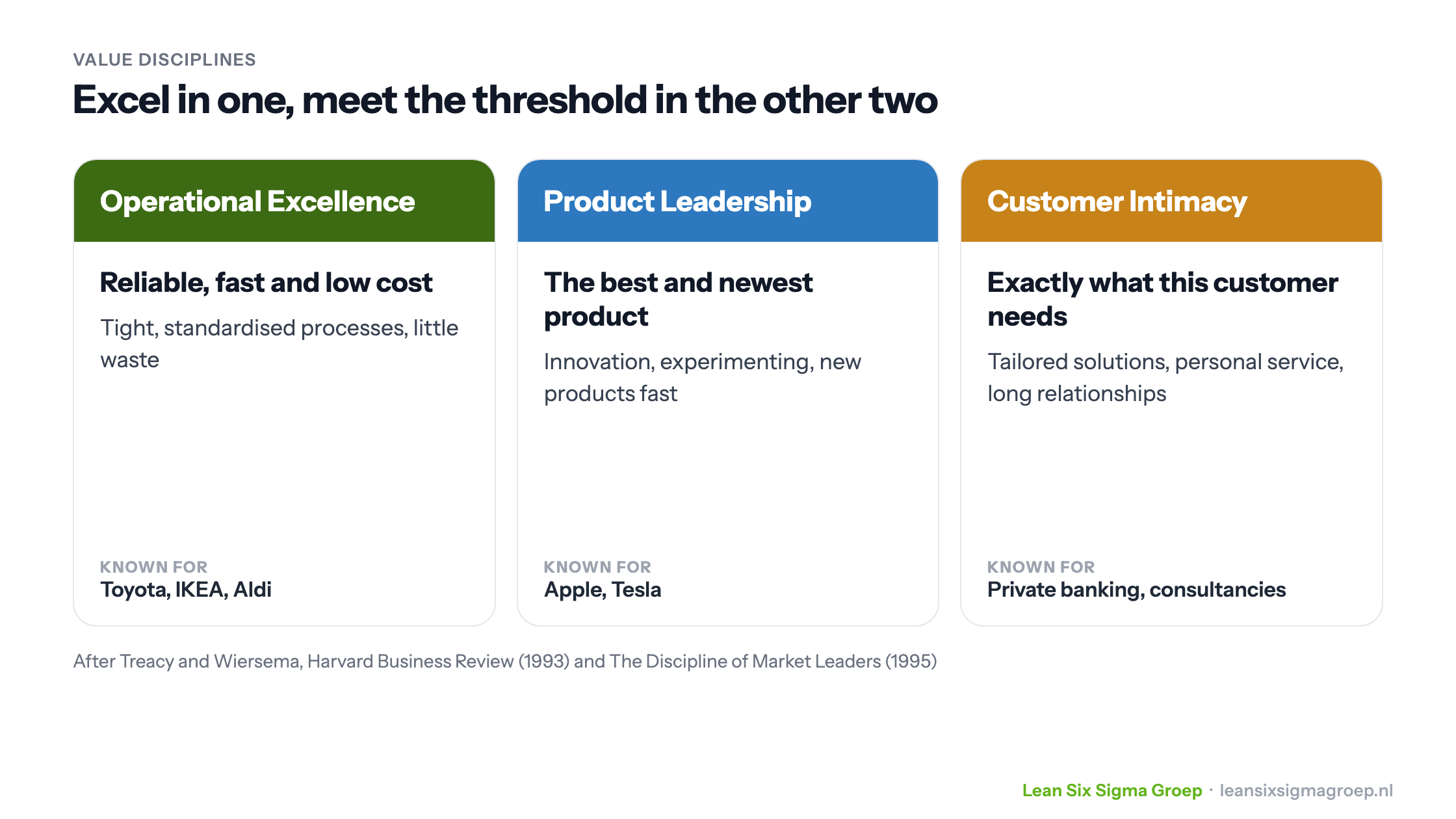
The term became well known through Michael Treacy and Fred Wiersema. In their article Customer Intimacy and Other Value Disciplines in Harvard Business Review (1993) and their book The Discipline of Market Leaders (1995), they distinguish three ways in which a company can lead its market. They are shown in the image at the top of this article:
- Operational Excellence: the customer gets reliable quality at a low price, without hassle. Think of Toyota, IKEA or a discounter such as Aldi.
- Product Leadership: the customer gets the best and newest product. Innovation and speed of development come first.
- Customer Intimacy: the customer gets exactly what they need, with tailored solutions, personal service and a long relationship.
According to Treacy and Wiersema, successful companies choose one to excel in, and make sure they meet the threshold on the other two: good enough not to lose customers. Trying to be a bit good at everything means excelling at nothing.
A company that chooses Operational Excellence continuously optimises its value streams, standardises its processes and builds a culture in which waste keeps shrinking. Exactly the principles of Lean and Six Sigma.
The roots: Juran and quality thinking
The thinking behind Operational Excellence is older than the term. Joseph Juran (1904-2008) was, like W. Edwards Deming, one of the founders of modern quality thinking. Both taught in Japan from the 1950s, where their ideas contributed to the quality revolution in Japanese industry.
Juran introduced the Cost of Poor Quality (COPQ): everything an organisation loses because things don’t go right first time, such as rework, complaints, scrap and inspection. He also gave the Pareto principle its name: focus on the “vital few”, the few causes that create most of the problem.
Well known is the Juran Trilogy from 1986: quality requires planning, control and improvement.
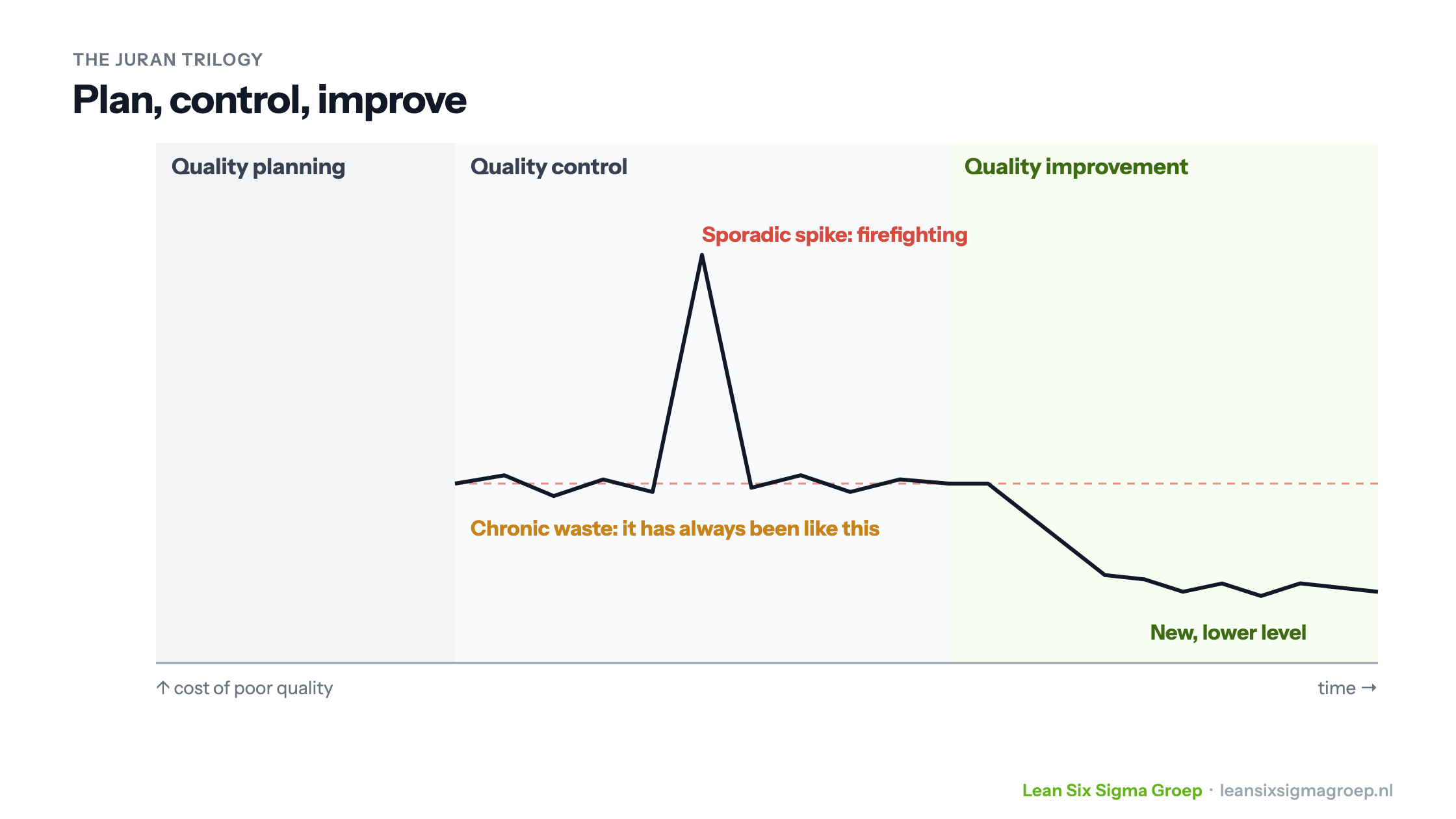
- Quality planning: designing processes and products so they meet the customer’s needs.
- Quality control: monitoring the process and stepping in at incidents, the spikes in the chart. That is firefighting.
- Quality improvement: tackling the chronic waste, the level everyone says “has always been like this”, and bringing the process to a new, lower level.
The difference between control and improvement is the core. Many organisations are good at firefighting, but leave chronic waste untouched. Operational Excellence focuses precisely on that.
Operational Excellence in practice
Operational Excellence takes more than a few improvement projects. It requires everyone in the organisation to take part, from the shop floor to the board. Some characteristics:
- Customer value comes first: not just a product that meets specifications, but a good customer experience.
- Standardised processes that everyone knows, for example captured in standard operating procedures.
- Continuous improvement as daily work, with the PDCA cycle and the methods of Lean Six Sigma.
- Strategy that reaches the shop floor, for example with Policy Deployment.
- Perseverance: the companies known for it have been doing it for decades. Operational Excellence is not a project with an end date.
Quality models such as EFQM help you determine where your organisation stands.
The video with this article shows how Operational Excellence focuses on improving processes, reducing waste and creating value for customers.
Want to learn how to tackle improvements in your organisation? Take a look at the Green Belt or Black Belt training course.
From theory to practice
Learn to apply this in practice
Topics like Operational Excellence are applied directly to an improvement project from your own organisation in the Green Belt training.
Next start dates
Lean Six Sigma Green Belt training →Not ready for a training yet?