
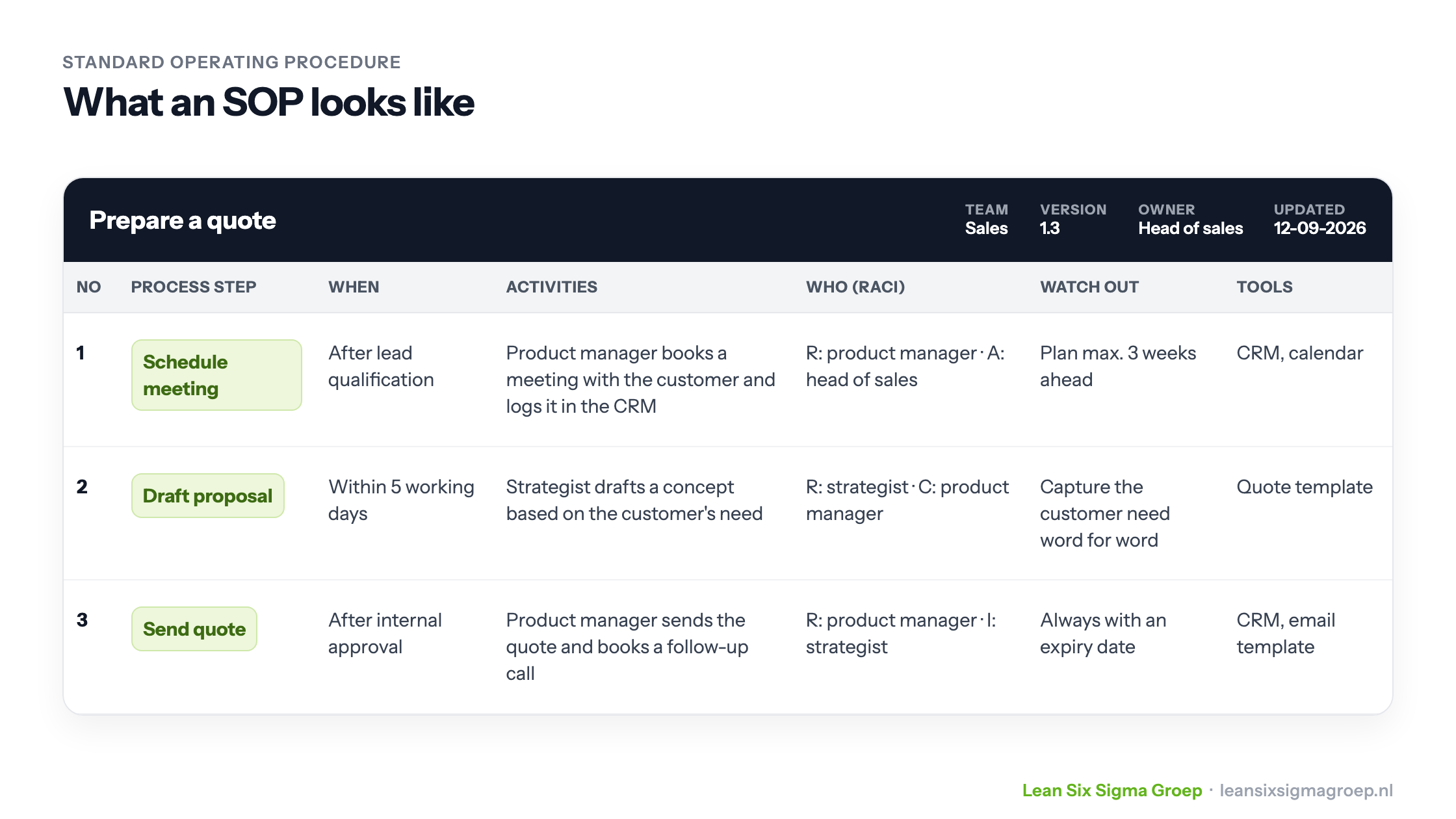
What is a Standard Operating Procedure (SOP)?
Anyone who has ever assembled an IKEA wardrobe knows how frustrating an unclear manual can be. You’re missing a screw, you don’t quite understand a step, and in the end the wardrobe is crooked. That is exactly what a poor SOP can cause in an organisation: confusion, errors and inefficiency.
An SOP is essentially a manual for a process. It is a document that describes, step by step, how a task should be carried out, so that everyone in a team or organisation works the same way. A well-written SOP is clear, to the point and easy to follow.
It stops employees from reinventing the wheel every time and makes an organisation more stable and more efficient.
But an SOP is not a static document that disappears into a folder somewhere. On the contrary, within Lean it is a living document that is continuously improved and adapted to changing circumstances.
Why are SOPs indispensable in a Lean organisation?
In a Lean environment, everything revolves around eliminating waste and maximising value for the customer. When tasks and processes are carried out inconsistently, the result is errors, delays and unnecessary costs. SOPs help reduce this variation and standardise work processes.
Think of a production line where one operator sets up a machine slightly differently from another. That can mean a batch of products fails to meet the quality standards. By implementing an SOP that describes exactly how the machine should be set up, this problem can be prevented.
SOPs are also essential for training new employees. Instead of an experienced colleague having to explain everything again and again, new team members can get started on their own with a well-written SOP. This not only saves time, it also helps new employees become productive faster.
And what if something still goes wrong? Then an SOP provides a point of reference. When a process doesn’t run as planned, a Green Belt can analyse where the deviation lies and make improvements based on that.
The crucial role of a Green Belt in SOPs
A Lean Six Sigma Green Belt is the specialist who helps organisations achieve process improvements. And one of the most powerful ways to do that is by developing and implementing effective SOPs.
Imagine a hospital that wants to improve how it dispenses medication. Patients complain that medication is sometimes given too late, while nurses complain about unclear instructions. A Green Belt can put the SOPs under the microscope here.
By carrying out process mapping and a root cause analysis, he or she can pinpoint where the bottlenecks are and how the standard way of working can be improved.
But an SOP alone is not enough. The implementation matters at least as much. People don’t always like change, and imposing new ways of working can provoke resistance.
A Green Belt knows how to guide teams and involve employees in the change, so that the new way of working is genuinely accepted and applied.
A good example can be found in the food industry, where strict hygiene protocols apply. When a factory introduces a new way of working, a Green Belt has to make sure employees genuinely understand and apply it. That can be done through training, workshops and clear communication.
SOPs as a dynamic tool for continuous improvement
SOPs are not documents you write once and then put away in a drawer. Within Lean they are a dynamic tool for continuous improvement. A good example is the PDCA cycle (Plan-Do-Check-Act), in which processes are regularly evaluated and improved.
A Green Belt keeps an eye on how an SOP performs and gathers feedback from employees. Is an SOP not working as expected? Then it’s time to make adjustments.
At a large logistics company, for example, it turned out that an SOP for order picking was far from optimal. Warehouse staff found the instructions unclear and therefore carried out tasks in different ways. By carrying out observations and interviews, the Green Belt was able to make improvements, which ultimately led to shorter lead times and fewer errors.
This shows how a Green Belt not only helps draw up SOPs, but also ensures their ongoing optimisation.
Want to learn how to use SOPs for Lean success?
SOPs are the backbone of a well-functioning Lean organisation. They ensure consistency, efficiency and quality assurance. But writing a good SOP is a craft in itself, and the real challenge lies in implementing and improving it.
That is why the role of a Green Belt is so important. As an expert in Lean and Six Sigma methods, a Green Belt helps organisations draw up, implement and continuously improve SOPs.
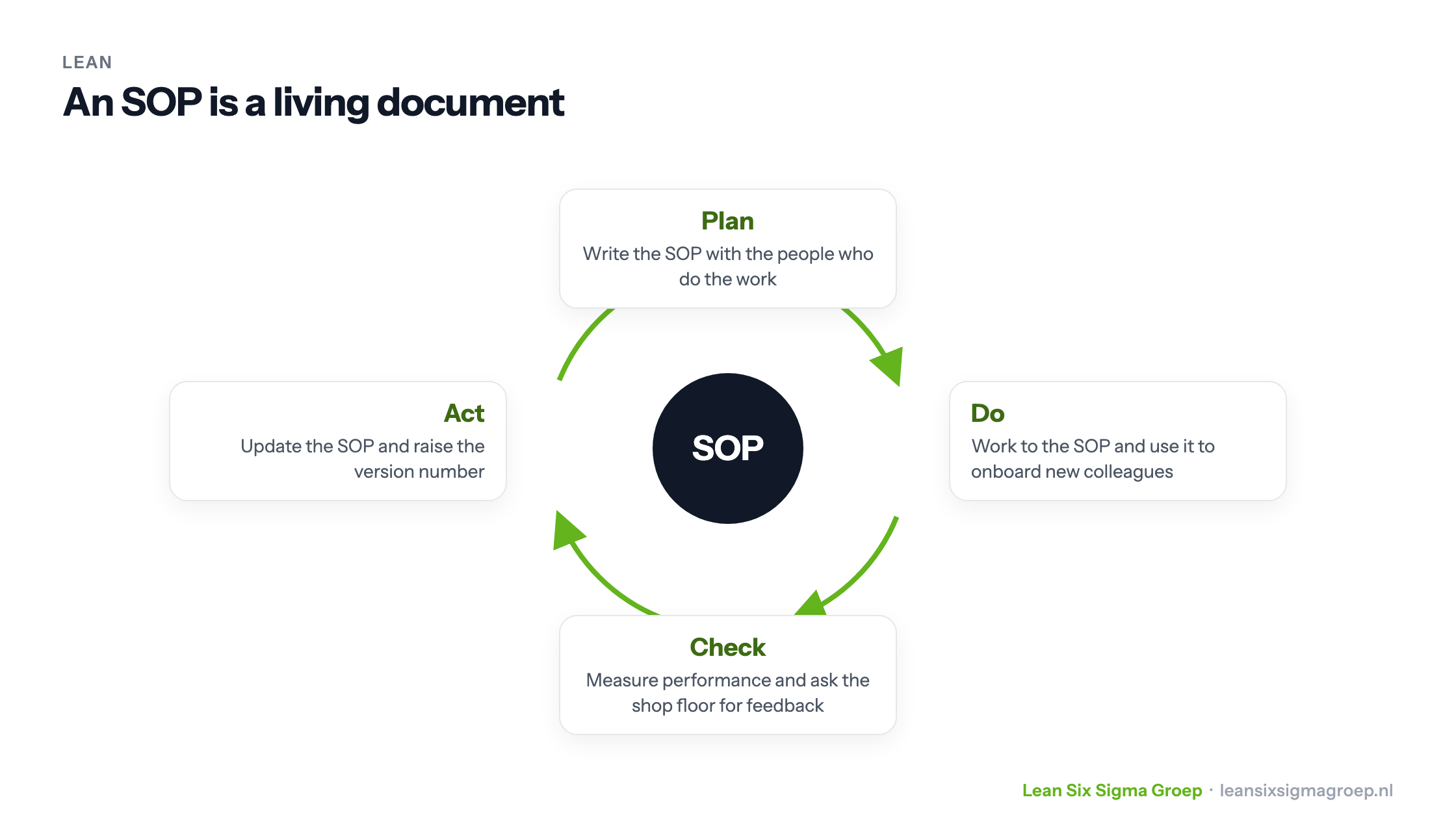
Want to learn how to do this yourself? In our Green Belt training you’ll discover how to use SOPs as a powerful Lean tool. During the training we cover SOPs in the Improve and Control phases of the DMAIC methodology.