Quality management is everything an organisation does to make sure its products and services consistently do what the customer expects. It is not a department or a certificate, but a way of working: knowing what the customer wants, designing the process for it, monitoring it and continually improving it. Lean Six Sigma is one of the most powerful ways to do the last part.
What is quality?
Quality is not “as good as possible”, but “as the customer needs it”. Joseph Juran called it fitness for use, Philip Crosby conformance to requirements. A simple quote that arrives within a day can mean more quality to a customer than a beautiful report that takes three weeks. That is why quality management always starts with the customer.
Juran’s quality trilogy
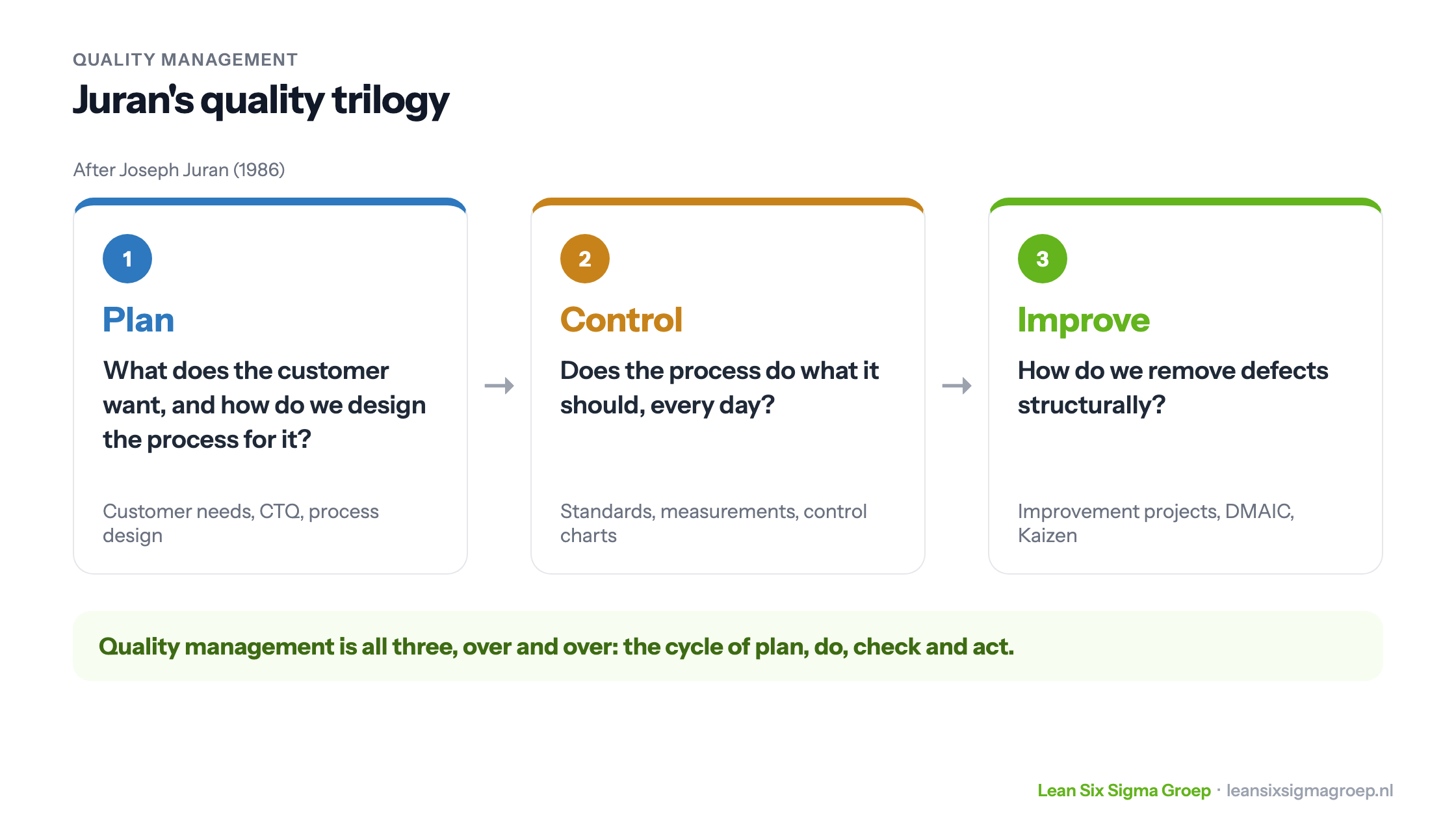
Juran divided quality management into three activities, as shown in the image at the top of this article:
- Quality planning: finding out what the customer wants, and designing products and processes accordingly.
- Quality control: making sure the process does what it should every day, with agreements, standards and measurements. Deviations are noticed and corrected.
- Quality improvement: tackling recurring defects structurally, so the process reaches a higher level.
The three belong together. Without control every improvement fades away, and without improvement control just maintains a mediocre process. The underlying cycle is PDCA: plan, do, check and act.
Quality control, quality assurance and quality management
- Quality control looks at the result: is this product good? A defect is only found once it has been made.
- Quality assurance looks at the process: have we set up the agreements and ways of working so that things go right?
- Quality management covers both, plus improvement and direction from leadership.
The further forward you get in that sequence, the cheaper quality becomes. Preventing a defect costs less than finding it, and finding it costs less than fixing it at the customer.
ISO 9001 and the seven principles
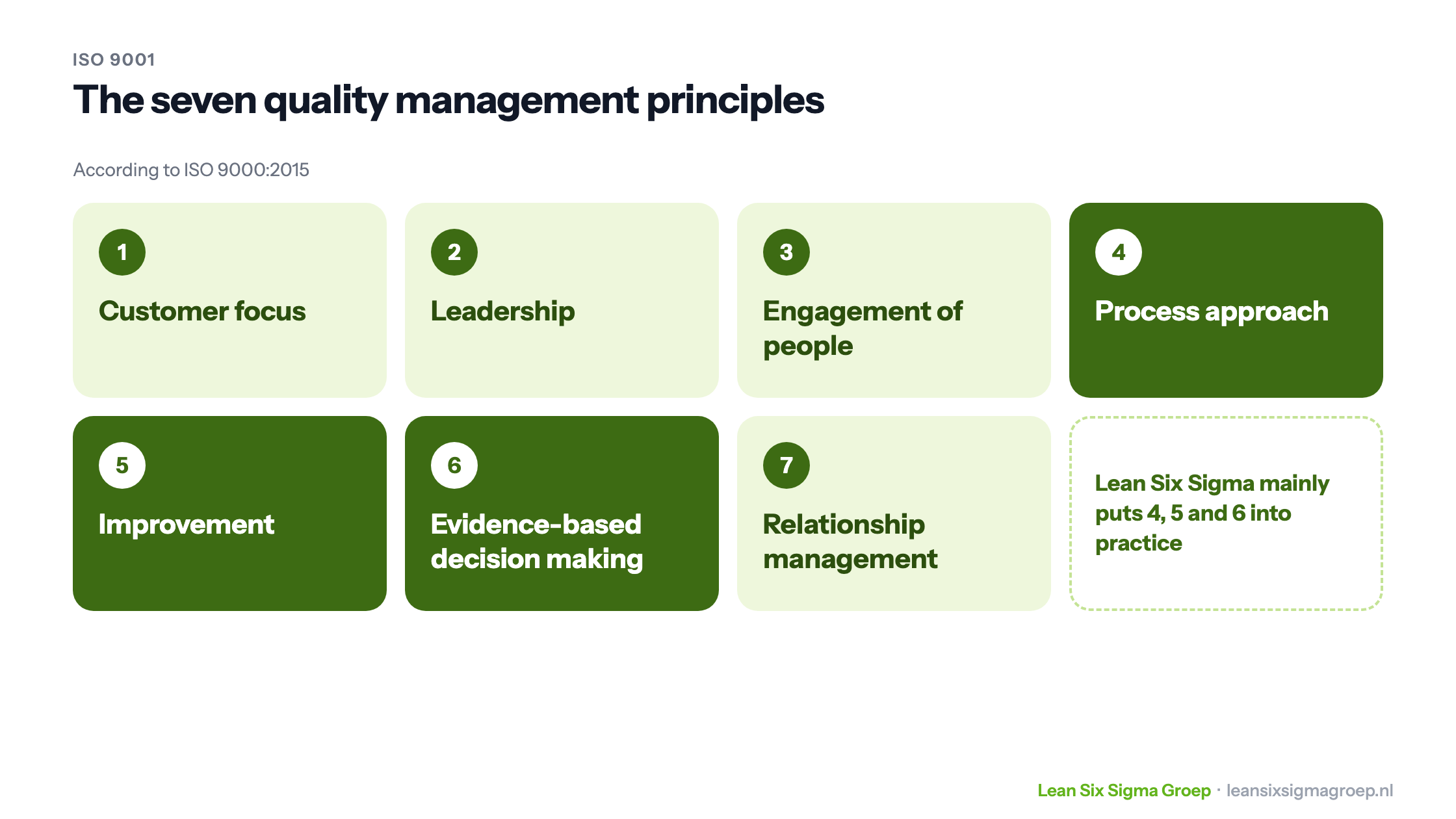
The best-known standard for quality management is ISO 9001. It rests on seven principles, described in ISO 9000, shown below.
An ISO 9001 certificate shows that an organisation has its quality management in order. But a certificate is not a goal in itself. Organisations that only work for the audit often have thick manuals and little improvement. Other models for organisation-wide quality are Total Quality Management (TQM) and the EFQM model.
What Lean Six Sigma contributes
Lean Six Sigma mainly puts three of those principles into practice: the process approach, improvement and evidence-based decision making.
- Improving with a fixed approach. DMAIC structures improvement projects: first the problem and the customer, then measurement, then the cause, and only then the solution.
- Measuring instead of guessing. With data, process capability and control charts you see whether a process is stable and meets the requirements.
- Preventing defects. With an FMEA you identify in advance what can go wrong, and with poka-yoke you make mistakes impossible.
- Removing waste. Lean shows which work adds no value, so quality doesn’t have to become more expensive.
- Better every day. With Kaizen and daily stand-ups, improvement becomes part of normal work.
Black Belts and Green Belts are the people who lead improvement projects and teach others to improve. That way quality management is not a paper system, but something that happens on the shop floor every day. Together this leads to operational excellence.
Want to learn how to make quality measurable and improve it? Take a look at the Green Belt or Black Belt course.