Publicatie
Balanced Scorecard
The Balanced Scorecard is a strategic management tool that measures performance on financial and non-financial indicators to achieve and improve organisational goals.
 Krijn VrolijkBlack Belt Consultant
Published 6 min read
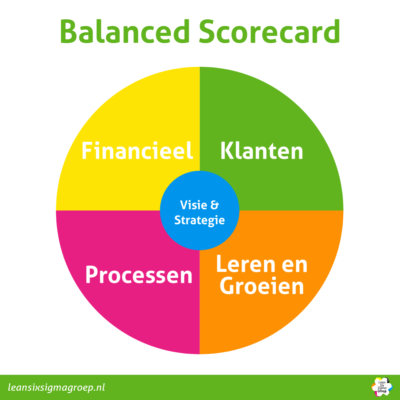
Four perspectives for a broad view
The (Business) Balanced Scorecard (BBSC) works with four perspectives, which are translated into KPIs, key performance indicators. These perspectives are:
1. Financial
The financial perspective focuses on the objectives and KPIs related to profitability, cost control and ROI. This perspective is crucial for assessing and improving the financial health of the organisation.
| Objectives | KPIs | Examples | Tips |
|---|---|---|---|
| Increase profitability | Revenue growth, profit margin, ROA, ROI | Raise the profit margin by 5% within two years. | Set realistic objectives that are in line with the overall strategy of the organisation. |
| Control costs | Cost reduction, debtor management, inventory management | Cut costs by 10% through efficiency improvements. | Choose KPIs that are relevant and that measure progress towards the objectives. |
| Optimise ROI | Implement activity-based costing to optimise the cost structure. | Use benchmarking to compare performance with other organisations in the same sector. |
2. Customer
The customer perspective focuses on improving customer satisfaction, loyalty and market share. This perspective is crucial for understanding what customers want and how to keep them.
| Objectives | KPIs | Examples | Tips |
|---|---|---|---|
| Increase customer satisfaction | Customer satisfaction, NPS (Net Promoter Score) | Raise customer satisfaction from 80% to 90% within one year. | Carry out regular customer satisfaction surveys to measure what customers think of your products or services. |
| Build loyalty | Churn rate (customer attrition), market share | Reduce the churn rate by 5% through better customer service. | Build a customer-focused culture within the organisation. |
| Grow market share | Complaint rate, repeat purchases | Develop a customer loyalty programme to encourage repeat purchases. | Offer excellent customer service to keep customers. |
3. Internal processes
The process perspective focuses on optimising internal processes for efficiency, effectiveness and quality. This perspective is crucial for eliminating waste and raising productivity.
| Objectives | KPIs | Examples | Tips |
|---|---|---|---|
| Increase efficiency | Lead time, error rate | Shorten the lead time of a process by 20%. | Identify bottlenecks in processes and eliminate them. |
| Optimise effectiveness | Productivity, process costs | Reduce the error rate by 50% through quality improvement. | Use process mapping to visualise and analyse processes. |
| Improve quality | Compliance with standards | Implement Lean Six Sigma to optimise processes. | Invest in training for employees to improve their skills. |
4. Learning and growth
The “Learning and growth” perspective focuses on developing employee skills, innovation and culture change. This perspective is crucial for equipping the organisation for the future. By investing in employees and encouraging a culture of continuous improvement, the organisation can adapt to changing circumstances and stay competitive.
| Objectives | KPIs | Examples | Tips |
|---|---|---|---|
| Increase employee satisfaction | Employee satisfaction, training hours | Raise employee satisfaction from 75% to 85% within one year. | Create a learning environment in which employees can develop. |
| Encourage innovation | Innovation rate (number of new ideas, patents), implementation of a suggestion scheme | Double the number of innovations per year. | Encourage innovation by rewarding employees for new ideas. |
| Achieve culture change | Absenteeism, employee turnover | Implement a culture of continuous improvement in which employees are encouraged to give feedback and contribute ideas for process improvements. | Invest in training and coaching to help employees develop their skills. |
This is one of the tools you learn to apply in the Green Belt training.
Combining the perspectives prevents navel-gazing and one-sided steering. A basic example: if an organisation steers on customer satisfaction alone, prices (after all an important KPI or CTQ from the customer’s point of view) for products or services could be kept so low that it comes at the expense of the business result. The other way round, whatever people may have thought in the 1980s, not everything revolves around money alone.
Four implementation steps, from making concrete to evaluating
Implementing the Balanced Scorecard takes four steps:
- Make the vision and strategy concrete
A vision gives direction: it tells you where the organisation wants to be in three or five years. Both vision and strategy are often abstract. The strategy map is a tool for visualising vision and strategy. We make vision and strategy concrete by translating the perspectives into KPIs, as described above. Looking in all four directions keeps these KPIs broad and makes clear how the strategy is to be achieved. This can be a combination of process KPIs and improvement KPIs. In some organisations you see the BBSC laid out with process KPIs in the top section and, underneath, improvement KPIs whenever a process KPI turned red. That helped to define and scope improvements.
- Communicate
What applies to vision and strategy also applies to the objectives linked to them: you cannot communicate about them often enough. Objectives are also linked to individual performance, so that every layer and every level of the organisation is working on them. Cascading them down to the different layers of the organisation is part of this too. You then see several BBSCs emerge, with regular meetings to check whether everyone is still on course.
- Plan and make measurable
Objectives come with deliverables and deadlines. And those in turn find their way into a plan. Planning is a discipline in its own right and we will not cover it in this article. For now it is enough to say that a realistic plan helps you to adjust course in time.
- Evaluate
The Balanced Scorecard is anything but an Excel file cast in concrete. On the one hand, vision and strategy are subject to change and development, which calls for flexibility. On the other hand, the Balanced Scorecard is rarely right first time, however much we want it to be and however hard we try. Evaluation helps to improve the Balanced Scorecard continuously, and so does discussing it regularly. In that sense the BBSC resembles an Obeya programme, or it can support one.
The advantages & disadvantages of the Balanced Scorecard
The Balanced Scorecard offers a wide range of advantages to organisations that implement the method. Some of the main advantages and disadvantages are:
| Advantages |
|
|---|---|
| Disadvantages |
|
Tips for a successful implementation:
- Make sure top management is strongly committed.
- Invest in training and coaching to help employees understand and use the BSC.
- Make the BSC relevant and practical for the organisation.
- Monitor and evaluate the BSC continuously.
- Be flexible and willing to adapt the BSC to the changing needs of the organisation.
Synergy with Lean Six Sigma
The Balanced Scorecard can be combined with Lean Six Sigma, another powerful management method that focuses on optimising processes and eliminating waste. The BSC can set the strategic context and the objectives for Lean Six Sigma projects, while Lean Six Sigma supplies the tools and techniques to optimise the processes and improve performance.
Conclusion
The Balanced Scorecard is a valuable tool that can help organisations implement their strategy, improve their performance and engage their employees. By maximising the advantages and minimising the disadvantages, the BSC can make a valuable contribution to the success of the organisation.
Want to know more about the Balanced Scorecard and the Lean and Six Sigma techniques you can plot on it? We are happy to tell you in which of our training courses we go into this in depth. You can contact us at [email protected] or 088 53 26 700.
From theory to practice
Learn to apply this in practice
Topics like Balanced Scorecard are applied directly to an improvement project from your own organisation in the Green Belt training.
Next start dates · Lean Six Sigma Green Belt training
Not ready for a training yet? Or .