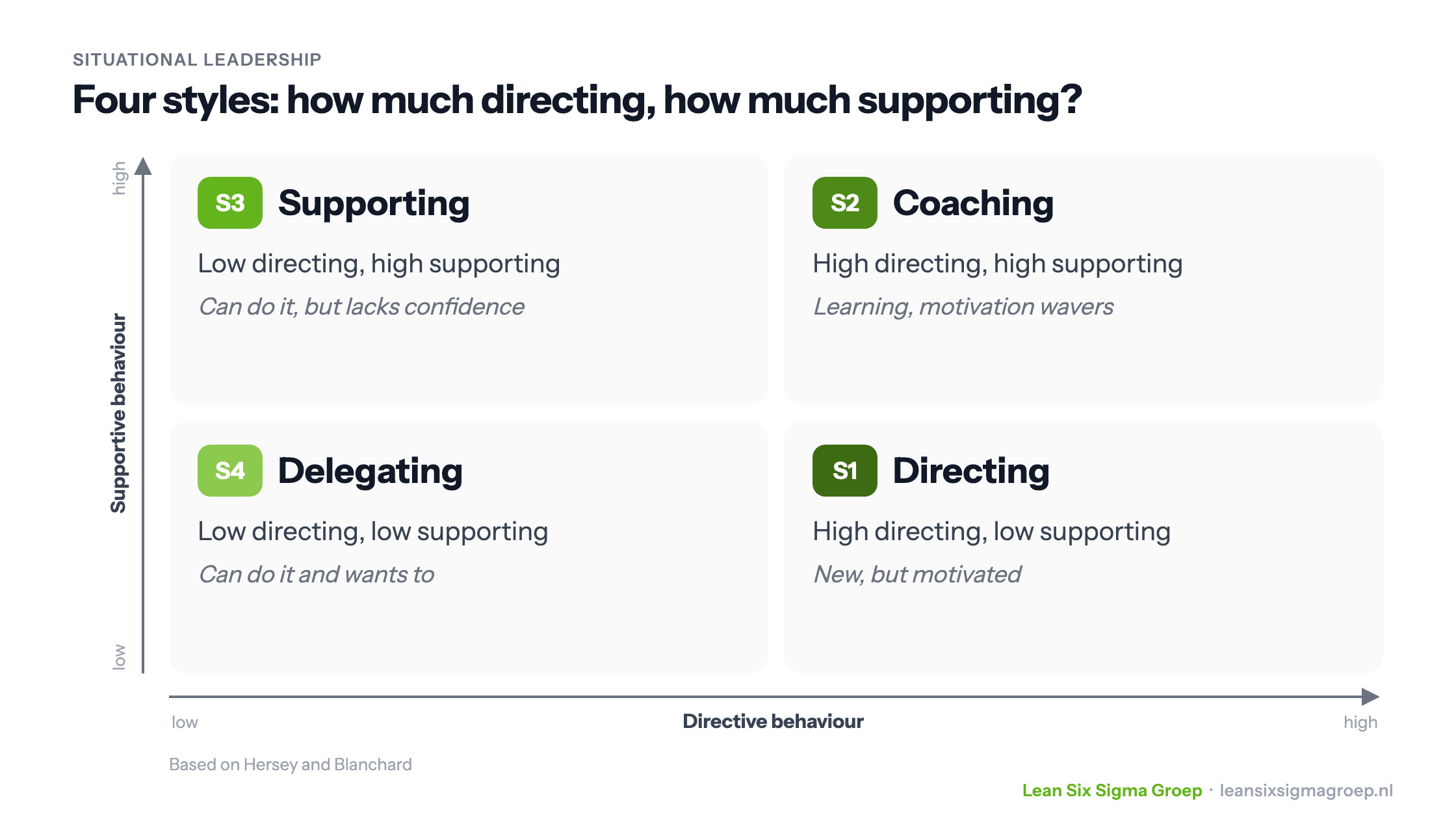
Situational leadership means adapting your leadership style to the situation: to the task, and above all to how competent and committed the employee or team is for that task. There is no single best style. The art is to see which style helps most at which moment.
Directing and supporting
The model comes from Paul Hersey and Ken Blanchard, who developed it in the late 1960s. It is based on two kinds of leader behaviour:
- Directive behaviour: setting boundaries, making clear what is expected of employees and when they do their job well, and checking that agreements are kept.
- Supportive behaviour: listening, encouraging and helping employees, with open questions, to work out for themselves how best to do their job.
Combining more and less of each gives four styles, shown in the image at the top of this article:
- S1 Directing: high directing, low supporting. Suits someone who is new to a task, but motivated.
- S2 Coaching: high directing and high supporting. Suits someone who is learning, and whose motivation sometimes wavers.
- S3 Supporting: low directing, high supporting. Suits someone who masters the task, but still lacks confidence.
- S4 Delegating: low directing, low supporting. Suits someone who can and wants to.
The same employee may need S4 for one task and S1 for a new task. So situational leadership works per task, not per person.
Tuckman’s team stages
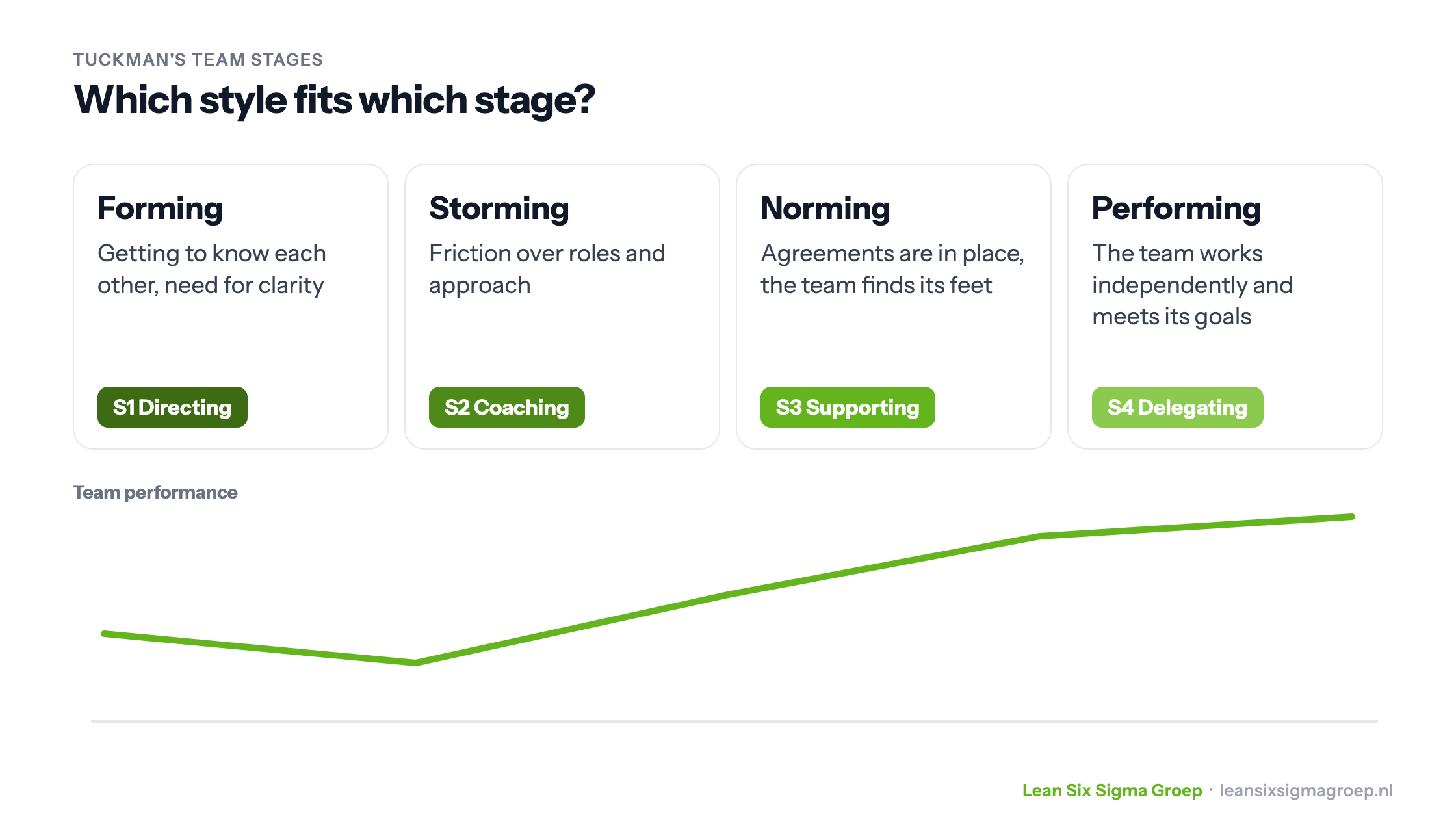
For teams, Bruce Tuckman’s 1965 model helps. He described four stages a team goes through. Each stage calls for a different style.
This is one of the tools you learn to apply in the Green Belt training.
Stage 1: Forming
The team has just been formed. People get to know each other and the task, and there is a need for clarity: what is the goal, who does what? Directing (S1) works best here.
Stage 2: Storming
The goal is clear, but relationships are not yet. Friction arises over roles and approach, and performance lags. Both direction and support are needed here: coaching (S2).
Stage 3: Norming
Agreements have been made on how the team reaches its goals, and the team finds its feet. Less direction is needed; supporting (S3) is enough.
Stage 4: Performing
The team works independently and meets its goals. The leader can delegate (S4). Remarkably, many leaders find this the hardest, perhaps because they start to doubt their own added value. A little steering and support remains welcome, of course.
In practice
Theory is easier than practice: it isn’t always clear what stage a team is in, and so which style fits. A gemba walk helps: go to the shop floor, look and listen, talk to people and sense the atmosphere. Be open, honest and curious.
An example: a mediator talked to the members of a team that had been stuck in the storming stage for years. She found that there had been too little direction from the start. People didn’t really know each other, which led to distrust, and roles and tasks had never been clearly agreed. Her advice to the manager: deliberately step back to the forming stage and start directing again (S1). That helped the team, not without struggle, finally get through the storming stage. Goals were met and employee satisfaction rose.
Want to know more about situational leadership, Tuckman’s model or the gemba walk? We’ll gladly tell you which training course covers this in depth. Contact us at [email protected] or +31 88 53 26 700.