Process optimisation is the ongoing improvement of processes so they work more effectively and efficiently: more value for the customer, with less time, cost and error. It is not a one-off project, but a continuous cycle of improvement.
What is a process?
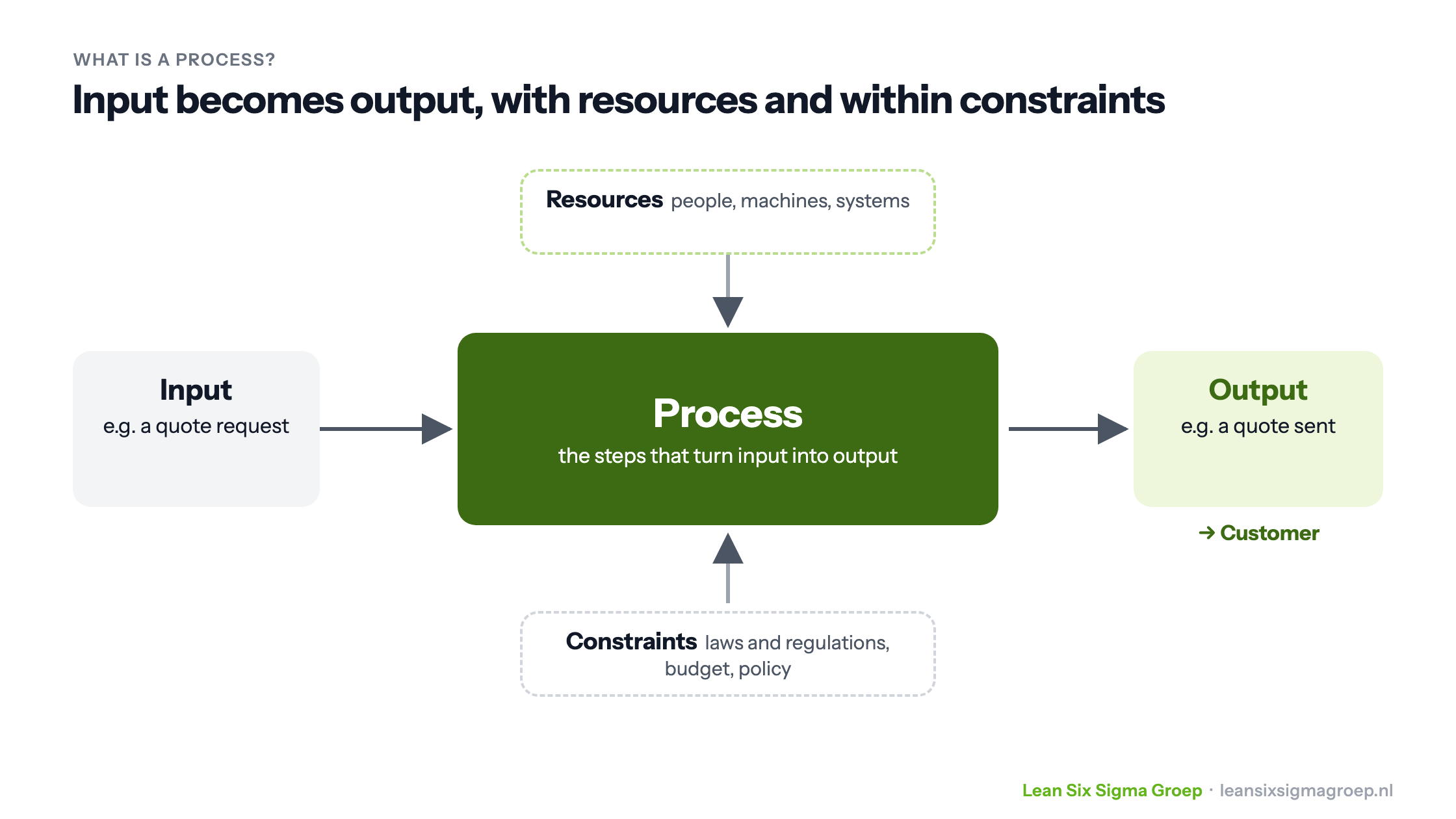
Trainer Krijn Vrolijk often starts his courses by asking: what is a process? The answers always come down to the same thing, shown in the image at the top of this article. A process has input and output, and in between a lot happens to turn the input into output. That requires resources, such as people and machines. And every process is subject to constraints, such as laws and regulations. Read more about what processes are and how an organisation structures them in business processes.
What is optimising?
Optimising means doing something as well as possible, or, as many professionals put it: as effectively and efficiently as possible. It doesn’t have to be perfect straight away. Every small improvement that brings you closer to the ideal situation counts. So optimising is a continuous process that is never really finished.
Process optimisation in six steps
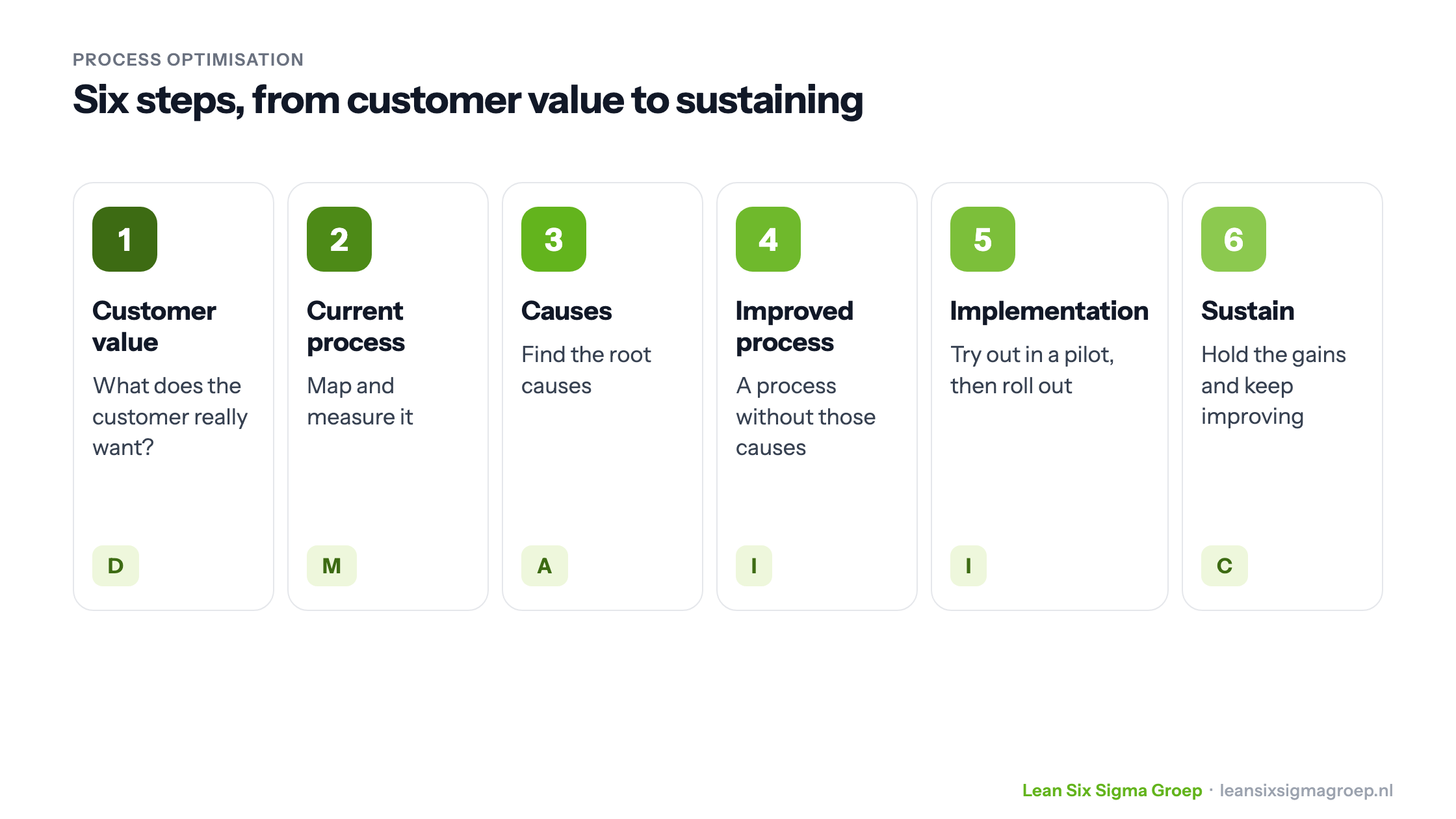
Methods differ, but broadly speaking process optimisation comes down to six steps. They largely follow the DMAIC cycle of Lean Six Sigma.
Step 1: Customer value
To put the customer first, you need to know what the customer wants, and what they are willing to pay for. The best way to find out is simply to ask, in a conversation or with a survey. That often produces surprising insights. At a large insurer, for example, it turned out customers read only one paragraph of quotes that were twenty pages long. With shorter quotes the insurer spent much less time, and customers were more satisfied too.
Step 2: The current process
Map the current process, together with the people who work in it, as it really runs, not as it should. Also measure what matters to the customer, such as speed and quality. Such a baseline measurement is often confronting: it is not unusual for much of the work to fall short of what the customer asks. That is a shock, but it also provides the urgency to change.
Step 3: Causes
Use data analysis, brainstorming and process analysis to look for the root causes. Importantly: the process fails, not the people. At first you will find many possible causes; the art is to keep the most important ones. Keep asking and don’t settle for a cause too quickly.
Also look for waste: work that takes time but adds no value. Its eight forms are summarised in TIM WOODS: transport, inventory, motion, waiting, overprocessing, overproduction, defects and unused skills.
Step 4: The improved process
Aspiring improvers often ask trainers how to improve a process fastest and best. The answer is as simple as it is sobering: “By abolishing it.” That is only half a joke. The best improvement is often not a faster step, but a step that is no longer needed at all.
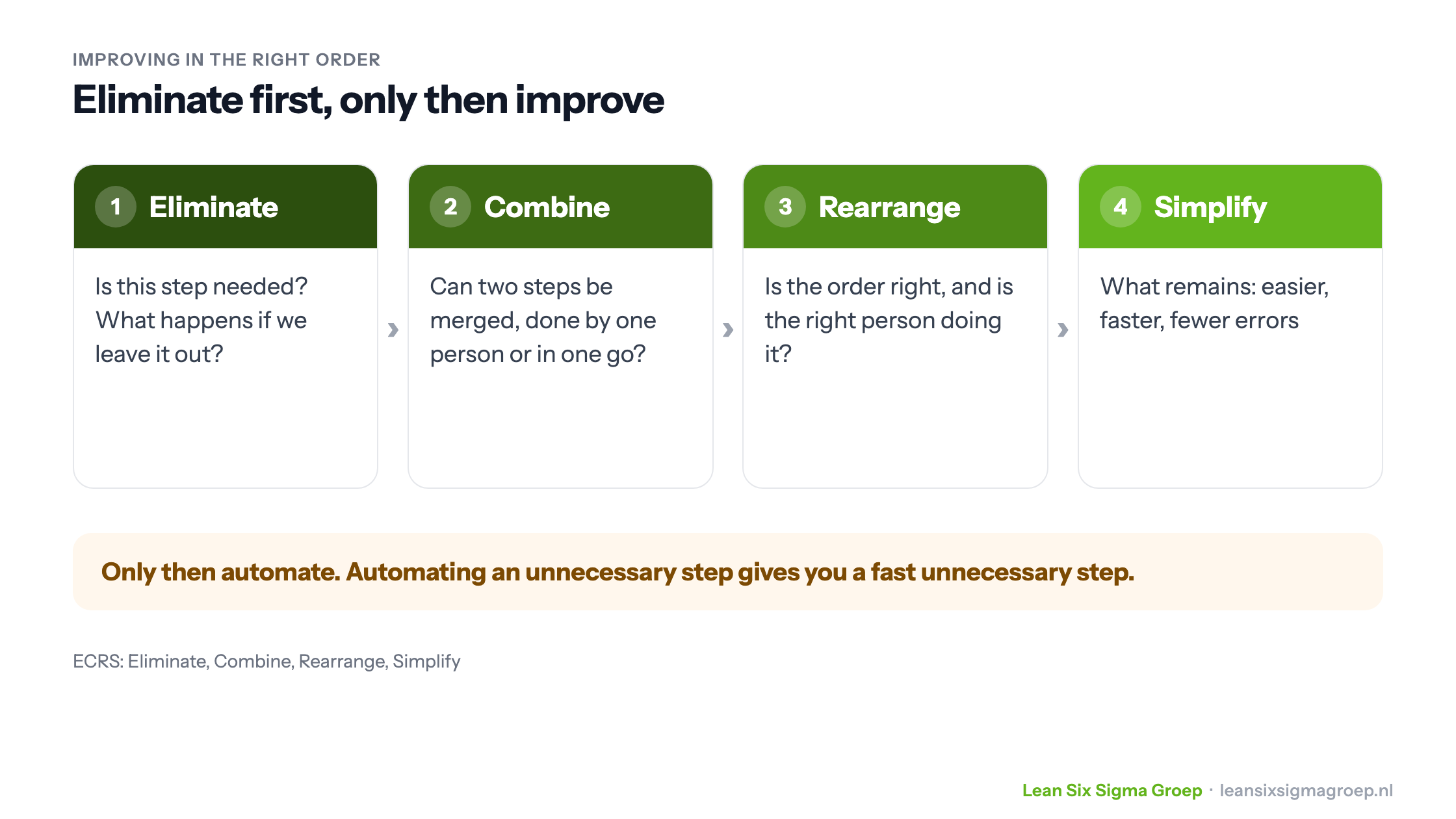
So design the new process in a fixed order, as shown below. First eliminate what adds no value. Then combine steps, put them in a better order and simplify them. And automate only last: automating an unnecessary step just gives you a fast unnecessary step.
An example: in one department six people read every (largely standard) letter, to add their own touch. At the end the text had hardly changed, and the content not at all. Why not trust the writer, with just a peer check for spelling and major blunders? That saves five rounds of waiting, and the writer feels responsible for their own work.
Make the new process visible, in the same way as the current process in step 2.
Step 5: Implementation
Thinking up improvements is not enough: you have to carry them out. With a pilot you test whether and how the improvements work in practice, and you bring employees along in the new way of working in a safe, small-scale way. Then you roll the improvement out more widely.
Expect this to be the hard part. The technique is often learned quickly; the real challenge lies in everything around it: communication, collaboration and dealing with resistance. People are attached to the way they work, even to steps nobody remembers the reason for. So involve them from the start.
Step 6: Sustain
Changes are like New Year’s resolutions: if you are not careful, after a few months everything is back to the old way. Record the new way of working, keep measuring, and make sure the team looks every day for ways to do the work a little better. A daily stand-up is a good tool for that.
Methods and tools
Many methods and tools are available for process optimisation. Lean, Six Sigma and Agile are widely used methods, each with its own toolbox. Our knowledge base explains many of those tools.
Ready to apply process optimisation yourself? In the Green Belt training course you get a toolbox full of tools to help a team, department or organisation take a big step forward. Those tools work in any organisation, now and in your next job.