
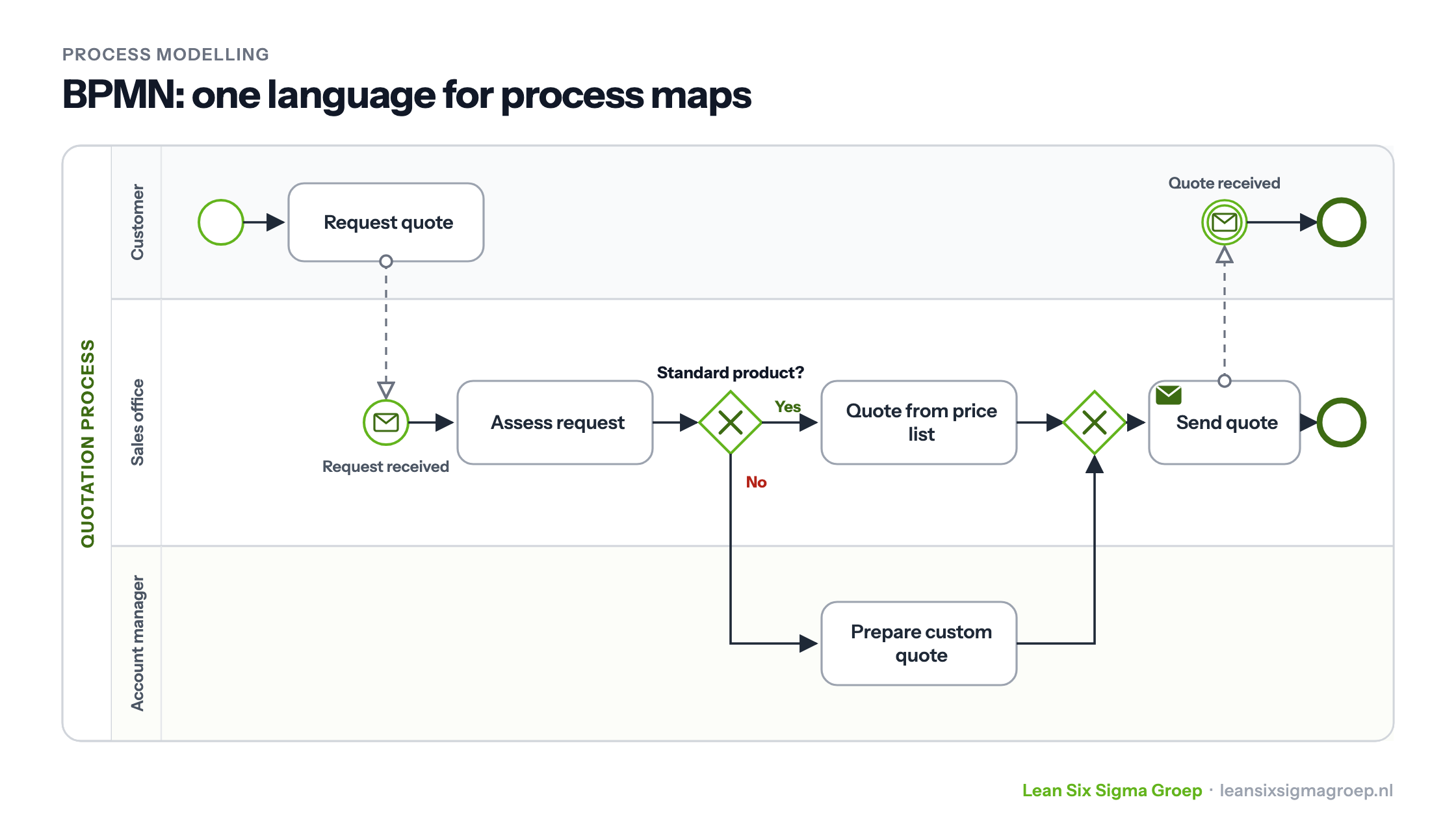
Business Process Model and Notation (BPMN) is a graphical notation for specifying business processes in a business process model. The aim of the method is to make it easy to communicate about business processes.
How do you capture a process properly? The traditional approach is the most obvious one. Using a handful of symbols, we try to depict and describe on paper how a process runs.
In this way of mapping, the basics are a circle that marks the start and end of a process, rectangles that stand for an action or step, and a diamond that shows where a choice has to be made or something has to be decided.
This is one of the tools you learn to apply in the Green Belt training.
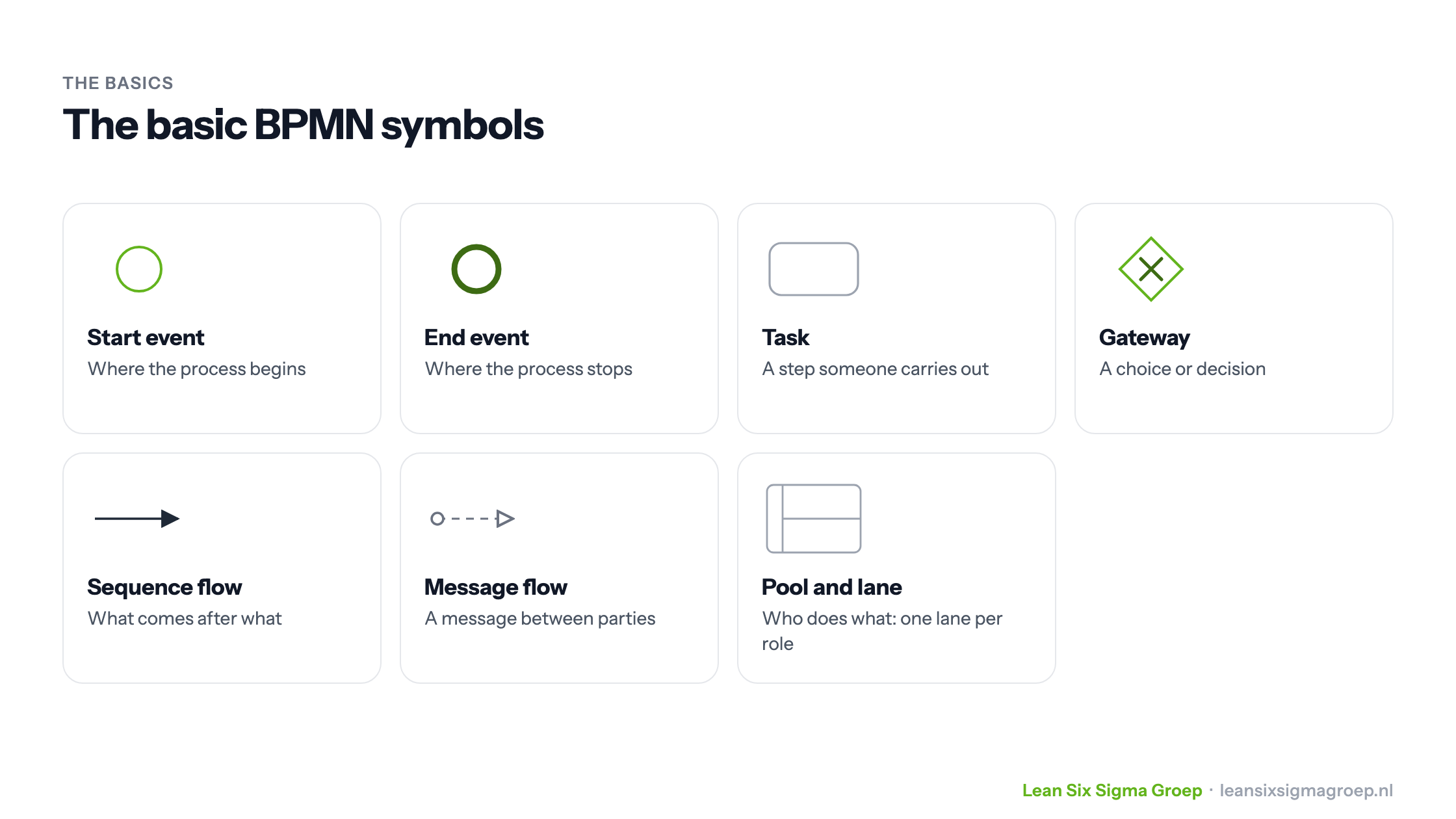
But it soon turns out that this overly simple set of symbols quickly leads to people using them differently. When several colleagues are drawing process maps, you will notice differences creeping in, because everyone interprets the symbols in their own way. Or one process flows from top to bottom instead of left to right.
And the more process maps you need, the greater the need for a uniform way of presenting this information. That makes them easier to read and, let’s be honest, it looks better too.
Who is it relevant for?
Business Process Model and Notation is a standard that describes how a process map is set up. Among other things, it defines which symbols are used and how the flow of information should be shown, and it comes with a set of rules and definitions.
It is relevant for business analysts, business consultants, process owners, managers and anyone involved in improving business processes.
Where does BPMN come from?
BPMN is an official trademark of the Object Management Group. The OMG is a standards body that looks after several standards. It brings together the knowledge, experience and expertise in a field and captures it in a standard.
That is why successive versions of a standard appear over time. BPMN is no exception: the current version is 2.0. This standard is freely available to everyone.
Only if you want to turn the standard into a product, for example software that helps you use BPMN properly, do you need to buy a licence.
Applying BPMN
As mentioned, the standard is open to everyone and free to use. This means, for example, that the prescribed symbols are available as Visio stencils that you can use yourself or across your organisation. Even then, there is still a risk that everyone applies the symbols according to their own definition.
You could, of course, read the standard’s 500 plus pages to see how it is put together. If you are looking for a short introduction and explanation, the Lucidchart website is very helpful. Besides clear information, they offer a platform where you can create process maps and store them in one central place.
The bigger picture
Especially in organisations that are rolling out process improvements, you see the need for standardised process descriptions grow. Over time, the OMG has added two more standards to BPMN:
- CMMN: Case Management Model and Notation. This standard builds on BPMN and defines how workflow systems can be taught to translate the process map into a workflow configuration. This creates a direct link between the process map and how it actually has to be applied by its users.
- DMN: Decision Model and Notation. Every process includes decision steps. This standard supports how decisions can be made properly. Roles, authority and recording decisions are at its core.
Together with BPMN, they form a trio that brings processes, and everything needed to capture them, together as one whole.