Customer demand is growing while the labour market is shrinking, as the Dutch employers’ federation VNO-NCW warns. Automation then seems a logical answer. But automation is not a quick fix: if you are not careful, you automate an inefficient process and just make the problem faster. Lean helps you put the process in order first. The ESSA method gives the order.
What is automation?
Automation means having software do work that people do. That can take several forms:
- Robotic Process Automation (RPA): software that mimics actions on a computer, such as filling in forms, copying data between systems or sending standard emails.
- Machine learning: systems that recognise patterns in data, and use them to make predictions or support decisions.
- Artificial intelligence (AI): systems that perform tasks that until recently required human intelligence, such as writing text, recognising images or transcribing speech. Also read Does AI make the Green Belt redundant?
Why Lean first?
Lean is about removing waste, reducing work in progress and creating flow. Automating without that lens carries three risks:
- Waste gets locked in. Unnecessary steps are not removed but cast in software. After that they are harder to get rid of than ever.
- Frustration. Staff keep working with a cumbersome process, now with a system that doesn’t bend.
- Less flexibility. An automated process is expensive and slow to change.
The ESSA method
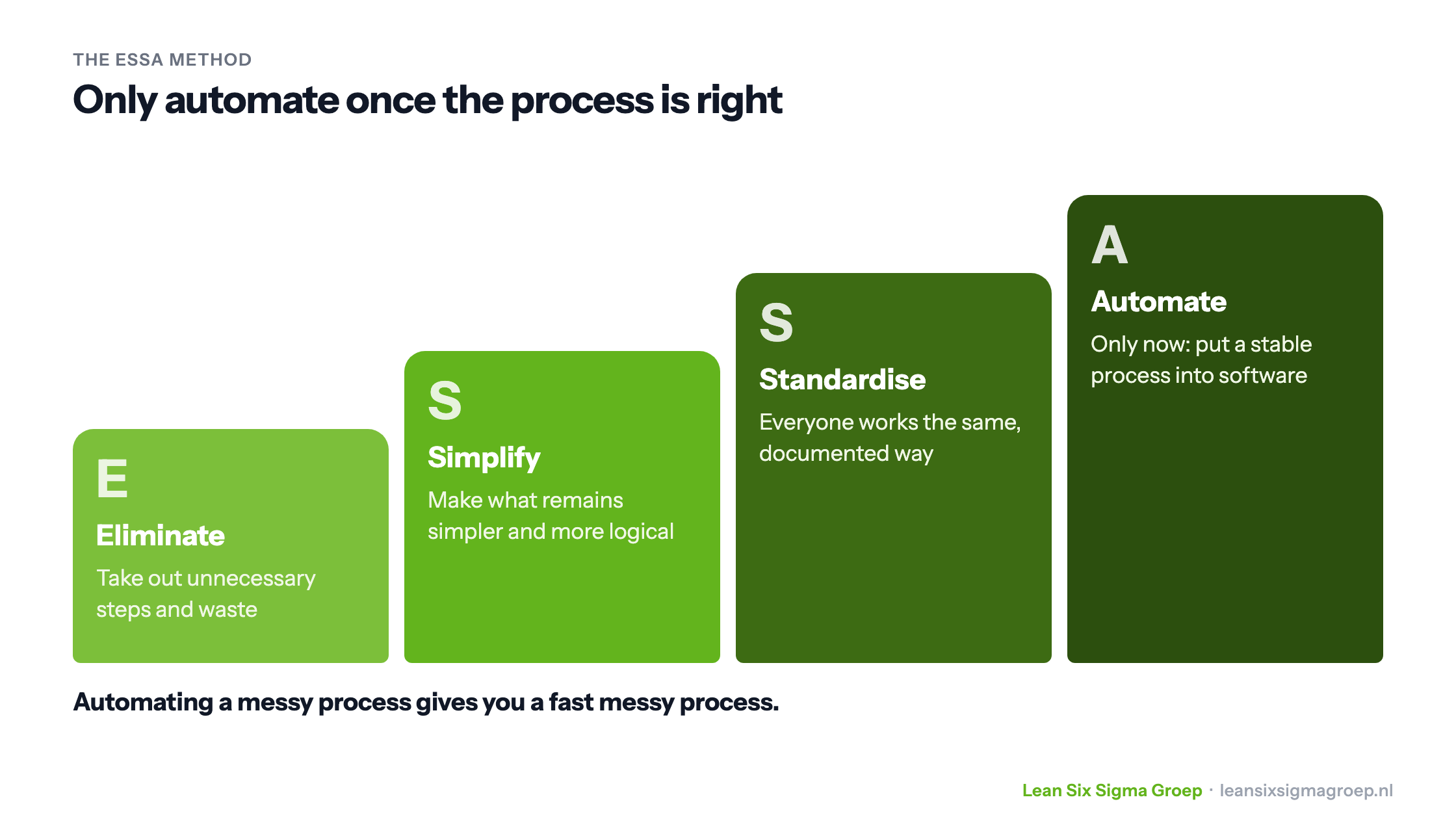
The ESSA method puts the steps in the right order, as shown in the image at the top of this article: Eliminate, Simplify, Standardise and only then Automate.
1. Eliminate
- Find waste with TIM WOODS: transport, inventory, motion, waiting, overprocessing, overproduction, defects and unused skills.
- Remove steps that add no value.
- Reduce waiting times and the causes of errors.
2. Simplify
- Make what remains as simple and logical as possible.
- Combine steps, reduce handovers and exceptions.
This is one of the tools you learn to apply in the Green Belt training.
3. Standardise
- Document how the process should be carried out, and make sure everyone does it the same way.
- Train staff in the new way of working.
- Safeguard quality, for example with quality management. A standardised, stable process is also the only kind that automates well.
4. Automate
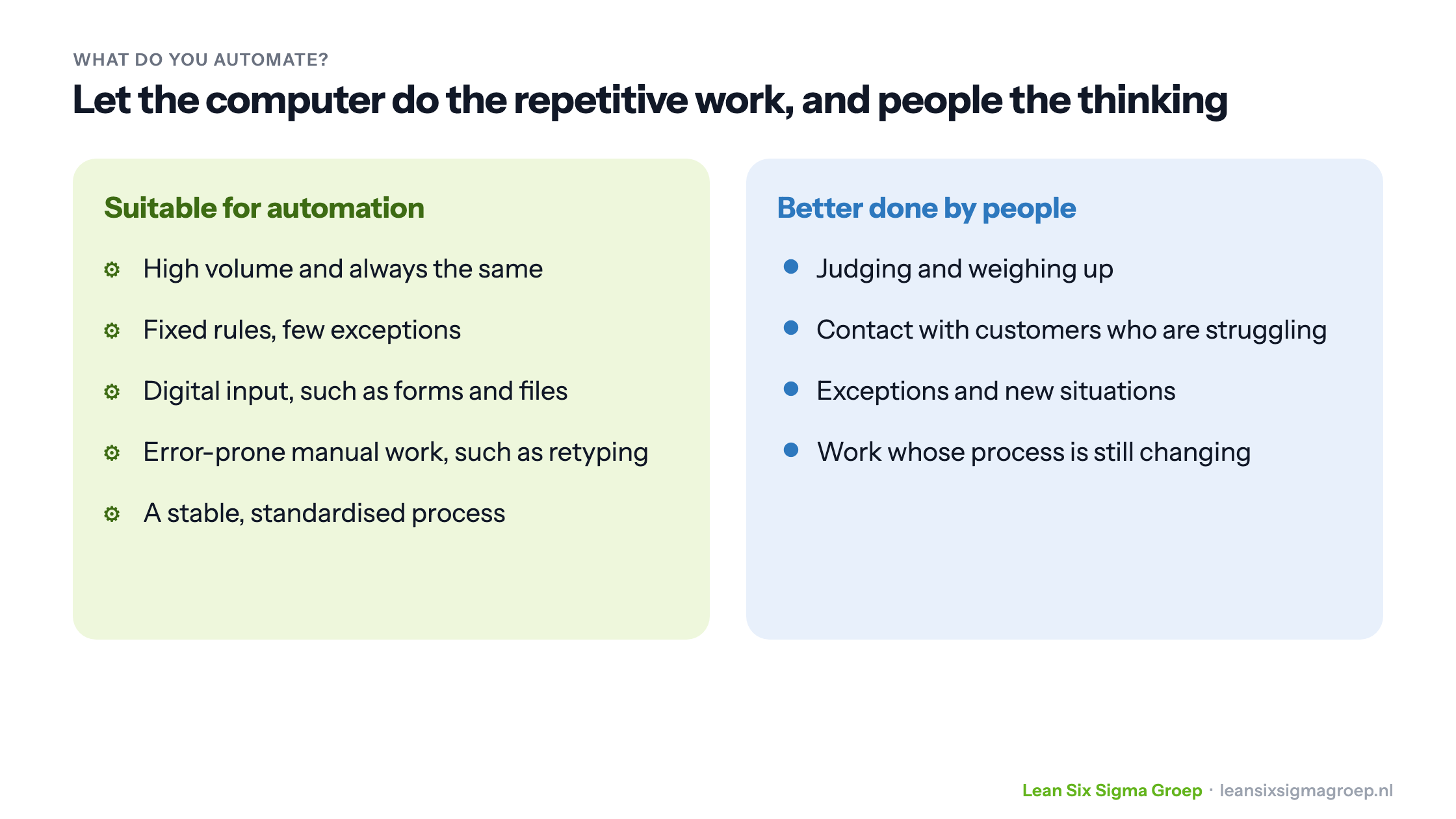
- Choose the tasks that suit it: high volume, always the same, with fixed rules and digital input. They are shown above next to the work that is better left to people.
- Choose the technology that fits, from a simple integration to RPA or AI.
- Test small, measure the effect and keep improving.
With process mining you can extract from system data in advance how a process really runs, and where automation will pay off most.
Freeing up talent
The aim of automation is not primarily fewer people, but people spending their time on work that matters: helping customers, solving problems, improving the process. In short:
- Eliminate waste to create flow.
- Simplify to reduce the chance of errors.
- Standardise for stability, and as a basis for further improvement.
- Automate to free up talent for more value, instead of wasting it on repetitive work.
Why eliminating is the best first step is also explained in process optimisation.