Business processes are the fixed sequences of activities through which an organisation does its work: from a customer request to a delivered product, from a vacancy to a new colleague, from an invoice to a payment. Every organisation has them, even if nobody calls them that. This article explains which kinds there are, how to structure and describe them, and why that is worth the effort.
What is a business process?
A process is a series of steps that turns an input into a result. A business process is such a process within an organisation, with a clear start (a request or trigger) and a clear end (a result for a customer, internal or external). A business process almost always cuts across departments: sales, planning, delivery and administration each contribute a part.
That is often exactly where the gains are. Each department can do its own part well, while the work gets stuck between departments. Thinking in processes means looking at the whole route the work travels, not just at your own step.
Three kinds of business process
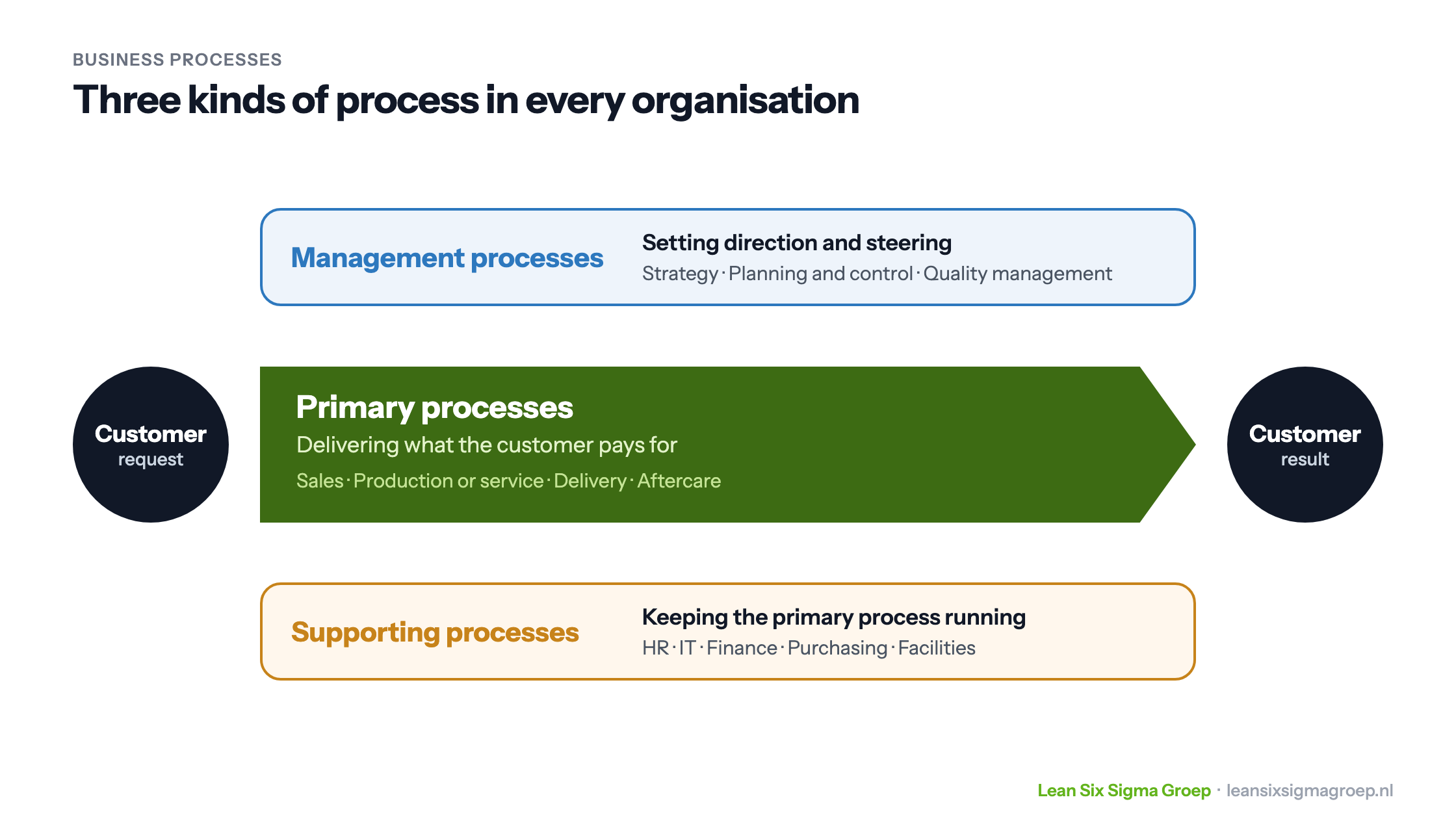
Business processes are usually divided into three kinds, as shown in the image at the top of this article:
- Primary processes deliver what the customer pays for: sales, production or service, delivery and aftercare. They run from customer request to result. Read more in Lean and the primary process.
- Supporting processes keep the primary processes running: HR, IT, finance, purchasing and facilities. Customers don’t notice them directly, but they do notice when they falter.
- Management processes set direction and steer: strategy, planning and control, quality management.
Which process is primary depends on the organisation. For a recruitment agency recruitment is a primary process; for a factory it is a supporting one.
Structuring business processes in levels
To keep an overview, you describe processes in levels, from broad to detailed:
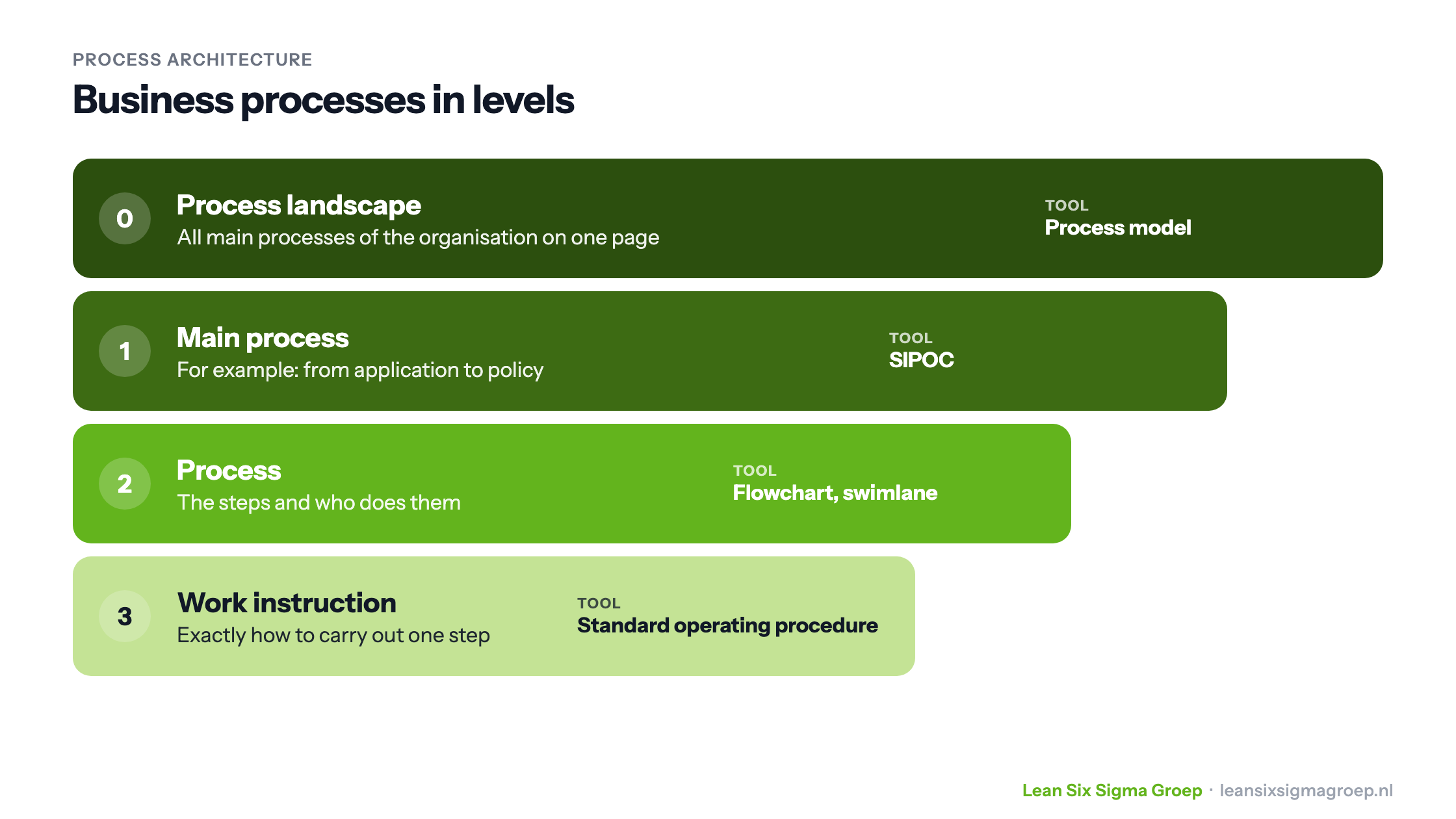
- The process landscape: all the organisation’s main processes on one page.
- The main processes, which you can describe with a SIPOC: suppliers, inputs, process steps, outputs and customers.
- The processes and their steps, in a flowchart, a swimlane diagram (who does what) or in the standard notation BPMN.
- The work instructions for a single step, for example as an SOP.
You don’t need to describe everything down to the lowest level. Start with the landscape, and only go deeper where needed: where errors occur, where new colleagues need to learn the work, or where a process needs improving.
The process owner
Because a business process runs across departments, it often belongs to nobody. That is why every important process ideally has a process owner: someone responsible for how the process performs as a whole, across departmental boundaries. The process owner knows the figures, guards the agreements and initiates improvements.
Why describe business processes?
- Overview: everyone sees how their work fits into the whole, and what the next step needs from them.
- Fewer errors at handovers: most problems arise between departments, not within a step.
- Onboarding and continuity: knowledge does not live only in the heads of a few experienced colleagues.
- Quality and certification: standards such as ISO 9001 call for a process approach.
- A basis for improvement: what you can’t see, you can’t improve in a targeted way.
Improving business processes
A described process is the starting point for improving it. That works best systematically: first know what the customer wants, map and measure the current process, find the causes of problems, and only then devise and sustain solutions. That approach follows the DMAIC cycle and is explained step by step in process optimisation. A value stream map shows where work waits and where the waste is.
Want to learn how to improve business processes in your own organisation? Take a look at the Green Belt course.