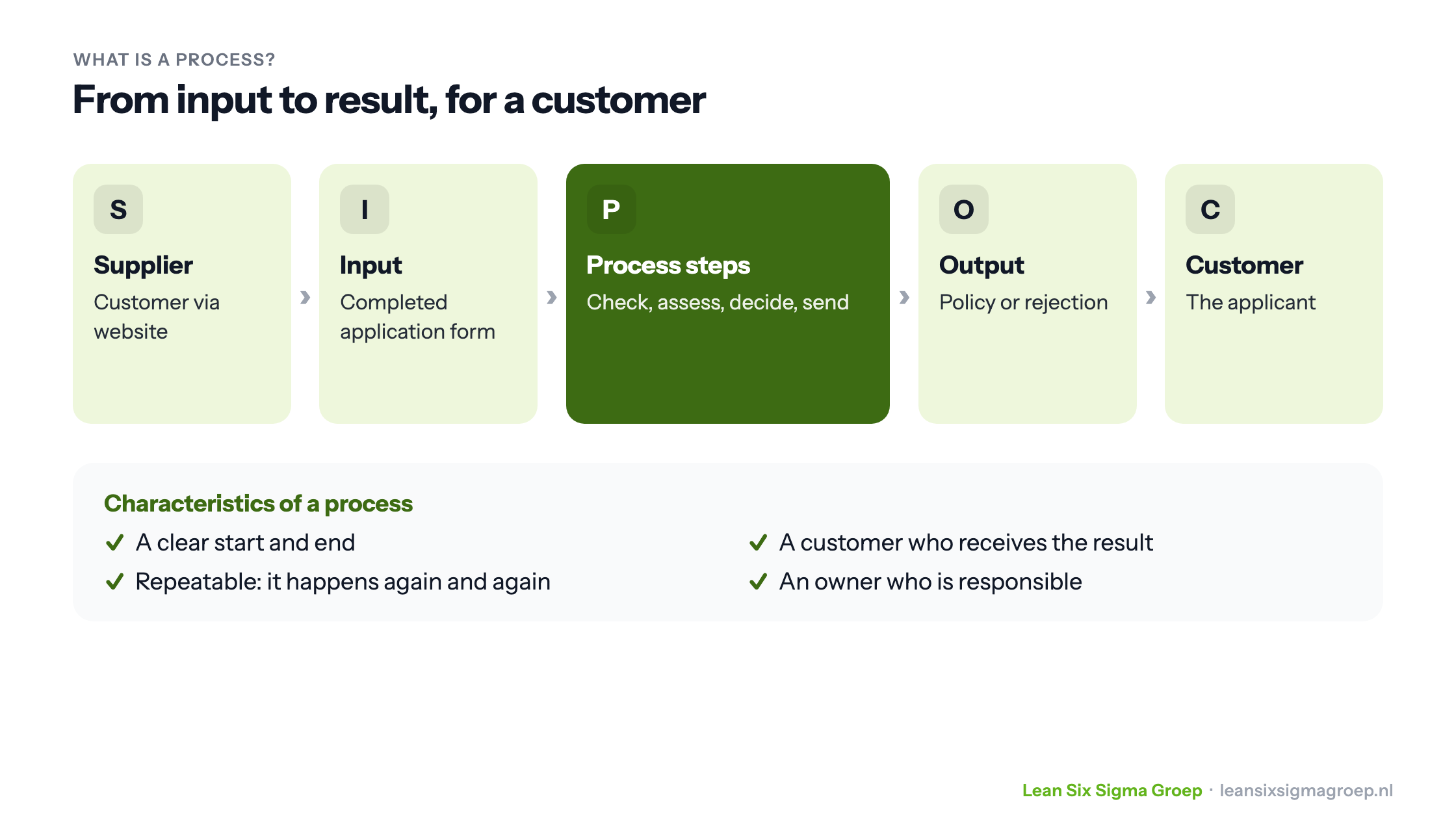
A process is a sequence of activities that turns an input into a result for a customer. It has a clear start and end, it happens again and again, and someone receives the result. Almost all work in an organisation runs through processes, even if nobody calls them that.
What is a process?
Look up the definition and you will find something like: a sequence of consecutive activities with a clear goal. That is correct, but from a Lean perspective we add something important: a process exists for a customer. That customer may be outside the organisation, but can also be a colleague who continues working with your result.
Processes have a few fixed characteristics, as shown in the image at the top of this article: a start and an end, a customer, repeatability, and ideally an owner responsible for how the process performs.
From a Lean perspective we constantly look at processes. We capture them, standardise them and keep trying to organise them more smartly. Also read about the different types of business processes.
Describing a process with a SIPOC
In an improvement project one of the first questions is: what actually is the process? You capture that with a SIPOC, which consists of five parts:
- Supplier: who supplies something to the process?
- Input: what does that supplier provide?
- Process: what are the five to seven main steps?
- Output: what comes out of the process?
- Customer: who is that result for?
The SIPOC gives a bird’s-eye overview. Later in an improvement project, in the Measure and Analyse phases, you go deeper, for example with a value stream map. That shows which steps add value, where work waits and where it could flow better.
Process management
Mapping, managing and improving processes, often with the help of data, together make up process management. When a process flows better, there is less waste and goals are met more often. That brings reliability, and so customer trust, and often more job satisfaction, especially when employees can help shape the improvements.
How do processes come about?
In our Lean training courses we ask participants to think about what processes actually are, and how they come about. What comes out is surprising to many participants.
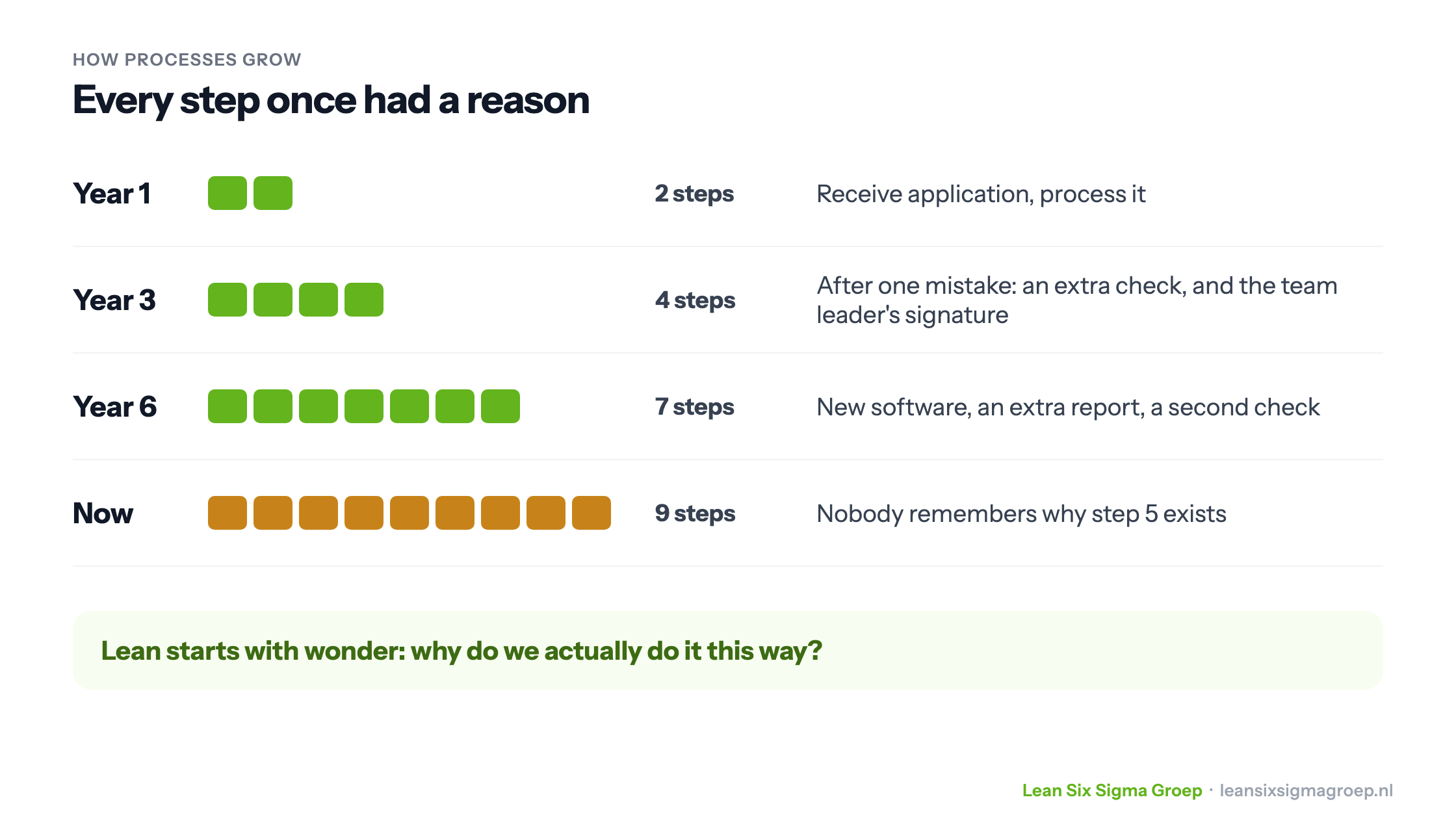
When you join an organisation, most processes are already there. During your induction you may wonder about some steps, but you don’t change everything straight away. And after that it is simply the way things are done.
That is how processes grow over the years. After a mistake an extra check is added. With new software an extra step. For a report yet another form. Every step once had a good reason, but after a few years nobody remembers which. The result is processes, large and small, that hardly anyone can follow any more, simply because nobody ever took the trouble to redesign them.
That is where Lean starts. With looking differently at what happens, where it happens, and mapping it. With wonder, as if seeing it for the first time: why do we actually do it this way? Also read the five principles of Lean.
Want to know more about processes and how to improve them? Take a look at the Green Belt training course.