
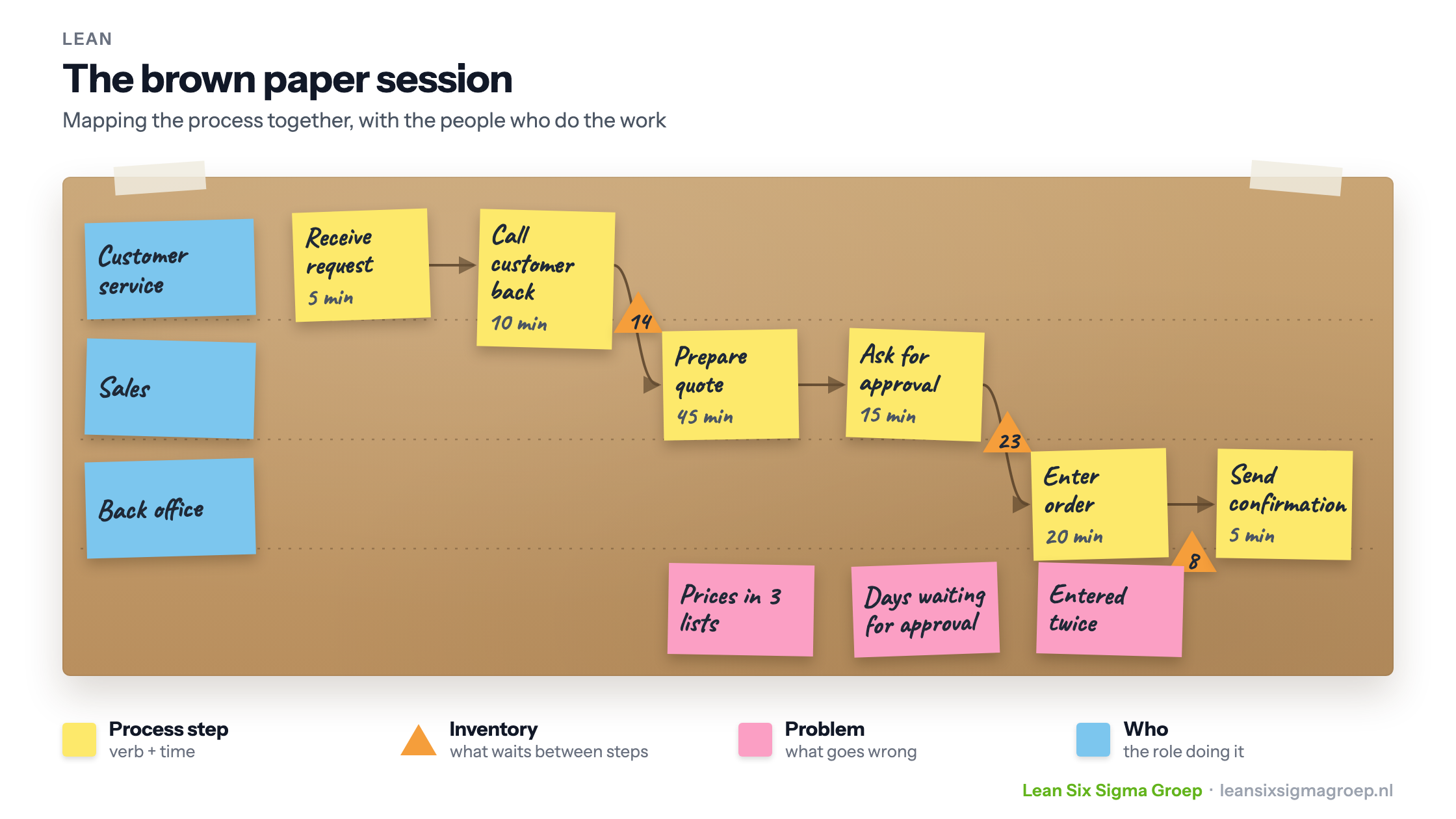
A brown paper session is a meeting of, for example, colleagues who work in the same process or in the same department. The purpose of the meeting is to gain insight into processes and problems, or in some way to “see” the work that has to be done.
The meeting is organised by someone who leads the session but who (deliberately) is not the person who knows most about the content of the work or the processes. That may seem odd, but it is precisely the person who knows less who is able to ask the questions that matter.
A fresh pair of eyes and open-minded questions usually yield the most insight, as opposed to making assumptions along the lines of “everyone knows that already”.
This is one of the tools you learn to apply in the Green Belt training.
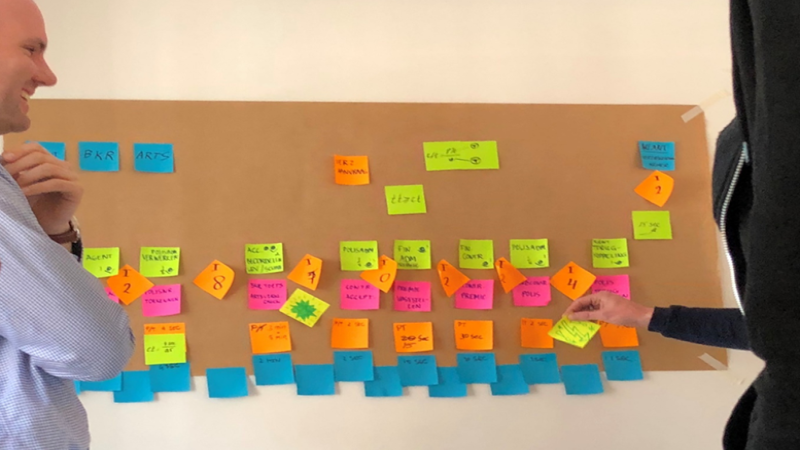
Why a brown paper session?
The use of brown paper, incidentally, comes down to practical considerations. It is very cheap, easy to order on a large roll, and the brightly coloured sticky notes you use stand out nicely against it.
In practice, brown paper sessions are often used to map processes that are causing problems at that moment. For example because waiting times are long, quality is frequently below par, the outcomes of the process are unpredictable, many mistakes are made, or it is simply unclear who is and who is not involved.
The Lean way of mapping processes is called “Value Stream Mapping” and is explained in a separate article.
Tips for a successful brown paper session
A few useful tips;
- Organise a brown paper session with the people who actually do the work themselves, at the place where the work is done, and allow plenty of time for it
- Write nothing on the brown paper itself, only on the sticky notes. You will soon find out why..
- Peel the sticky notes off carefully and stick them firmly onto the brown paper, so that you find them in the same place next time
- Ask the people involved to write on the sticky notes themselves, using verbs, what they do in the process and how much time it takes
- Enrich the data by asking how much work in progress sits between the steps, and go and have a look for yourself
You will notice that after about 10 minutes everyone is enthusiastically explaining what they do in the process.
Then everyone starts wondering why everyone does something different, or exactly the same, and why nobody has given this kind of insight into the process before… We could have prevented things going wrong, waiting a long time for others, and we could have learned from each other. That is the effect of a brown paper session, however simple it sounds. You always learn a great deal from it!