An Agile Coach helps teams and organisations start working in an Agile way, and keep getting better at it. Not by telling them how to do it, but by teaching, guiding and letting people find their own answers. The Agile Coach works with teams, with several teams at once and with management.
What does an Agile Coach do?
Agile working takes more than a new method. Teams start planning differently, collaborating differently and deciding more themselves. Managers start leading differently. That doesn’t happen by itself, and that is where the Agile Coach helps.
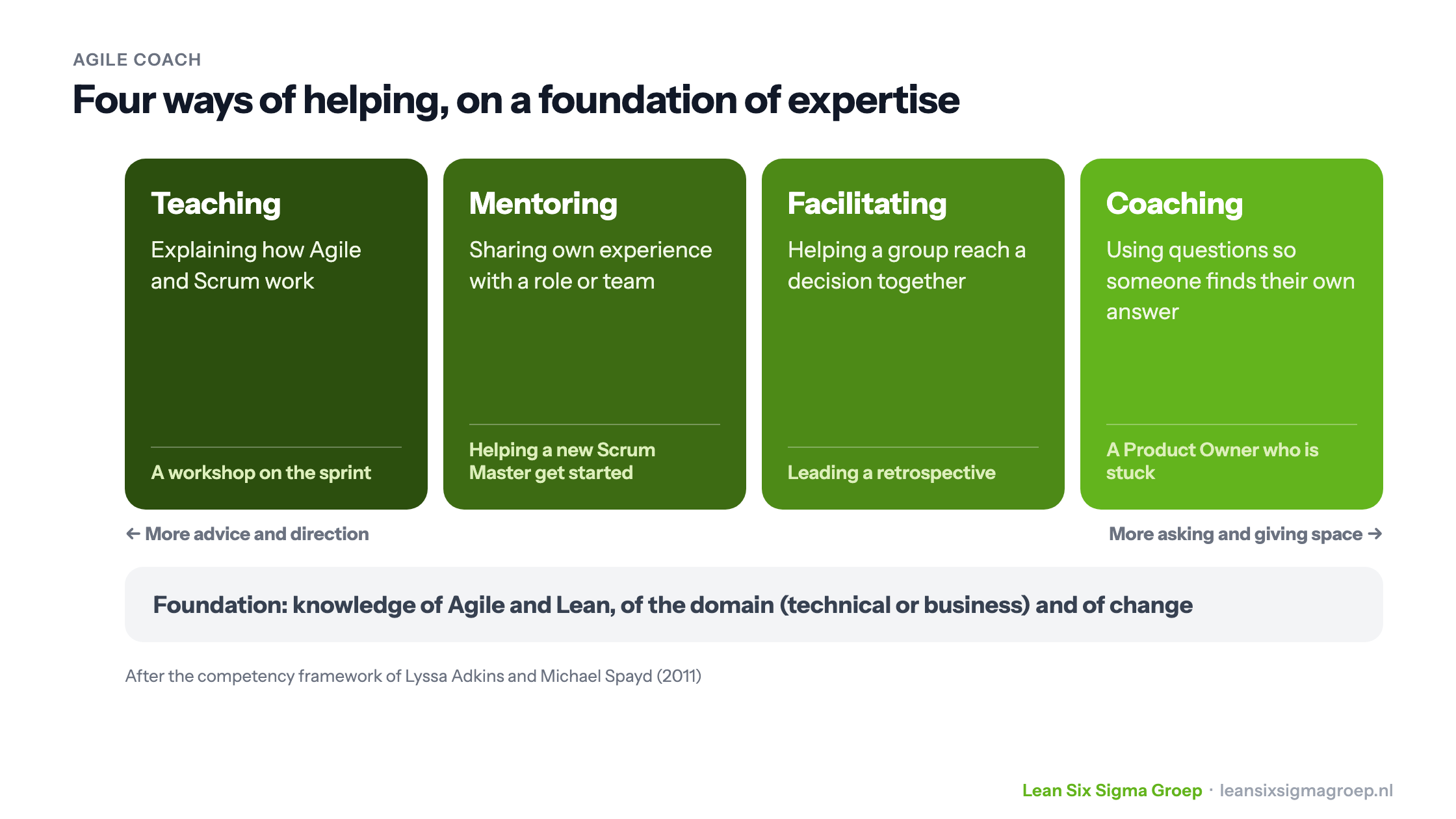
A widely used model for the work of an Agile Coach is the competency framework of Lyssa Adkins and Michael Spayd from 2011. You can see it in the image at the top of this article. It distinguishes four ways of helping:
- Teaching: explaining how Agile, Scrum and Kanban work, for example in a workshop.
- Mentoring: sharing own experience with someone in a role, such as a new Scrum Master or Product Owner.
- Facilitating: helping a group reach a decision together, for example in a retrospective or a planning session.
- Coaching: using good questions so someone finds their own answer, instead of giving the answer.
A good Agile Coach switches between these four, depending on what the situation calls for. A team that is just starting benefits more from explanation. An experienced team benefits more from good questions. The foundation is expertise: in Agile and Lean, in the work itself (technical or business) and in how change works in organisations.
Agile Coach or Scrum Master?
The two roles look alike, but differ in scope.
This is one of the tools you learn to apply in the Green Belt training.
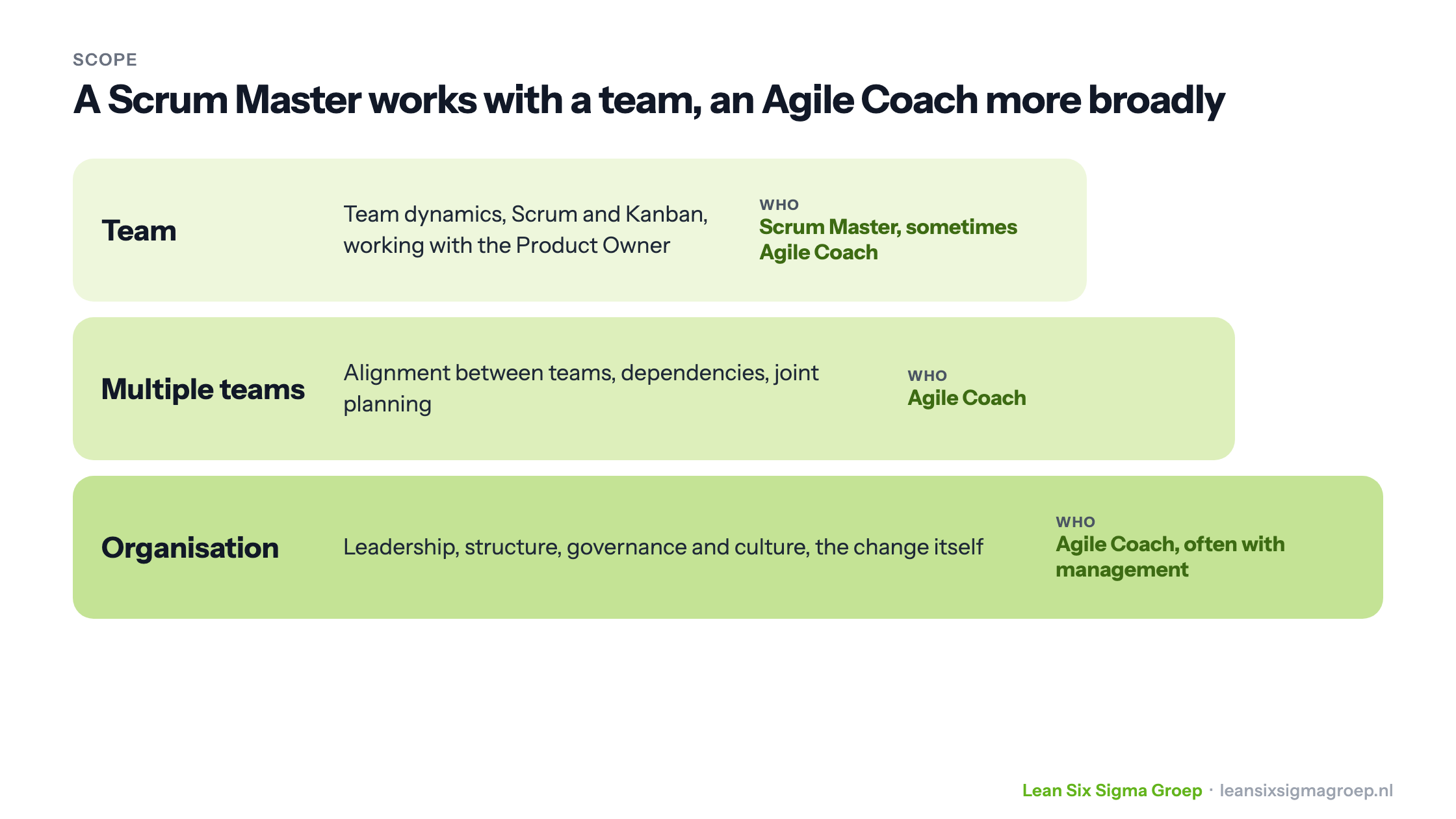
A Scrum Master usually works with one or two Scrum teams and makes sure they apply Scrum well. According to the Scrum Guide the Scrum Master also helps the organisation, but in practice the emphasis is on the team. An Agile Coach works more broadly: with several teams, with alignment between teams and with the organisation around them, such as leadership, structure and culture.
Agile Coaches often have a background as Scrum Master, project manager, product manager or developer. They know several ways of working, from Scrum and Kanban to a framework for large organisations such as SAFe.
Why is it about behaviour?
Many Agile introductions focus on processes: new roles, new meetings, a new board. What is often overlooked is that it is above all a change in behaviour. People have to learn to give feedback, push decisions down the organisation and dare to make mistakes. That creates resistance, and that is normal.
An Agile Coach helps by having the conversation, taking resistance seriously and helping people find their new role. Knowledge of change management and of team dynamics, such as the Belbin team roles, is very useful here.
Becoming an Agile Coach
An Agile Coach programme typically covers:
- applying the principles and values of Agile and Lean;
- coaching and developing teams, and guiding an organisation through behavioural change;
- listening at different levels, asking good questions and giving feedback;
- dealing with resistance;
- more insight into your own behaviour and that of others, and with it more influence.
Take a look at our training courses.