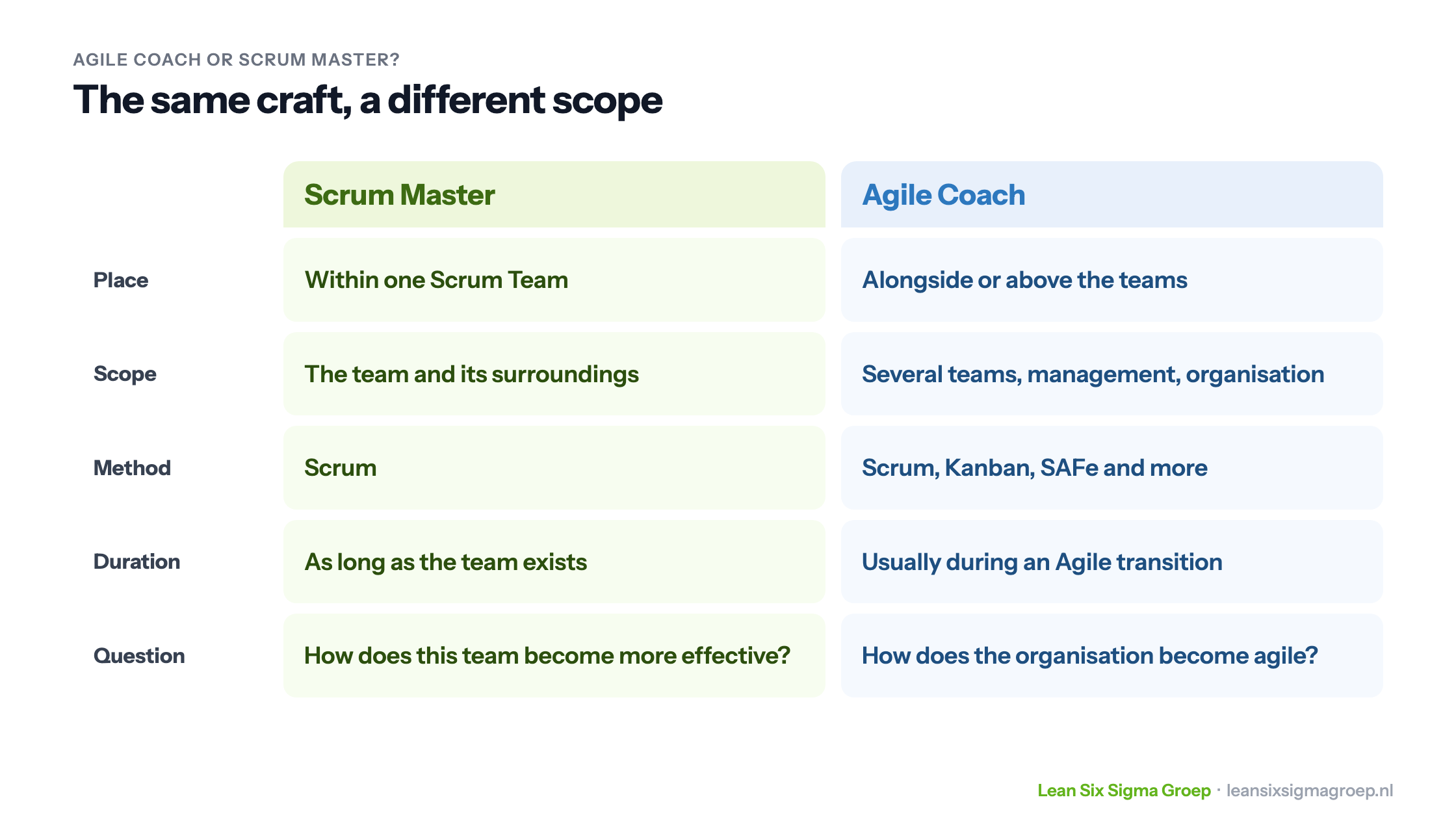
Agile Coaches are in high demand. But what does such a coach add when teams already have a Scrum Master? The two roles are similar: both help people and teams work Agile, with comparable techniques. The difference lies in scope, as shown in the image at the top of this article. This article puts the roles side by side and shows how you can grow from one to the other.
The Scrum Master
The Scrum Master belongs to one Scrum Team. According to the Scrum Guide 2020, the Scrum Master is accountable for that team’s effectiveness, and is a leader who serves the team and the organisation. They know the team inside out and know what is going on.
What the Scrum Master does:
- helping the team manage itself and work cross-functionally;
- making sure Scrum is understood and applied well, and that the events take place and are useful;
- causing impediments to be removed, preferably by the team itself;
- helping the Product Owner with techniques for a good Product Goal and a well-managed backlog;
- helping the organisation understand and adopt Scrum.
What the Scrum Master does not do: direct the team or decide the content. That is the pitfall at the top of common Scrum Master pitfalls. The attitude behind the role is covered in The real role of the Scrum Master.
The Agile Coach
The Agile Coach doesn’t belong to one team. They work with several teams, with Scrum Masters and Product Owners, and above all with management. The focus is not on one team but on the organisation as a whole: how does it become agile?
What the Agile Coach does:
- making teams and managers aware of their strengths and weaknesses, so they can grow;
- coaching Scrum Masters and offering new techniques, for example for the Retrospective;
- getting teams to work together, sometimes with a scaling framework such as SAFe;
- guiding the organisation in the transition to Agile working, including the way of leading.
An Agile Coach is not tied to Scrum: Kanban, Lean and other approaches are also part of the toolbox.
From Scrum Master to Agile Coach
Many Agile Coaches started as Scrum Masters. Below is a growth path in three steps.
This is one of the tools you learn to apply in the Green Belt training.
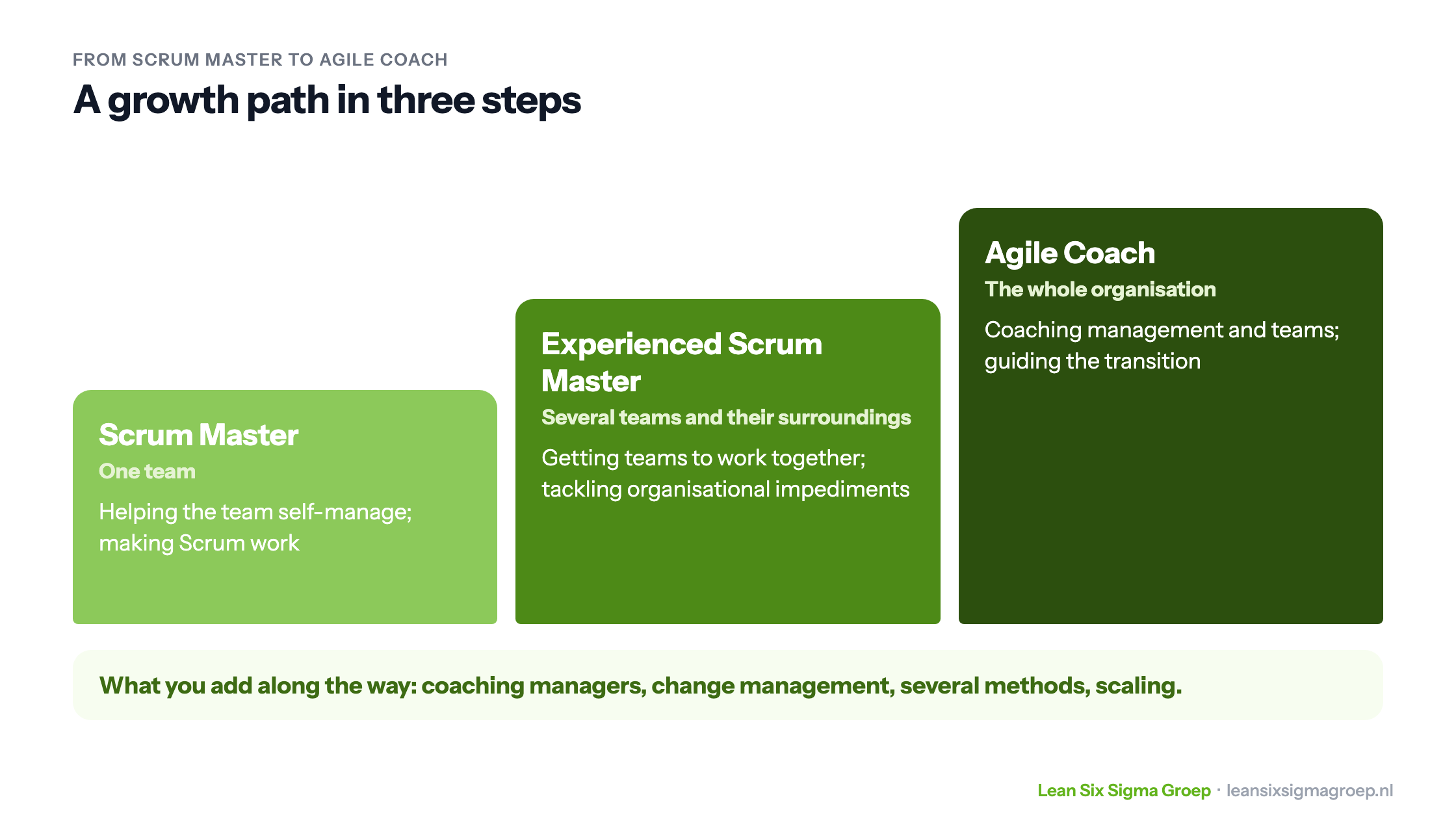
As a Scrum Team matures, it needs the Scrum Master less for day-to-day matters. The Scrum Master then has room for several teams and for impediments outside the team: how decisions are made, how budgets flow, how departments work together. Those who get good at that, and learn to coach managers too, naturally grow towards the Agile Coach role.
Which one do you need?
- You are starting with Scrum in one or a few teams: a Scrum Master per team.
- You want to make the whole organisation more agile: an Agile Coach alongside the Scrum Masters.
- Your teams get stuck on their environment: an Agile Coach who works with management.
Don’t mix up the roles. A Scrum Master who has to change the whole organisation has no time left for the team; an Agile Coach who sits in one team every day is doing a Scrum Master’s job. The roles reinforce each other.
An Agile transition is never quite finished. Organisations keep changing, and so there remains work for both roles. Want to learn one of the roles? Take a look at our Agile training courses.