Timeboxing means deciding in advance how much time an activity may take, and sticking to it. A block of time, and then it is done, or you deliberately choose a new block. It sounds like a form of time management, and it is, but its value for teams and projects is often underestimated.
What is timeboxing?
You can use it for almost anything. Parents use it for their children’s screen time, organisations for meetings, and projects work with fixed phases or iterations. The idea is always the same: the task doesn’t decide how long you work on it, the time decides how much of the task you do.
Timeboxing and Lean
Lean is about reducing waste, because waste slows the flow. Timeboxing directly counters several wastes from TIM WOODS:
- Overprocessing: polishing something that is already good enough.
- Overproduction: making more than needed, because there is no limit.
- Waiting: work left waiting because something else overruns.
Timeboxing also creates rhythm. A team that works in fixed blocks produces a predictable flow of finished work, which helps the rest of the organisation plan around it.
At a personal level: the Pomodoro technique
Do you often fail to stick to your own plan, because you keep getting distracted or keep perfecting? Then plan a meeting with yourself: block time in your calendar, add the subject, and stick to it.
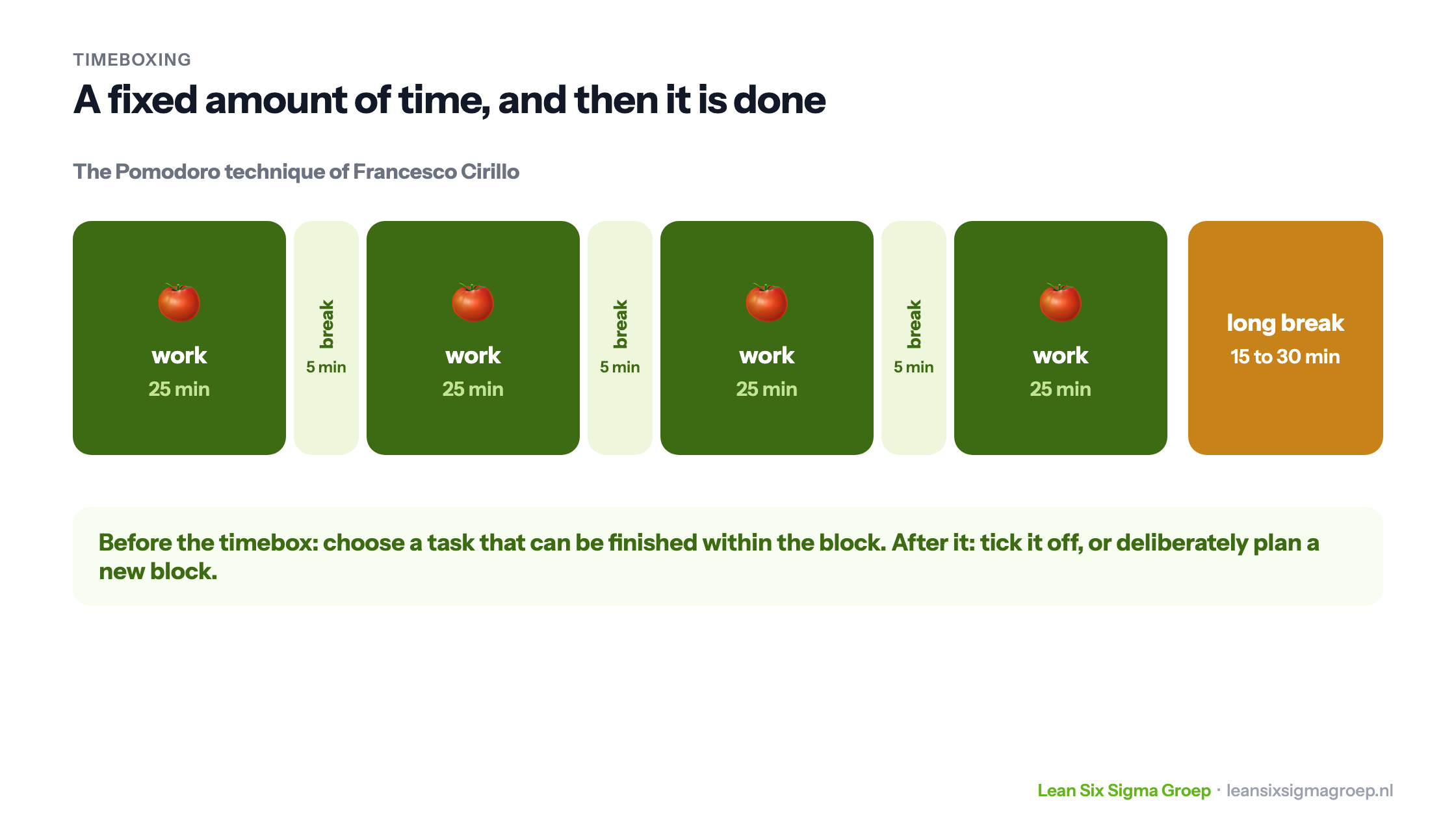
A well-known form is the Pomodoro technique, devised in the late 1980s by Francesco Cirillo, then a student who struggled to concentrate on his studies. He used a tomato-shaped kitchen timer (pomodoro is Italian for tomato). You work for 25 minutes with full focus, take a 5-minute break, and after four blocks a longer break, as shown in the image at the top of this article. If your work needs longer blocks, make them longer.
The key: just blocking time isn’t enough. Choose a task that can be finished within the block. Ticking something off feels better than starting again on something that still isn’t done. So break large tasks into smaller pieces.
In Scrum: every event a timebox
Timeboxing is built into Scrum. Every event has a maximum duration, as shown below. The Sprint itself is also a timebox: at most a month, and the end doesn’t move.
This is one of the tools you learn to apply in the Green Belt training.
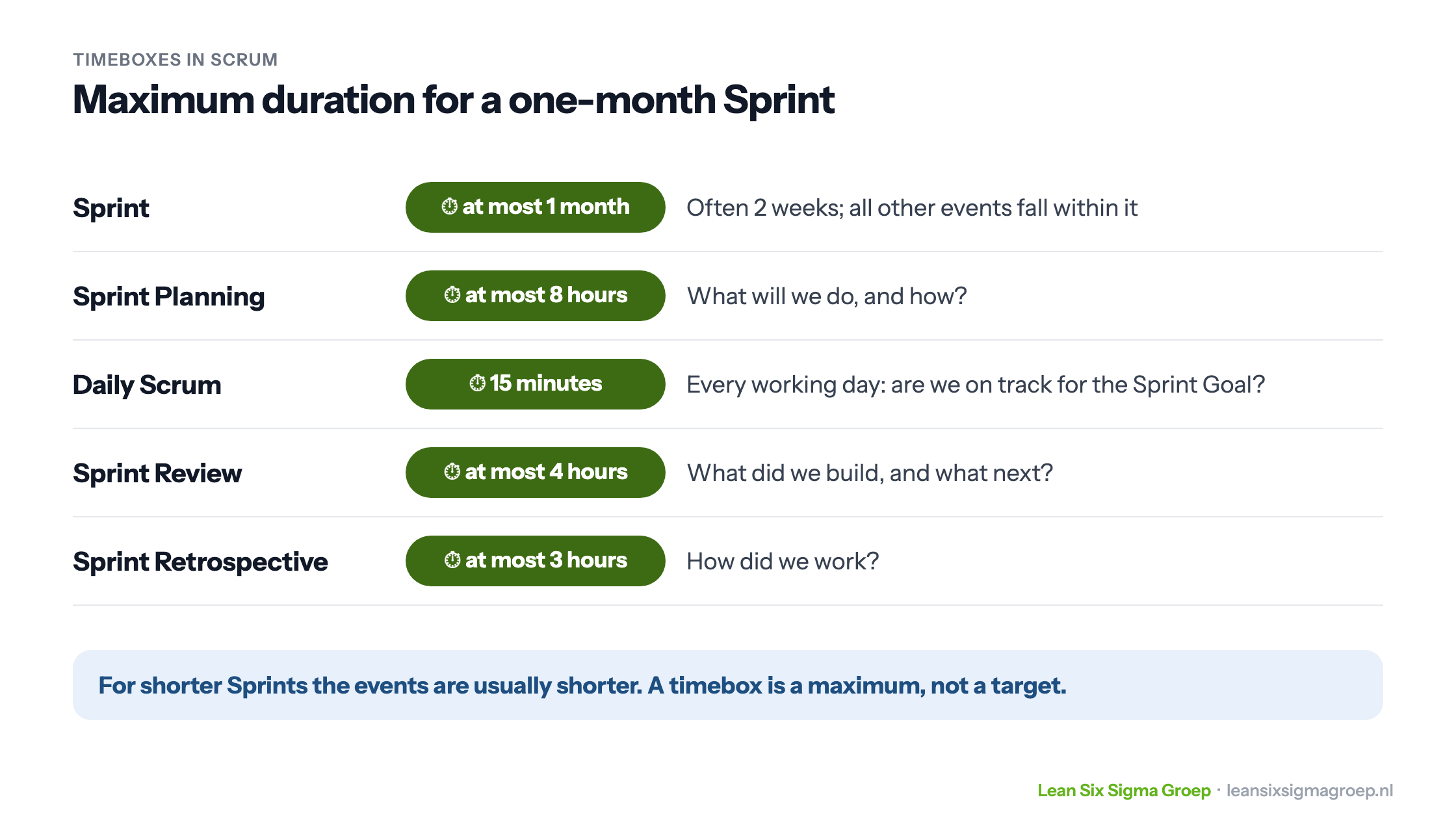
It works because it forces choices. If not everything fits in the Sprint, the team and the Product Owner discuss what matters most, instead of moving the deadline. And a Sprint Retrospective of at most three hours stays sharp precisely because it has an end.
In the team and the organisation
“But my colleagues keep cycling straight through my calendar!” Timeboxing only works when the team makes agreements about it. A few examples:
- A visible signal that someone is concentrating: a flag on the desk, a light by the door, or the status in Teams. Agree what such a signal means, and use it consistently.
- Friendly wording. “We are available between 10 and 12 and between 1.30 and 4” works better than “Closed now”. With the latter, people walk in anyway to ask when you are open.
- What does blocked mean? Is a block in the calendar always unreachable, or may the team disturb you in an emergency?
- Room between meetings. How much time do we leave between two meetings, so the next one can start on time?
Such agreements are not only about time, but also about collaboration. From change management we know the formula E = Q × A: the effect of a change is the quality of the solution times its acceptance. A timebox the team doesn’t accept doesn’t work.
In projects
In project management time, money and quality are linked, the well-known project triangle. If a project overruns, it costs more money, or quality suffers. Timeboxing turns the question around: not “how long will this take?”, but “what is the best we can deliver in this time?”. That reduces the risk of a project overrunning endlessly.
Conclusion
Timeboxing is setting a block of time for an activity that is then finished. It prevents overprocessing, overproduction and waiting, and gives work a rhythm. Good agreements in the team make it truly effective.
And of course: sometimes you have to break a timebox. If there is a fire, you don’t finish your work before leaving the building.