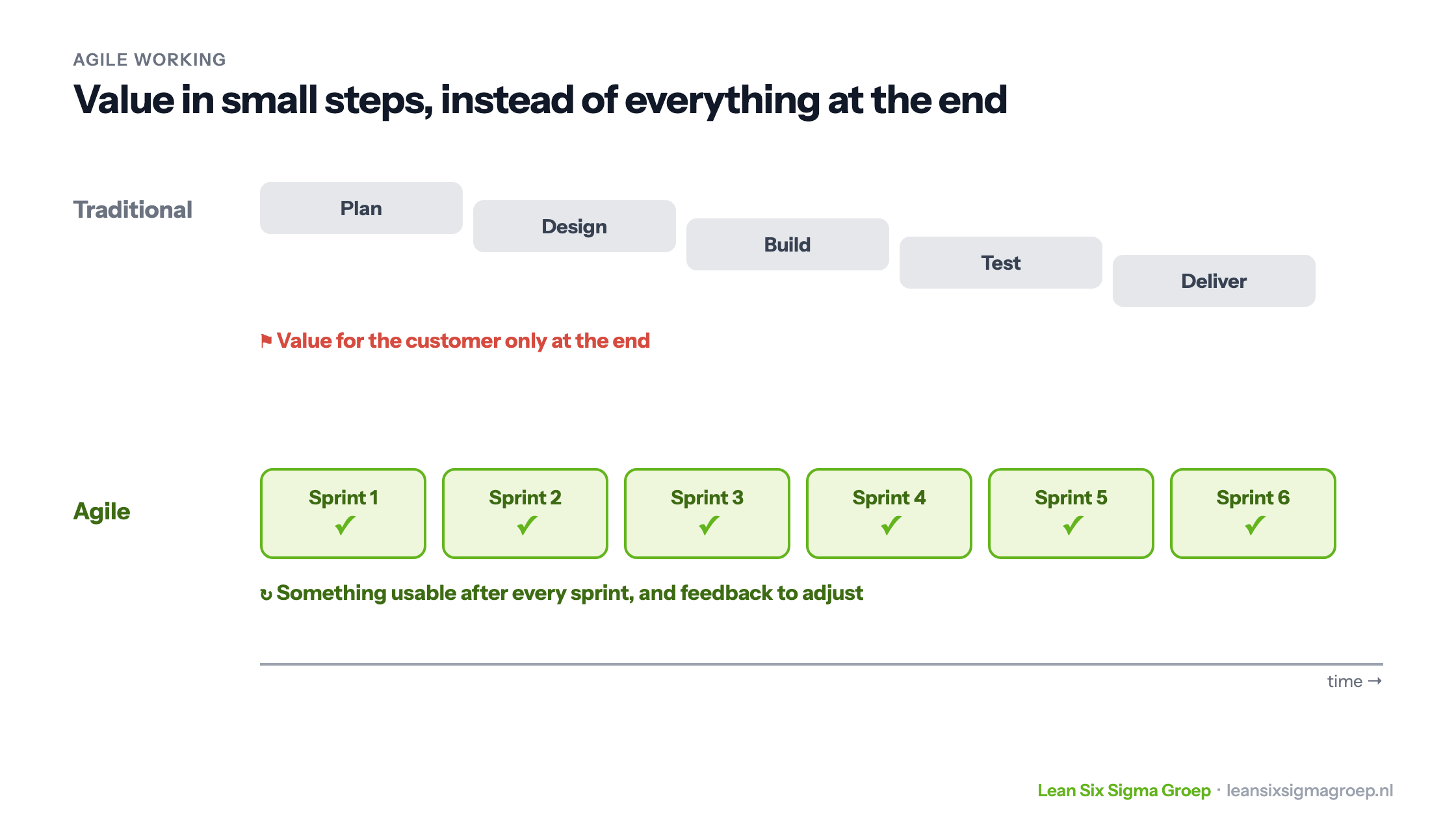
Agile working means a team delivers value in short steps, gathers feedback continuously and adjusts based on it. Instead of spending months building one big result that is only tested at the end, the team delivers something usable every few weeks. This article is about what that looks like in practice. What Agile is as a mindset, with the twelve principles, is covered in What is Agile?
Why work Agile?
In a traditional approach everything is first planned and designed, then built, then tested and only then delivered, as shown in the image at the top of this article. That works well when it is clear in advance what is needed. But often the customer only knows what they want when they see something, or the market changes along the way. Then it only turns out at the end that the result doesn’t fit.
Agile working turns that around. In short rounds, called Sprints in Scrum, the team delivers a working piece of the result each time. The customer sees it, gives feedback, and the team adjusts the next step. That reduces risk and brings value to the customer sooner.
The Agile Manifesto
The basis of Agile working is the Agile Manifesto, written in 2001 by seventeen software developers. It consists of four values and twelve principles. The four values are shown below. The manifesto doesn’t say the items on the right have no value, but that the items on the left weigh more.
This is one of the tools you learn to apply in the Green Belt training.
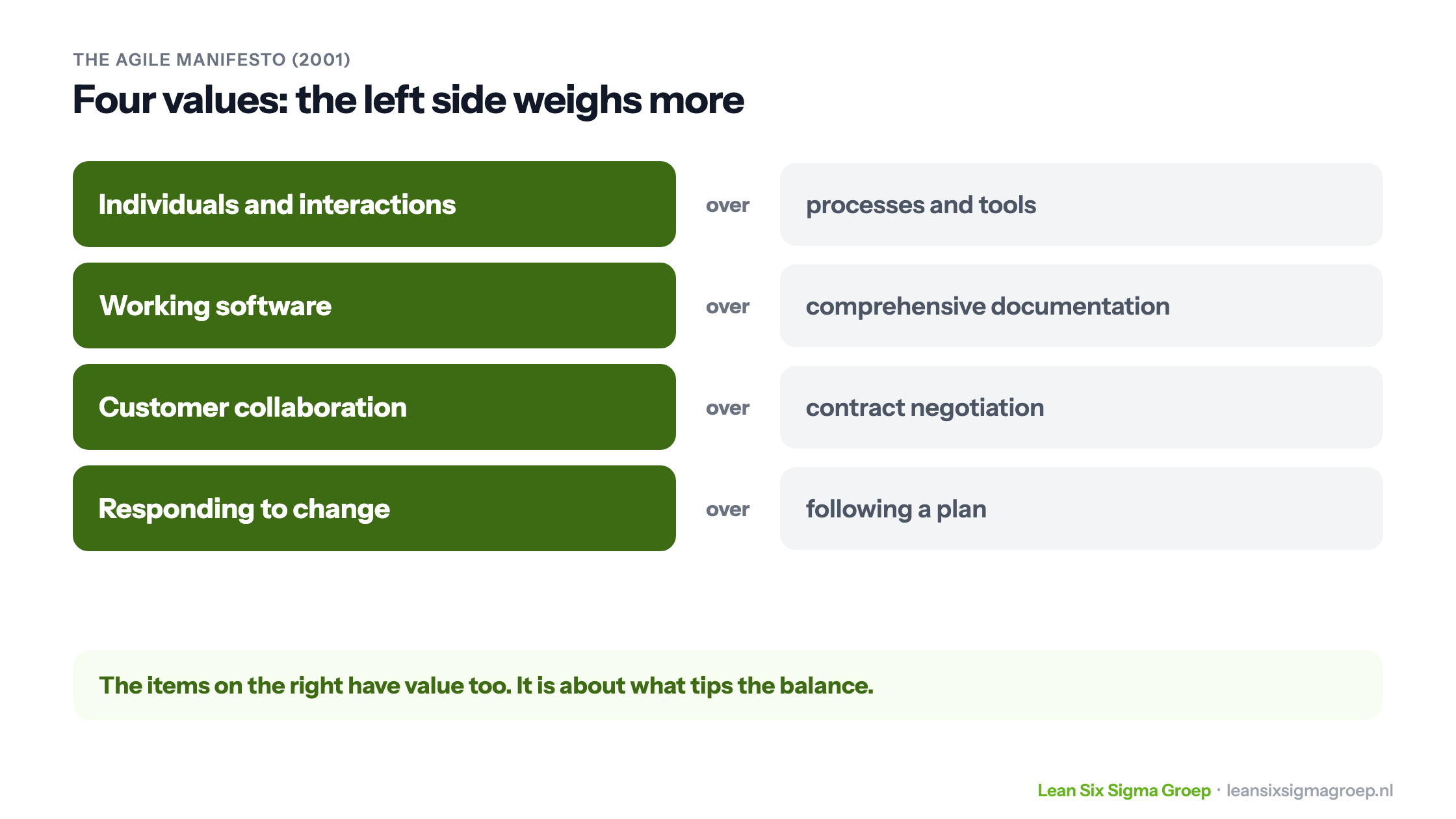
The manifesto was about software, but the values also apply beyond it. For a marketing team, an HR department or an improvement project, “working software” simply means: a working result the customer can use.
What does Agile working look like?
Agile is a mindset with several methods. The best known are Scrum and Kanban. What they share:
- A small, cross-functional team that has everything it needs to finish the work, and decides itself how to do it.
- One ordered list of work, such as the Product Backlog, with what delivers the most value at the top. In Scrum the Product Owner decides the order.
- A fixed rhythm: planning, a short daily alignment, showing the result to the customer and reflecting on the collaboration, for example in a Sprint Retrospective.
- Visible work: a board showing what is ready, in progress and done.
- Short feedback loops: better to adjust every two weeks than to discover after a year that it should have been different.
How do you start?
- Choose one team and one clear goal. Start small, with a team that wants to try it.
- Make the work visible and put it in one order. That alone often makes a big difference.
- Work in short rounds of one to four weeks, and show something at the end of each round.
- Reflect every round on how it went, and improve one thing.
- Involve managers. Agile working asks them to steer on goals and give room, instead of on tasks and hours.
Where it often goes wrong
- The rituals without the mindset. Introducing daily stand-ups and Sprints, while decisions are still made the old way.
- Too much at once. A team working on ten things finishes none of them.
- No real customer. Without feedback from users, a Sprint is just a shorter planning period.
- Agile as the goal. The goal is value for the customer, not “being Agile”.
Agile and Lean complement each other well: Lean helps you see waste in the process, Agile helps you deliver quickly and flexibly. Read more in What is Lean Agile? For larger organisations with many teams there are scaling frameworks such as SAFe.
Want to learn to work Agile yourself? Take a look at our Agile training courses.