The Belbin team roles model describes nine roles that people naturally take on in a team. Meredith Belbin developed it from research into teams in the 1970s, and published it in 1981 in his book Management Teams. His main conclusion: teams perform best when all roles are present in balance.
What is a team role?
Belbin described a team role as the way someone behaves, contributes and interacts with others in a team. Everyone has one or more preferred roles: roles you take on naturally and enjoy. There are also roles you can take on when needed, and roles you are better off leaving to others.
Each role has strengths, but also an associated weakness, which Belbin called an “allowable weakness”: the flip side of the same strength. Someone who wants to move fast can be impatient; someone with many original ideas sometimes forgets practicalities.
If a role is heavily overrepresented in a team, that can harm the team. The same applies if a role is missing altogether.
The nine roles in three groups
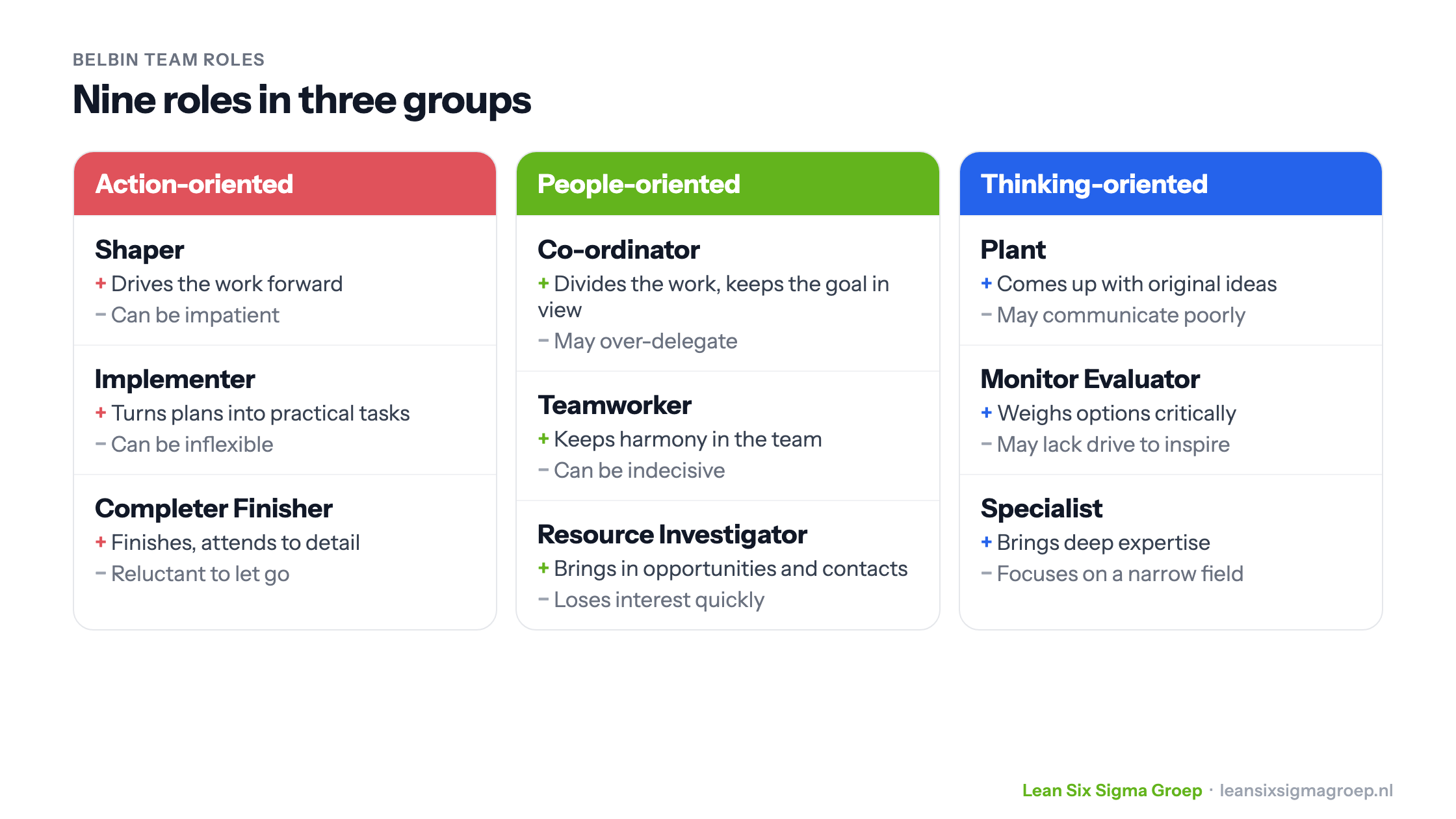
The roles fall into three groups, as shown in the image at the top of this article.
Action-oriented roles
- Shaper: wants to move forward, applies pressure in the right places and removes obstacles. Can be impatient or provocative.
- Implementer: a doer who turns plans into practical tasks. Structure and discipline matter. Can be somewhat inflexible and slow to respond to new possibilities.
- Completer Finisher: makes sure work is really finished, dots the i’s and spots risks. Can find it hard to let go and worry too much.
People-oriented roles
- Co-ordinator: the natural co-ordinator, who makes sure the right person is in the right place to reach the goal. Doesn’t have to be the smartest or most creative. May over-delegate.
- Teamworker: sensitive and focused on harmony, the oil in the team’s machine. Can be indecisive in difficult choices.
- Resource Investigator: a networker looking outward, who brings in opportunities and contacts. Loses interest quickly once the novelty wears off.
Thinking-oriented roles
- Plant: the creative thinker with original ideas. The name comes from the idea of “planting” such a person in a team to generate new ideas. Can be somewhat introverted and lose sight of practicalities.
- Monitor Evaluator: analytical, critical and thoughtful; weighs options carefully. May lack the drive to inspire others.
- Specialist: brings deep expertise, and is often more of a loner than a team player. Belbin added this role in 1988. Sometimes focuses on too narrow a field.
Balanced teams
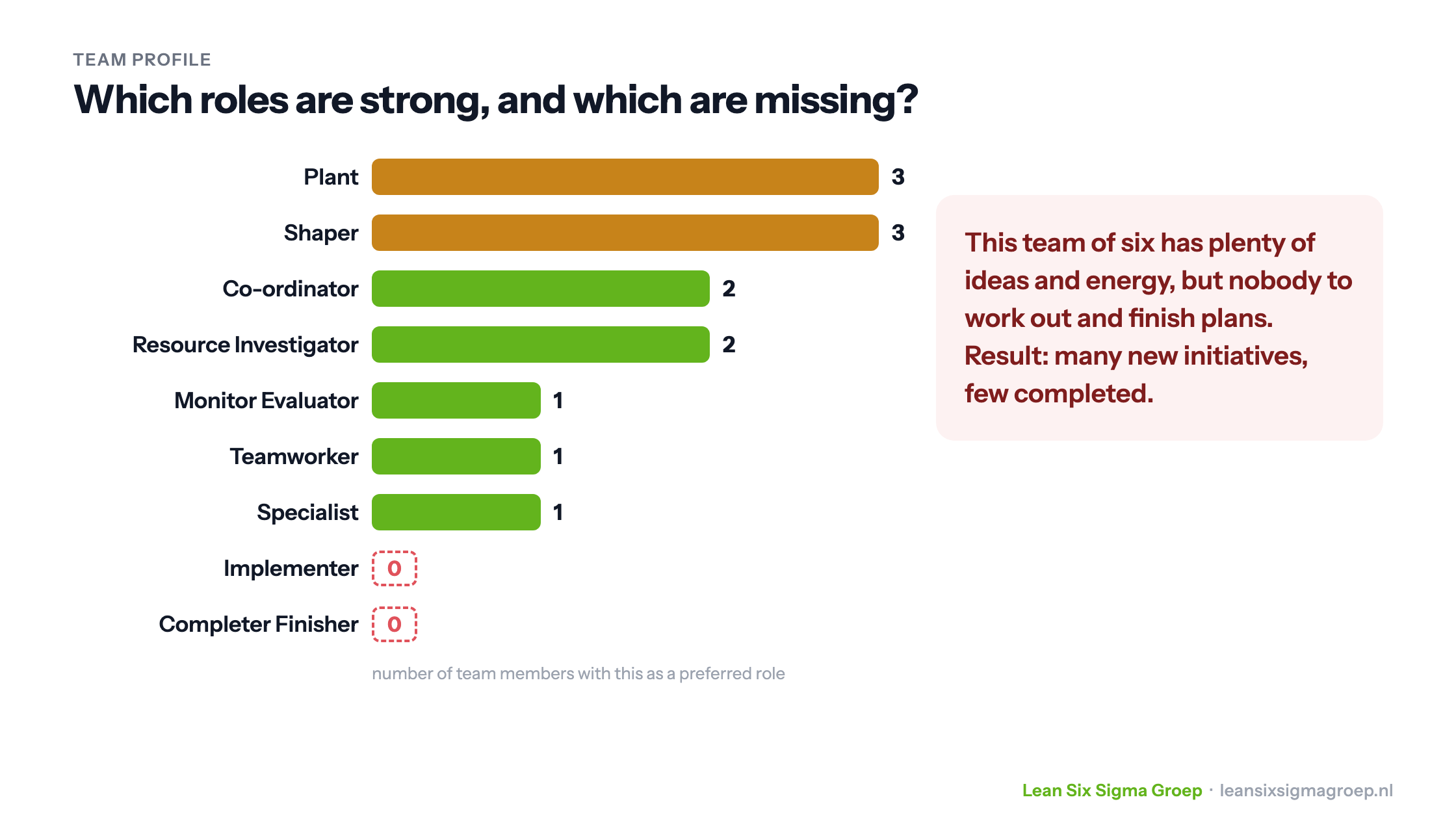
Once a team has worked together for a while, preferred roles become visible in how the team works and what it delivers. A team with many Plants comes up with wonderful plans but rarely gets to execution. A team with several Co-ordinators has pleasant meetings but achieves little. And without a Completer Finisher, work often doesn’t quite get finished. A team profile makes that visible.
This is one of the tools you learn to apply in the Green Belt training.
What is my team role?
You determine your team role with a questionnaire. The official Belbin test is the most extensive, with control questions and the option for colleagues to assess how they see you. There is a cost for this test. There are also shorter, free versions that give a first impression.
It helps to take the test with the whole team and discuss together which roles are strongly present and which are missing. A missing role needn’t be a problem, as long as the team knows: then someone can consciously take on that role, or you bring someone in.
Belbin in practice
In our Agile Coach training course we use the Belbin team roles to discuss team dynamics, and how you can steer them as a coach. Questions about the team roles or the Belbin test? Feel free to contact us.
The video with this article shows how the different roles contribute to a team’s success.
From theory to practice
Learn to apply this in practice
Topics like Belbin team roles are applied directly to an improvement project from your own organisation in the Green Belt training.
Next start dates
Lean Six Sigma Green Belt training →Not ready for a training yet?