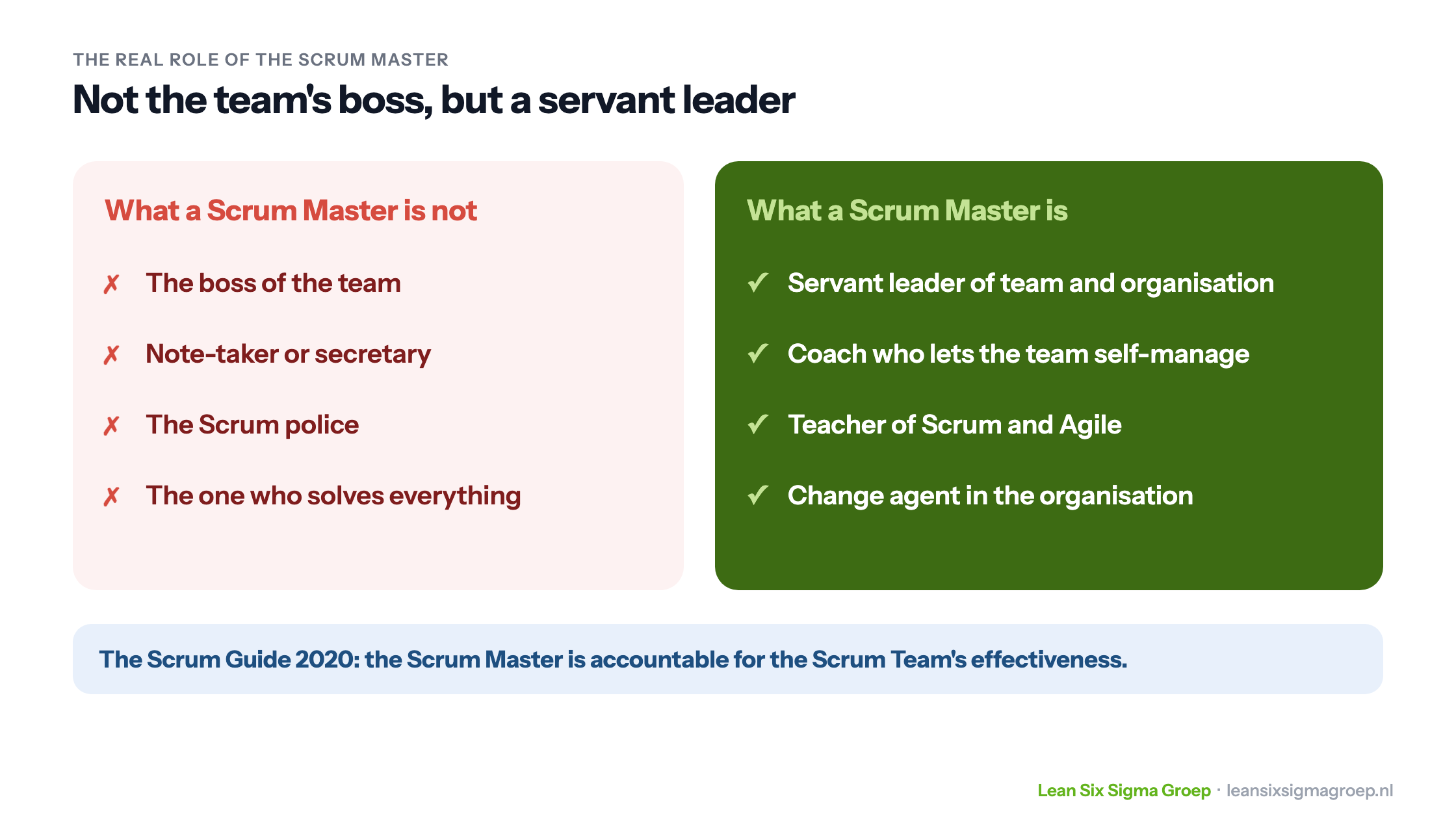
Many people see the Scrum Master as the team’s boss, the chair of meetings or the person who takes the minutes. That is not what it is. The Scrum Master is a servant leader: someone who helps the team and the organisation make Scrum really work, without taking control. A master in the sense of a craftsman, not in the sense of a boss.
What a Scrum Master does day to day, for the team, the Product Owner and the organisation, is covered in What is a Scrum Master? This article is about the attitude behind those tasks.
Not the boss, but accountable
The Scrum Guide 2020 is clear: the Scrum Master is accountable for the Scrum Team’s effectiveness, and is a true leader who serves the team and the organisation. That sounds contradictory, but it isn’t. The Scrum Master doesn’t steer what the team does, but ensures the team can work as well as possible. The image at the top of this article puts the misconceptions and the reality side by side.
A Scrum Master who acts like a boss makes the team dependent. The team starts waiting for answers and instructions, and so doesn’t become self-managing. A Scrum Master who acts as note-taker or planner becomes a secretary instead of a coach.
Doing Agile or being Agile
Scrum is built on the values of the Agile Manifesto: collaboration, working results, customer collaboration and responding to change. But there is a world of difference between doing Agile and being Agile. A team can hold all the events and still work the old way.
Scrum only works when the values are carried by the team and the organisation around it. The Scrum Master helps with that: by teaching the team to manage itself, take responsibility for quality, hold each other accountable and learn together. The fifth Agile principle puts it this way: build projects around motivated individuals, give them the environment and support they need, and trust them to get the job done.
Guardian of a safe environment
Scrum is about empiricism: learning by doing, looking and adjusting. Discovering mistakes early is then a gain. But that only works if people dare to report mistakes. In a culture of control and punishment, Scrum becomes a ritual without effect.
The Scrum Master creates and protects that safety, in the team and beyond. Sometimes that means a conversation with a manager who steers too much, or with a Product Owner who imposes decisions instead of having the conversation.
Eight stances
Barry Overeem described eight stances a Scrum Master takes in turn. A good Scrum Master knows which stance fits at which moment.
This is one of the tools you learn to apply in the Green Belt training.
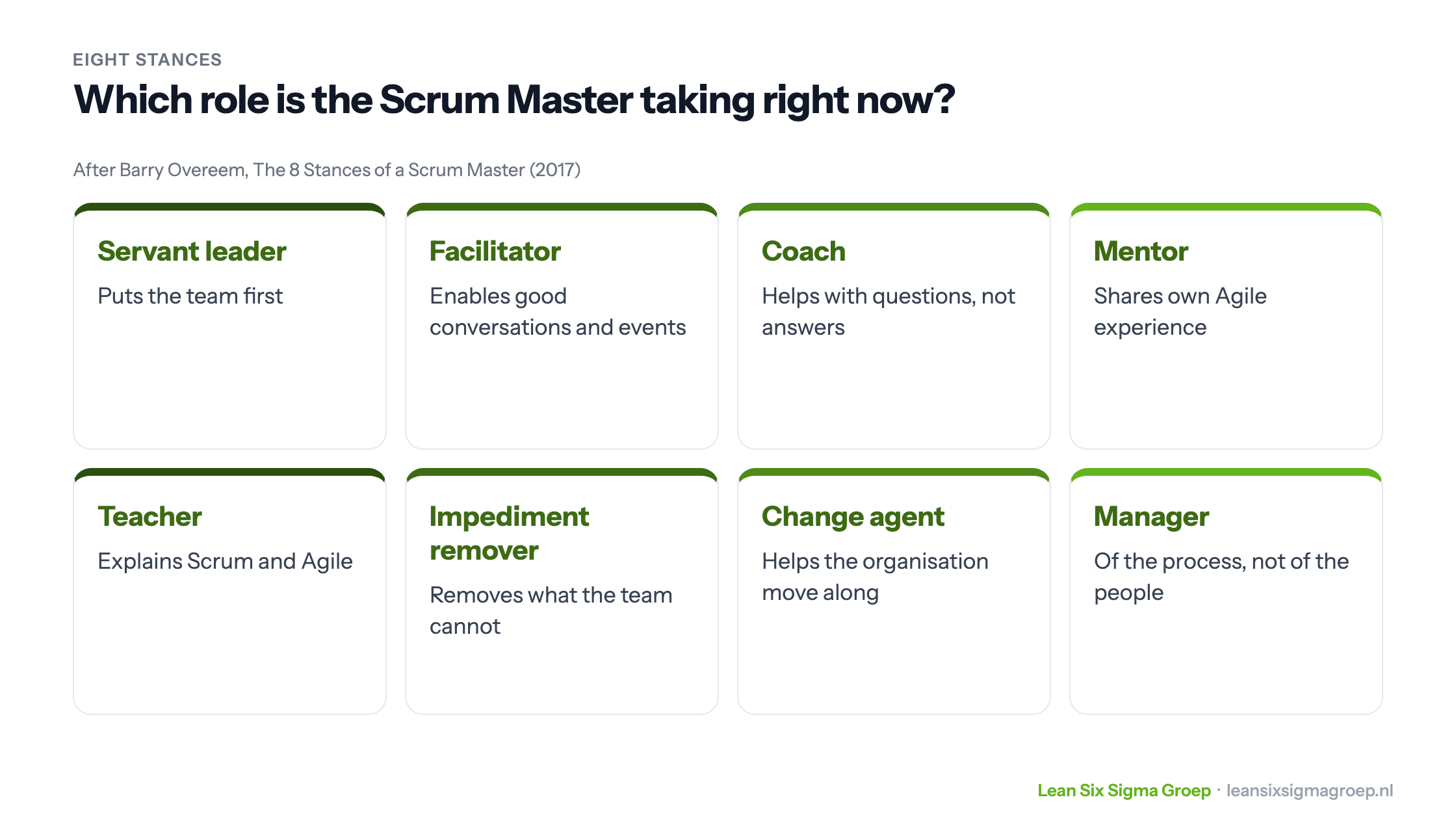
A new team often needs a teacher, who explains how Scrum works. A team that is stuck more often needs a coach, who helps it find the solution itself through questions. And when the problem lies outside the team, for example in how budgets or decisions flow in the organisation, the Scrum Master is a change agent. The “manager” in the list is about the process, not the people.
Servant leadership starts with setting an example
Leadership in an Agile environment means serving, not steering. That applies not only to the Scrum Master but also to managers. People don’t follow words, they follow behaviour. An Agile transformation that only happens at team level gets stuck on the way the rest of the organisation works. That is why the Scrum Master also works with managers, often together with an Agile Coach.
Agile working doesn’t stop at Scrum either. Kanban and Lean share the same values: short feedback loops, self-management and continuous improvement.
Become a Scrum Master yourself?
Our Agile training courses, including the Scrum Master course, teach you how to make Scrum work in your organisation, guide teams towards self-management and lead without steering.