Scrum is a lightweight framework that lets teams deliver value in short cycles, learning and adjusting along the way. The team decides itself how to solve the customer’s question. Scrum is the best-known form of Agile working and comes from software development, but is now used for all kinds of teamwork.
The idea behind Scrum
Scrum assumes you don’t know everything at the start of a project. So you work in short cycles, sprints. Each sprint you deliver something usable, gather feedback and adjust the plan. Reprioritising is built into the way of working, so the team constantly adapts to changing circumstances and wishes.
The elements of Scrum
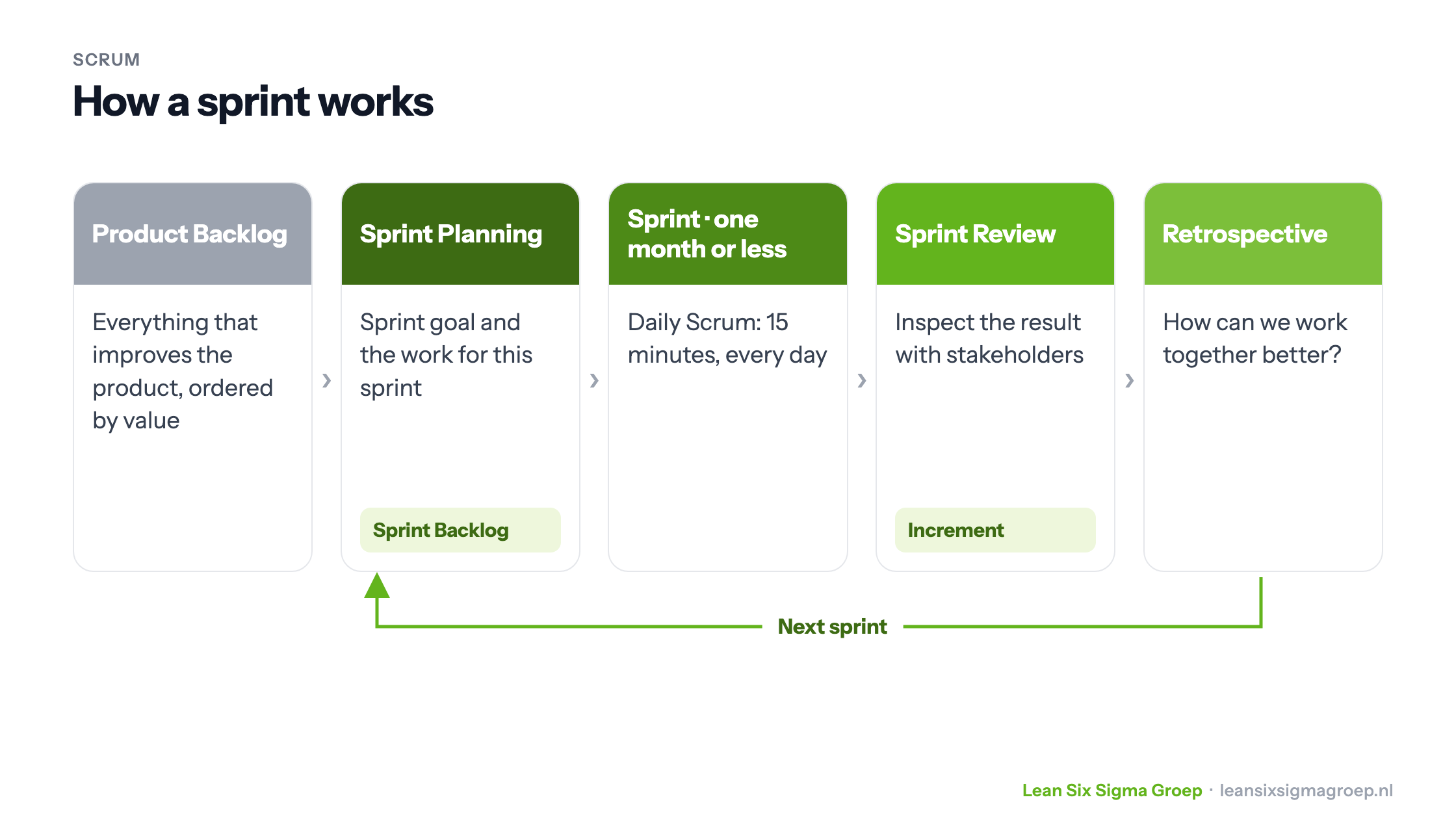
Scrum consists of three accountabilities, five events and three artifacts. The image at the top of this article shows how a sprint works.
Sprints
A sprint lasts a fixed period of one month or less, often two or three weeks. Each sprint produces at least one usable result. A new sprint starts immediately after the previous one. The sprint is itself an event: all other events take place within it.
The three accountabilities
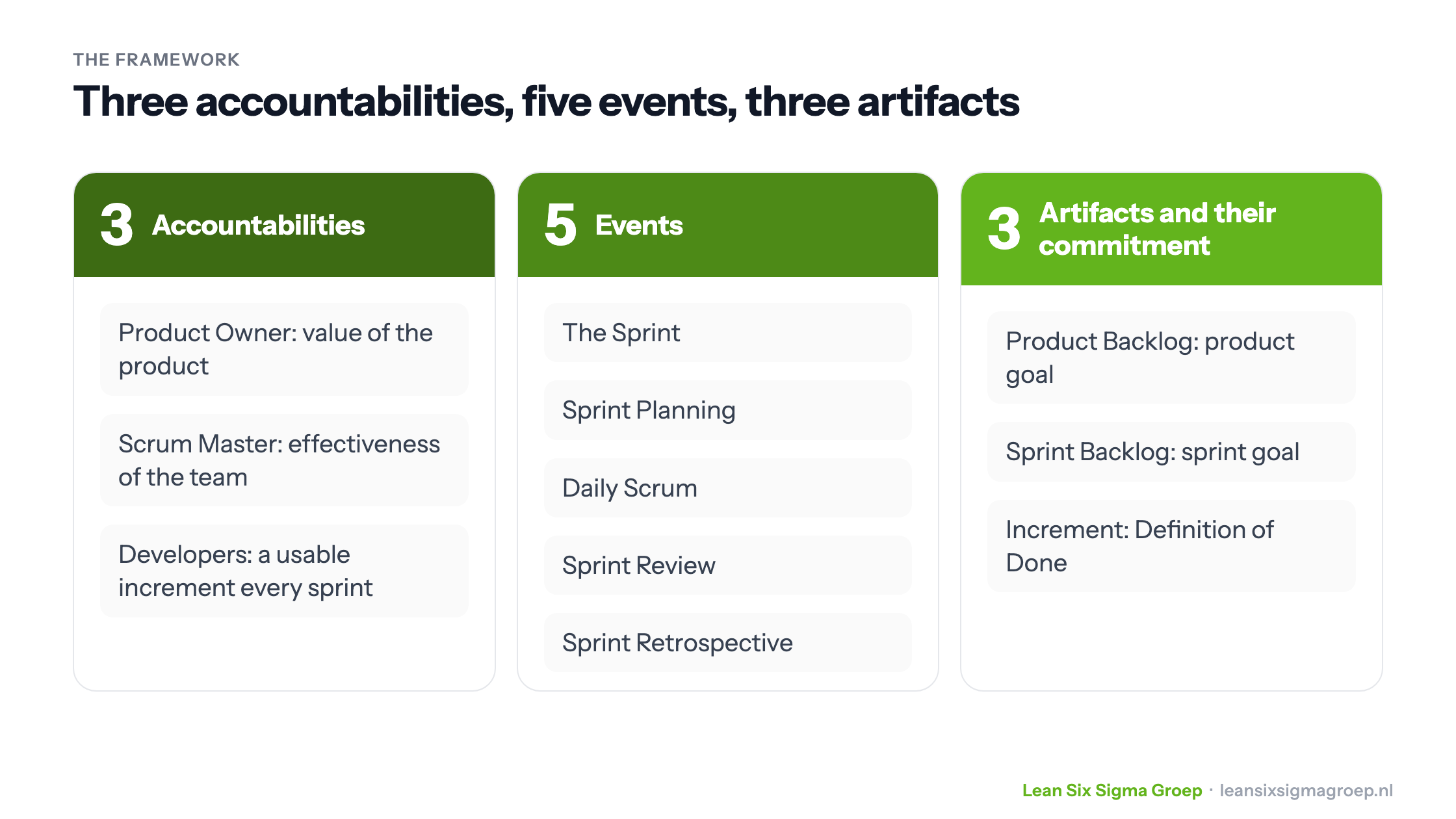
A Scrum Team is cross-functional: together the team has all the skills needed to deliver value every sprint. The team is self-managing: team members decide among themselves who does what, when and how.
- Product Owner: accountable for the value of the product. Manages the Product Backlog and works with stakeholders.
- Scrum Master: accountable for the effectiveness of the team. Coaches the team and helps the organisation understand and apply Scrum.
- Developers: the team members who create a usable result every sprint. They don’t have to be programmers.
The five events
- The sprint itself, the container for all other events.
- Sprint Planning: the whole team sets the sprint goal and the work for the sprint.
- Daily Scrum: at most 15 minutes every day in which the developers review progress towards the sprint goal and adjust their plan for the day.
- Sprint Review: the team shows the result to stakeholders, and together they decide the next step.
- Sprint Retrospective: the team looks back on collaboration, way of working and the Definition of Done, and chooses improvements for the next sprint.
This is one of the tools you learn to apply in the Green Belt training.
The three artifacts
Each artifact has a commitment that provides direction and focus:
- Product Backlog: an ordered list of everything needed to improve the product. Items are often written as user stories, wishes from the user’s perspective. The commitment is the product goal.
- Sprint Backlog: the sprint goal (why), the selected items (what) and the plan to deliver them (how). Teams often make it visible on a Scrum or kanban board. The commitment is the sprint goal.
- Increment: the usable result of the sprint. The commitment is the Definition of Done: the agreements on when something is really finished.
Where does Scrum come from?
The name comes from rugby: the scrum, in which the whole team pushes forward together. In 1986, Hirotaka Takeuchi and Ikujiro Nonaka described in Harvard Business Review how successful product teams worked this way. Jeff Sutherland and Ken Schwaber developed this into a framework for software development in the 1990s and presented it in 1995.
Their aim was to let software deliver value faster and limit risks, instead of delivering something only after months of work without consulting the customer in between. Schwaber and Sutherland wrote The Scrum Guide, the official description of Scrum, last updated in 2020.
What can you do with it?
Scrum lets teams decide for themselves, within fixed boundaries such as laws, regulations and budget, how to solve the customer’s question. By working in short cycles and aligning with the customer each time, you quickly see whether the team is on course. Scrum started in software development, but its principles work for all kinds of teamwork, from marketing to education.
Scrum and Agile
Scrum and Agile are often used interchangeably, but they are not the same. Agile is a way of thinking, captured in the Agile Manifesto. Scrum is a concrete framework for putting that way of thinking into practice. Other examples are Kanban and SAFe.
The video with this article gives a short explanation of Scrum.
From theory to practice
Learn to apply this in practice
Topics like Scrum are applied directly to an improvement project from your own organisation in the Green Belt training.
Next start dates
Lean Six Sigma Green Belt training →Not ready for a training yet?