
The SAFe model is a framework for organisations in which multiple teams work on (complex) products in a constantly changing environment. It sets up an organisation in an Agile way, with the focus on generating customer value and continuously improving the quality of the product delivered.
SAFe combines Scrum, Kanban and Lean and scales them up, so that multiple teams work in alignment with one another to deliver value to the customer continuously.
Background and purpose
In a world where change, planned and unplanned, follows change ever more quickly, the ability to transform is becoming an increasingly essential quality. Companies will have to adapt their services faster and faster to keep meeting customer needs, regulations and technological developments.
That makes it ever harder for the existing IT infrastructure, the business model and the organisational structure (hierarchy) to keep pace with change. The SAFe model (Scaled Agile Framework) helps organisations behave and organise themselves in such a way that they can keep up with the pace of change in customer needs, regulations and technology.
How does SAFe work?
The SAFe model is organised around a number of fixed functional levels in the organisation. These levels are aligned in such a way that they all work to the same cadence to deliver customer value.
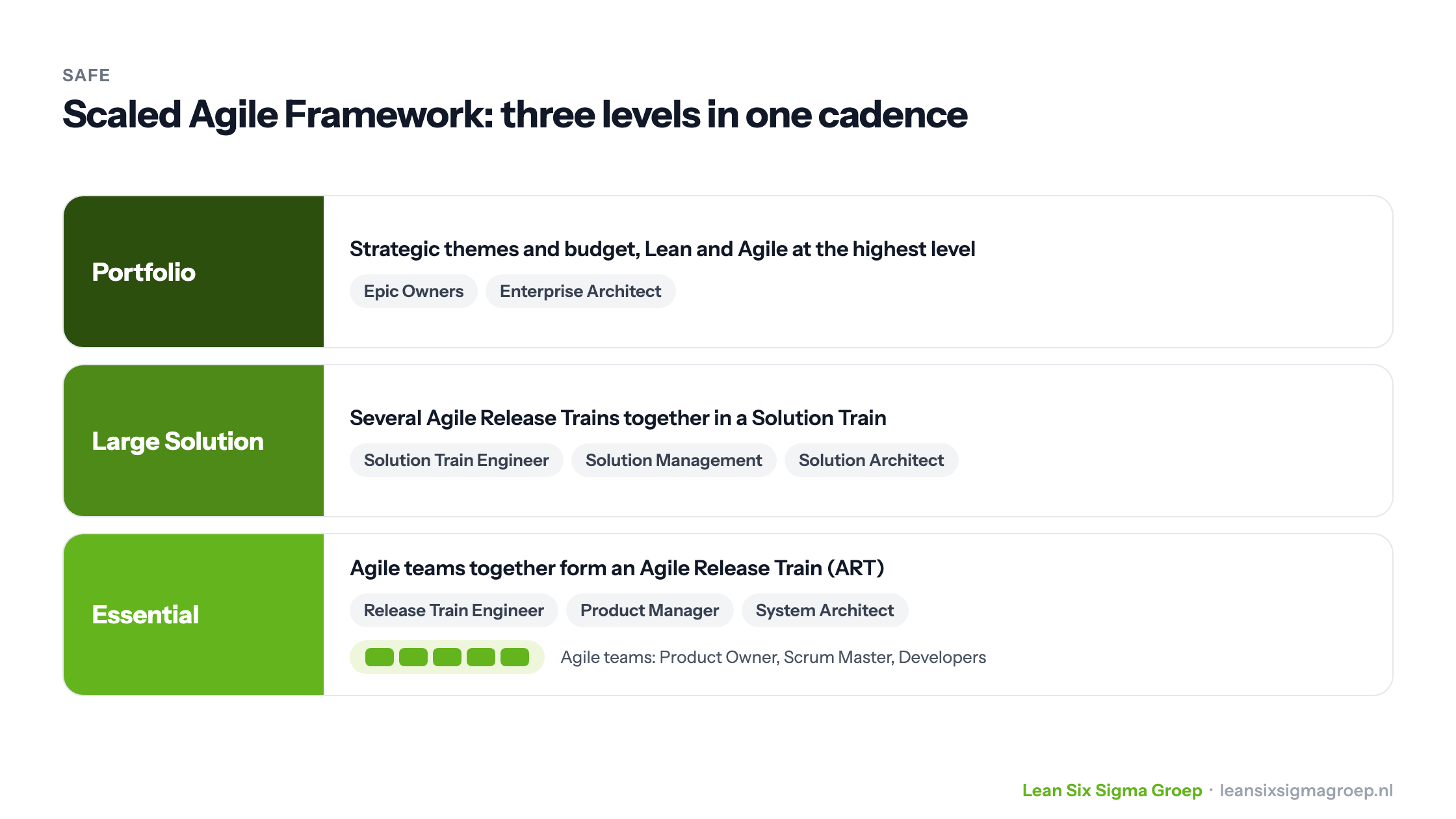
SAFe has three levels, which can be used separately or together
Essential (formerly the Program and Team Level):
SAFe sets out a number of minimum criteria that must be in place to deliver through Agile Teams and an Agile Release Train:
- Self-organising teams made up of a Product Owner, a Scrum Master and Developers. The Scrum framework and Kanban are used to deliver products.
- Several Agile Teams together form an Agile Release Train (ART). This collaboration produces what is known as a Continuous Delivery Pipeline (CDP), in which a (partial) product is delivered at a fixed cadence.
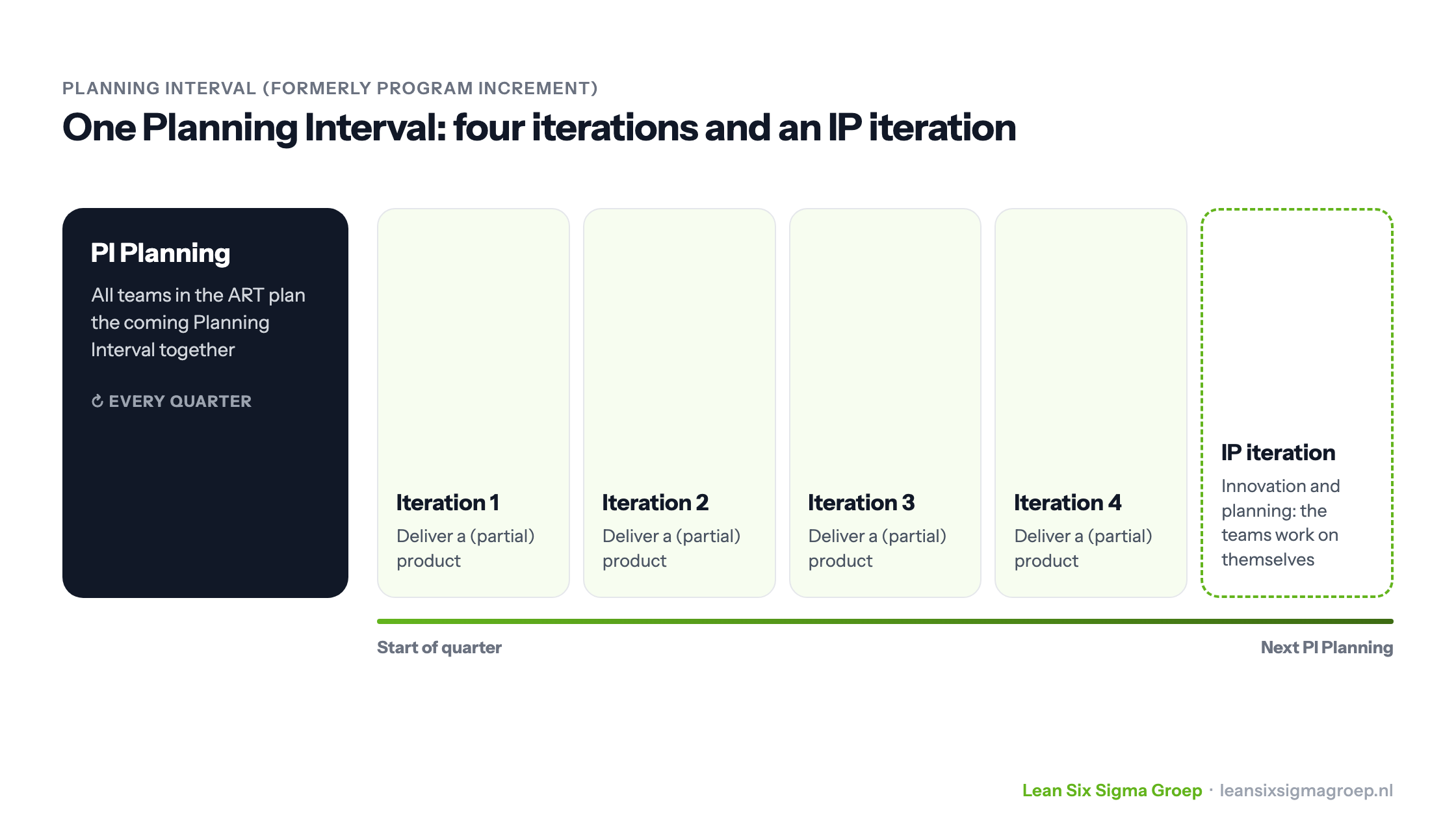
- Work is organised in Planning Intervals (called Program Increments until SAFe 6.0 in 2023): fixed timeboxes of usually eight to twelve weeks. A Planning Interval usually consists of five iterations. In the first four, a (partial) product is delivered. The fifth is the IP Iteration: the Innovation and Planning Iteration. No work is done on a partial product; instead, the teams work on themselves and come up with creative ideas.
Several roles are crucial in the Essential layer:
- The Product Manager manages the ART Backlog (formerly the Program Backlog) and the product. He or she is responsible for making sure the right features are included and that the product is delivered in line with customer needs.
- The Release Train Engineer steers the Agile Release Train. Much like a Scrum Master, he or she is responsible for the process as a whole and safeguards the rules of the SAFe way of working.
- The System Architect makes sure the architectural guidelines are followed.
At the start of each Planning Interval, usually every quarter, all teams in an ART plan the work together in PI Planning. By the end of the session, it is clear what each team will be working on for the next three months.
Large Solution: If several ARTs are needed to develop a product, a Solution Train is set up. Here, the Solution Train Engineer oversees the process, Solution Management oversees the product, and the Solution Architect safeguards the technical guidelines.
Portfolio: Agile and Lean principles are applied at the highest level of the organisation to steer the Strategic Themes. This also embeds Business Agility, the organisation’s ability to adapt, at this level. Epic Owners oversee the prioritisation of the Strategic Themes, including budgeting.
The Enterprise Architect is responsible for setting and safeguarding the technical guidelines.
Full SAFe: the combination of all three levels. This configuration is meant for the largest organisations, where several Solution Trains fall under one portfolio.
This is one of the tools you learn to apply in the Green Belt training.
Examples in practice
Many large companies work with this method or methods derived from it, such as ING and Aegon. There are also companies that have developed the Agile mindset further themselves within their own development environment, such as Amazon and Spotify.
Alternatives to the SAFe model
Whereas the SAFe model has a fixed structure with clear guidelines and roles, some organisations want to place even more responsibility and trust with the teams themselves, for maximum agility and customer value.
Perhaps the best-known example is the so-called Spotify model.
Characteristics of the Spotify model are
- The organisation creates its own model
- Based on transparency and trust
- Aims for simplicity and few dependencies between teams
- The process description is very brief; collaboration comes first
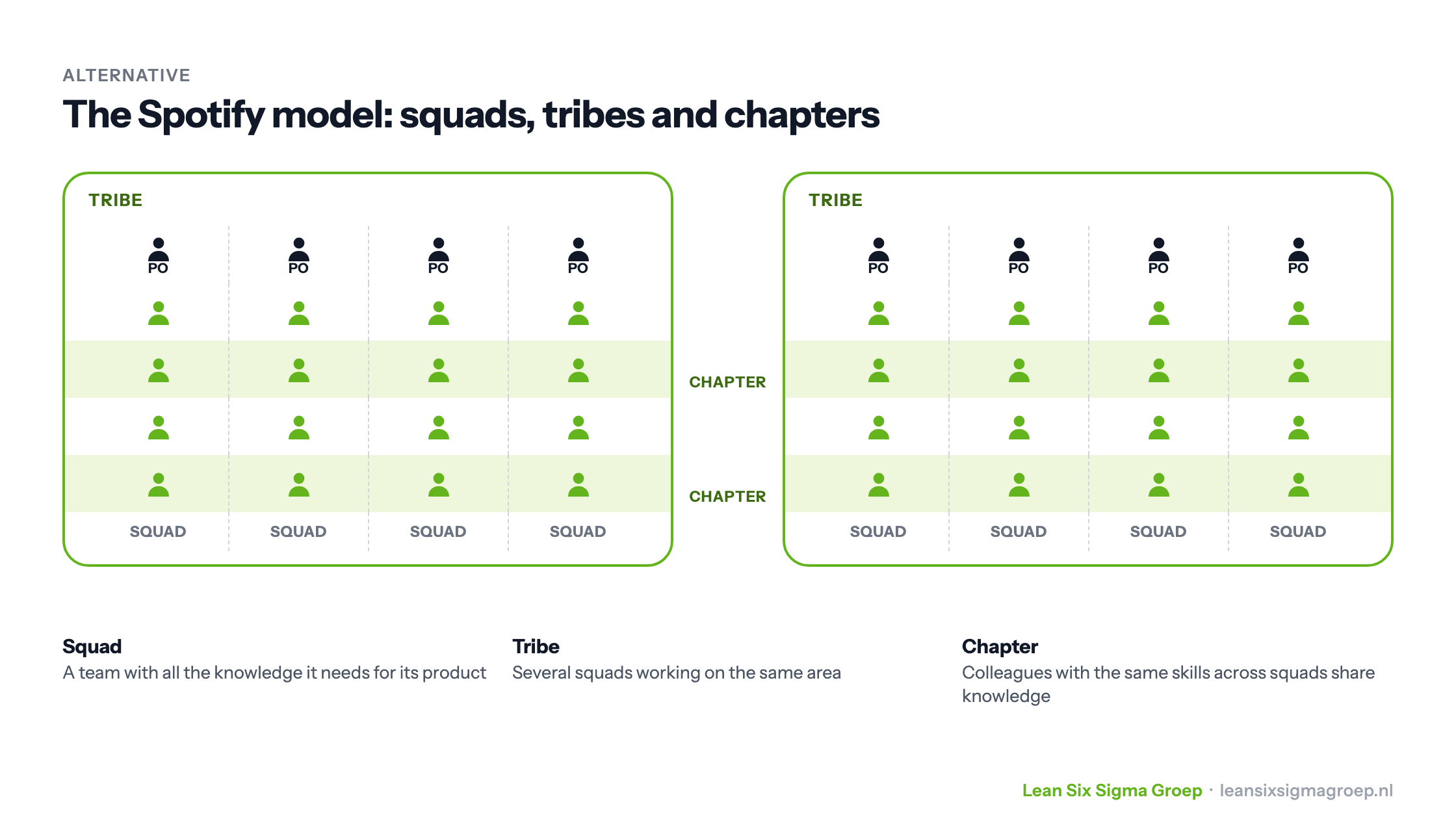
In the Spotify model, teams are organised into what are called Squads. Each Squad has all the knowledge on board for the product it has to deliver. The Product Owner oversees prioritisation, and Agile Coaches can support the collaboration between team members. Several Squads form a Tribe.
Colleagues with the same expertise who work in different Squads within a Tribe come together in so-called Chapters to share experience and knowledge.