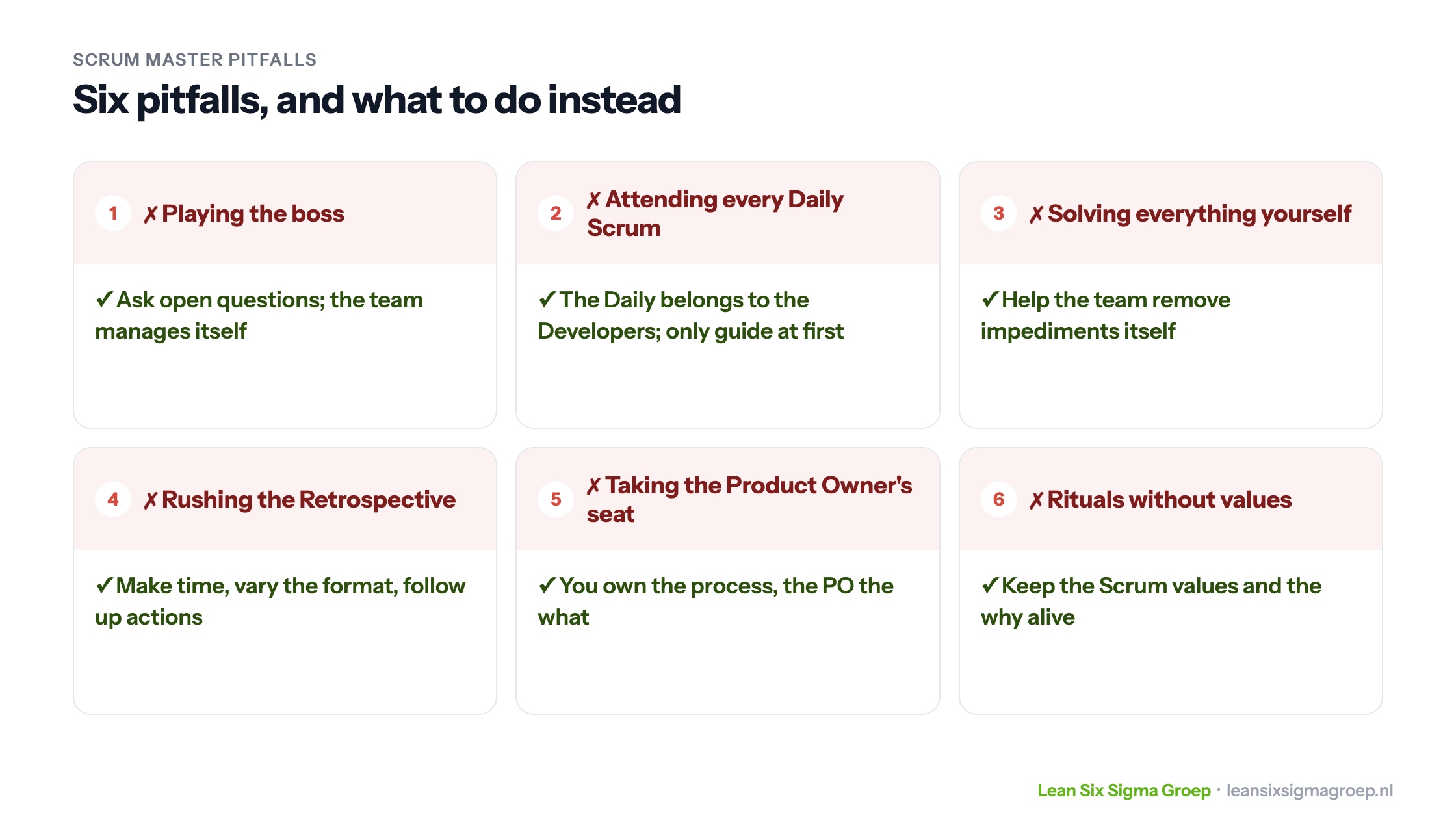
A course and an exam don’t make you an experienced Scrum Master. You mainly learn the role in practice, and that is where many Scrum Masters fall into the same pitfalls. This article lists the six most common, with what to do instead, as shown in the image at the top.
The attitude behind the role is covered in The real role of the Scrum Master; the tasks in What is a Scrum Master?
1. Playing the boss
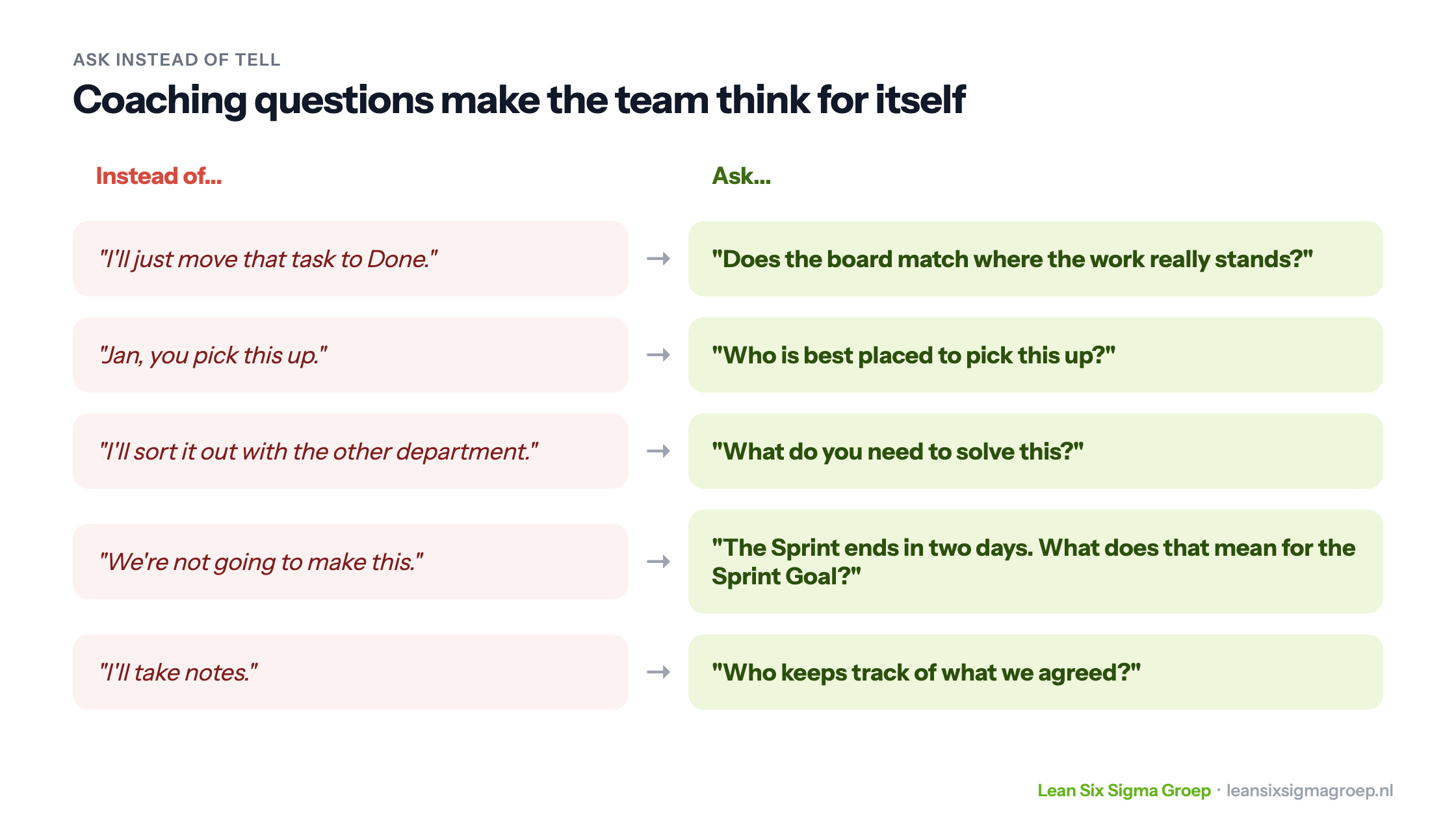
A Scrum Master is not a manager or project manager. Yet you often see it: the Scrum Master does most of the talking during events, moves tasks on the board, assigns the work or takes the minutes. Especially when a manager is given the role, this is a risk. The result: the team looks to the Scrum Master for answers, and doesn’t become self-managing.
What to do: ask open questions, allow silences and keep asking. Give the responsibility back to the team. Examples of such questions are shown below.
2. Attending every Daily Scrum
The Daily Scrum belongs to the Developers. They discuss progress towards the Sprint Goal and adapt their plan. The Scrum Master ensures the Daily takes place and that the team knows how to run it well, but doesn’t always have to be there.
What to do: guide the first few, make clear what the Daily is for, and then drop in now and then. Agree when the team will call you in.
3. Solving everything yourself
The Scrum Master causes impediments to be removed, but that doesn’t mean solving them all personally. Fixing every problem for the team takes away its chance to learn. And making mistakes is allowed: that is how a team learns.
What to do: guide the conversation about the impediment instead of offering a solution straight away. “We see X as a problem. Who knows a way to solve it?” Only take on yourself what lies outside the team’s influence.
This is one of the tools you learn to apply in the Green Belt training.
4. Rushing the Retrospective
The Sprint Retrospective is the moment for the team to get better. Yet it is often shortened or skipped when things are busy, which is exactly when it is most needed.
What to do: plan enough time, make it a safe place, vary the format and make sure agreed improvements are actually picked up. Start the next Retrospective by asking whether they worked.
5. Taking the Product Owner’s seat
Some organisations combine the Scrum Master and Product Owner roles, or the Scrum Master starts interfering with the content. That causes confusion. The Product Owner is responsible for what is built and in which order; the Scrum Master for how the team works. They are different accountabilities requiring different skills.
What to do: keep the roles separate and agree together who is responsible for what. Ask questions about the process, not the content.
6. Rituals without values
A team can hold every event neatly and still not work Agile. Then Scrum has become a meeting schedule. Scrum rests on five values: commitment, focus, openness, respect and courage. Without them the Daily becomes a status report and the Review a presentation without conversation.
What to do: keep explaining the why. Now and then, discuss in the Retrospective how the team puts the values into practice, and look together at the Agile values Scrum is built on.
Conclusion
Scrum stands or falls with good guidance. The common thread in all these pitfalls: the Scrum Master takes over too much. Those who give the team room, ask questions and are patient gradually make themselves less necessary for day-to-day matters, and then have time for the organisation around the team.
Want to learn to fill the role well? Take a look at our Agile training courses.