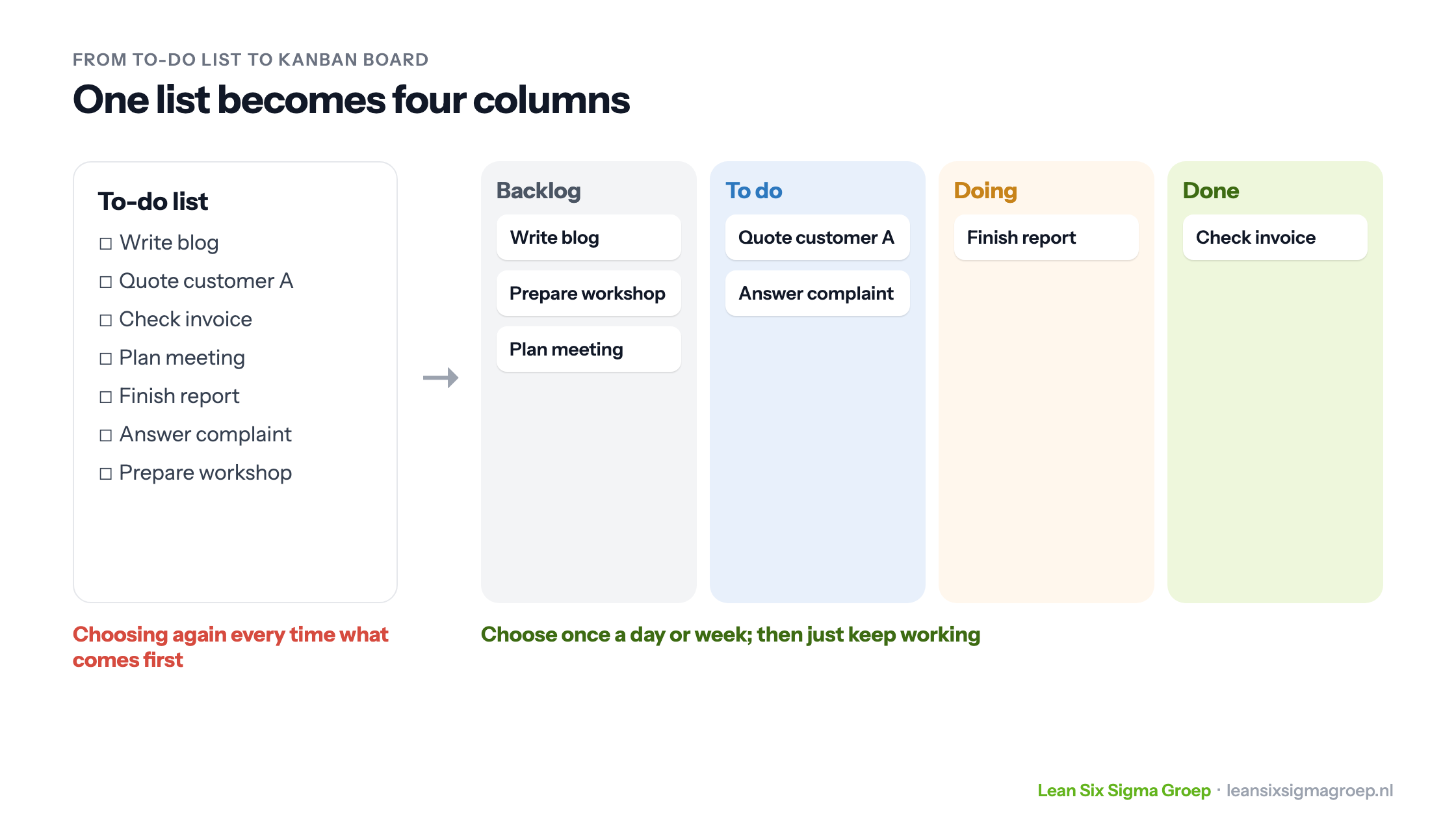
A Kanban board shows what needs doing, what is in progress and what is done. Combine it with a short daily meeting, a daily stand-up, and the team gets overview and focus in fifteen minutes every day. This article shows how to go from an ordinary to-do list to such a board, and how to run the stand-up at the board.
What is Kanban?
Kanban roughly means “visual board” or “signal card” in Japanese. It comes from Toyota’s just-in-time production: a card signalled when a process step needed new material. A well-known example is two-bin Kanban: at the workstation there are two bins of, say, screws. When the first is empty, you take the second, and the empty bin is the signal to refill. That way there is never too much and never too little stock.
Today Kanban is widely used in services and knowledge work. There the cards are tasks, and the board shows where each task stands.
From to-do list to Kanban board
Many people work with a to-do list. Everything is on it, and every time you look at it you choose again what comes first: what is urgent, what is important, what do I have the concentration for right now? Unnoticed, that takes a lot of time. And some tasks, like writing this article, keep getting pushed back. Show the same list to a colleague, and they choose a different order.
With a Kanban board you turn that one list into four columns, as shown in the image at the top of this article:
- Backlog: everything that needs to happen at some point.
- To do: what you will really take on this week or today.
- Doing: what you are working on now. Keep this column small.
- Done: what is finished.
So you choose once a day or week what moves from the backlog to “to do”, and then you just keep working. It becomes really powerful when a team shares a board, for example when you depend on each other or share a workload. That can be a physical board with sticky notes or a digital board; how to set one up in Trello is covered in The Kanban method in Trello.
The stand-up at the board
When a team works with a board, the need for a fixed moment to look at it together arises naturally. That is the daily stand-up: every day at the same time, standing, at most fifteen minutes.
This is one of the tools you learn to apply in the Green Belt training.
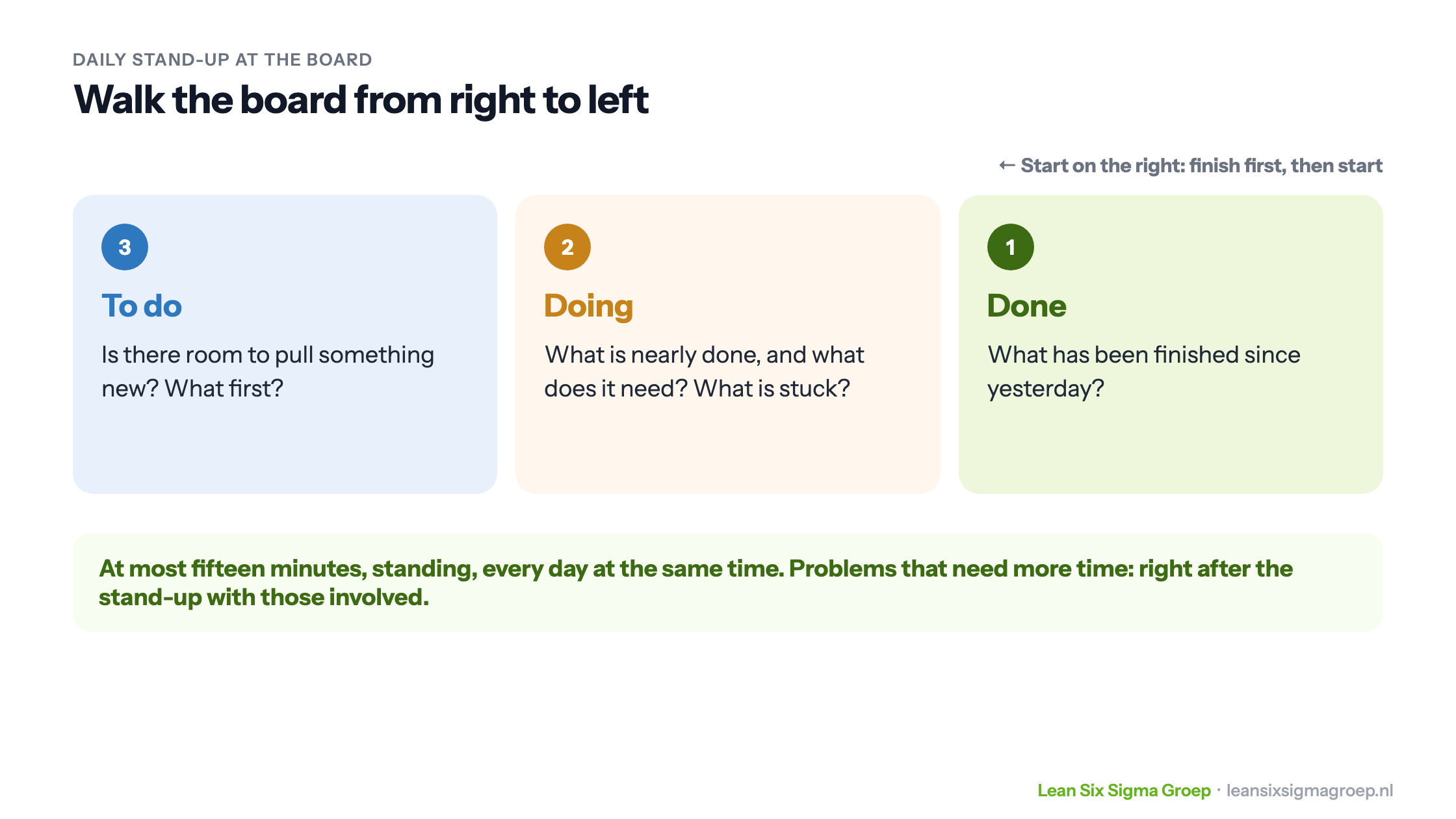
A useful way to run it: walk the board from right to left, as shown above. Start with what is done, then move to what is nearly done and what is stuck, and only last see whether there is room for new work. That puts the emphasis on finishing rather than starting. The difference from the classic round of everyone (“what did you do yesterday?”) is that it is about the work, not the people.
Problems that need more time are not solved in the stand-up. Agree who will discuss it, and do so straight afterwards with those involved. That keeps the stand-up short, and it often produces a new card on the board.
What it delivers
- Overview: everyone sees what the team is working on, without anyone having to ask.
- Focus: by doing little at once, things get finished faster.
- Problems spotted earlier: a card that stays in “doing” for days stands out.
- Energy: seeing every day what has been finished is motivating.
If you work with Scrum, this meeting is called the Daily Scrum. It belongs to the Developers and is about progress towards the Sprint Goal; the board is then usually the Sprint Backlog.
Want to know more about this way of working? Take a look at our Agile training courses.