Trust is the basis of every form of collaboration. But trust doesn’t arise by itself: you have to get to know each other, including what drives you. Management Drives is a method that makes people’s drives visible, with a colour for each drive. It gives a team a shared language to talk about collaboration.
Trust as the foundation
In his well-known model of the five dysfunctions of a team, Patrick Lencioni describes how everything starts with trust. Without trust, team members don’t dare to engage in conflict, don’t commit, don’t hold each other accountable and lose sight of results. According to Lencioni, the key to trust is the willingness to be vulnerable. Read more in The Lencioni pyramid.
Bruce Tuckman also described how a team goes through stages: forming, storming, norming and performing. In the first stage team members get to know each other as if they were strangers. The better that goes, the faster a team gets through the difficult storming stage.
Above and below the surface
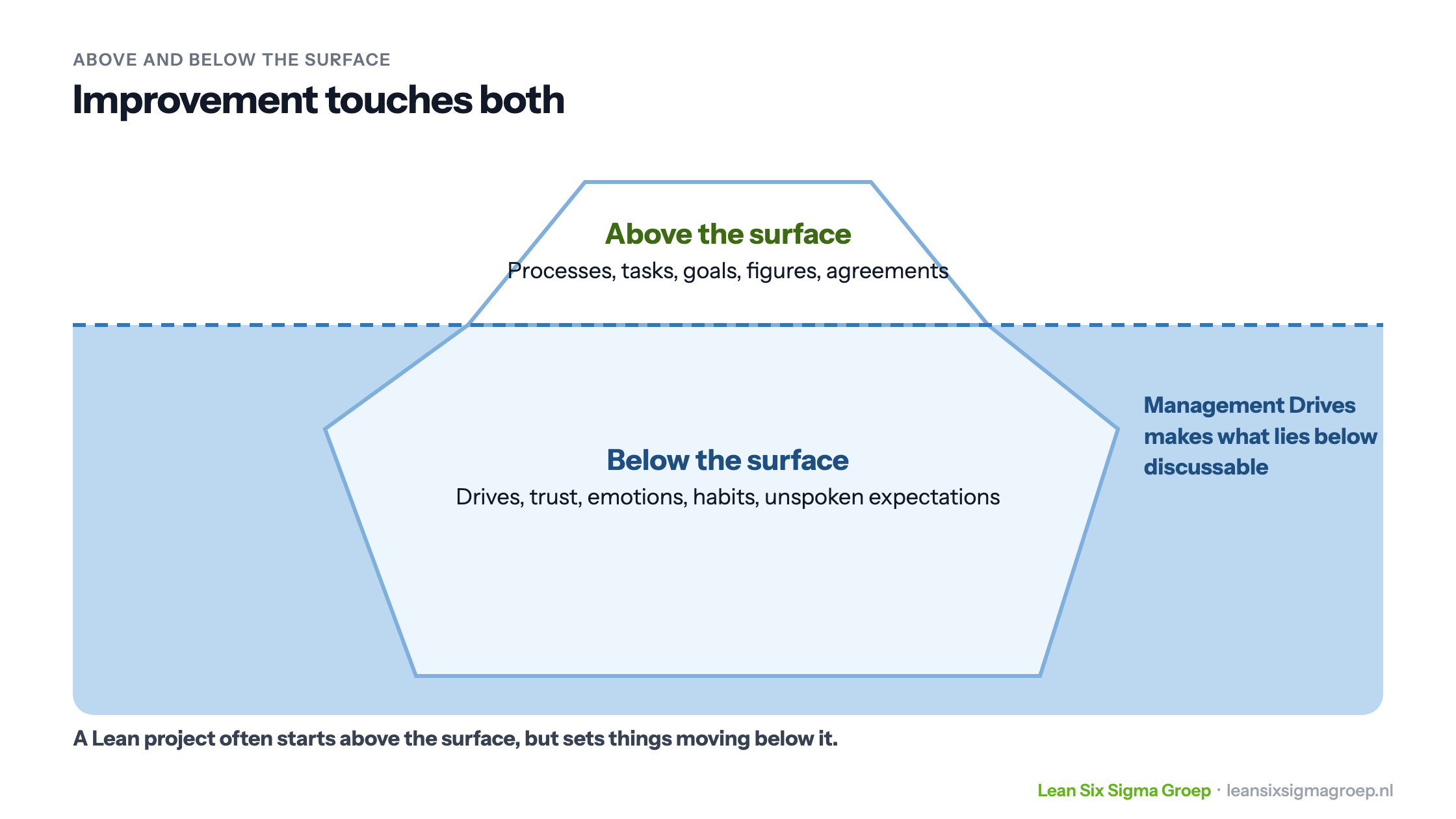
Getting to know each other involves two layers, as shown below. Above the surface is what is visible: processes, tasks, goals, figures and agreements. Below the surface is what lies underneath: drives, trust, emotions, habits and unspoken expectations. In other words: the rational and the emotional level.
This is one of the tools you learn to apply in the Green Belt training.
What is Management Drives?
Management Drives is a Dutch method that uses a questionnaire to map what drives people. Drives are the inner motivations and values that shape how someone thinks, communicates and decides. The method is related to Spiral Dynamics, which goes back to the work of the American psychologist Clare Graves.
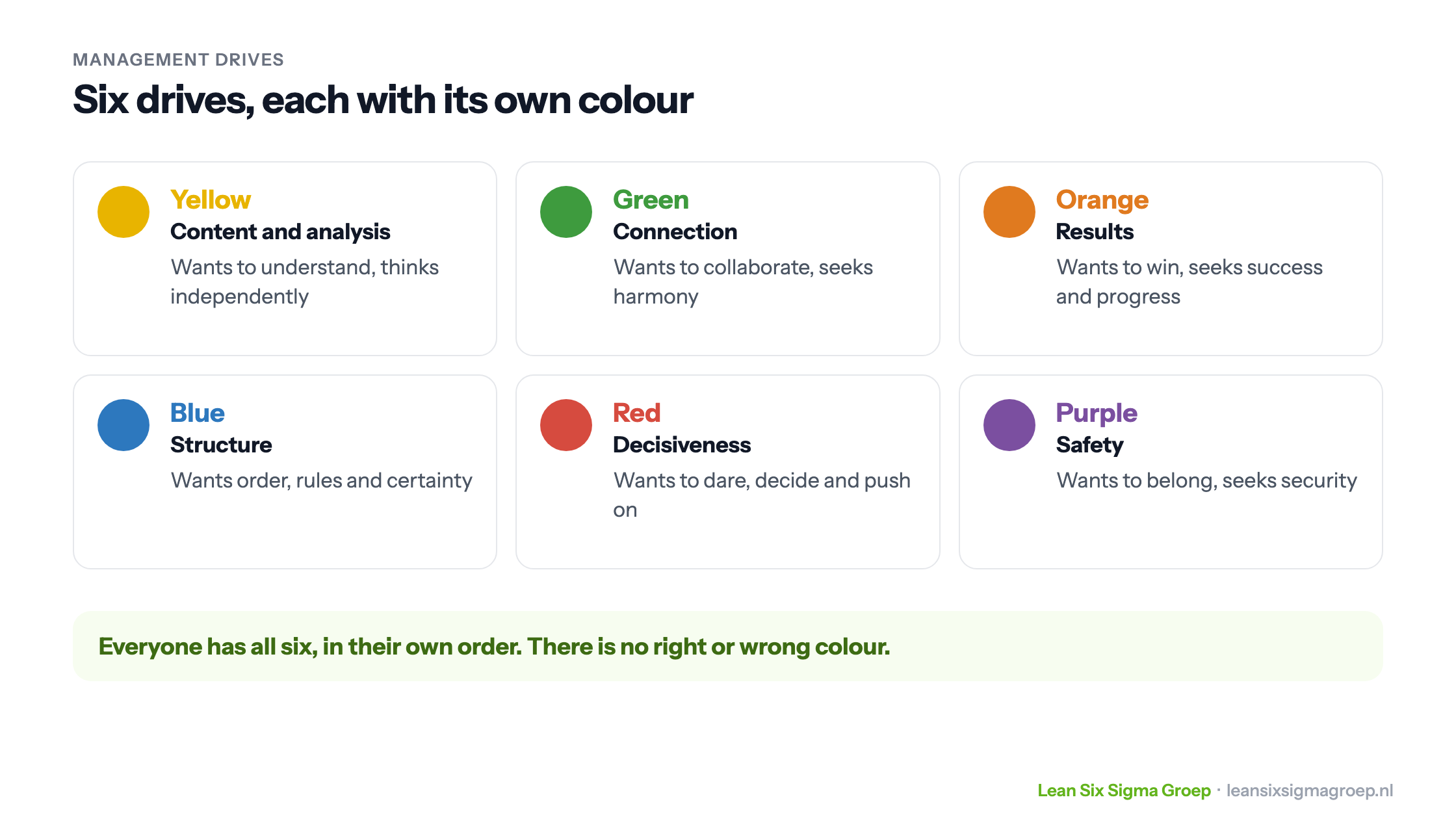
There are six drives, each with its own colour, as shown in the image at the top of this article: yellow (content and analysis), green (connection), orange (results), blue (structure), red (decisiveness) and purple (safety and belonging). Everyone has all six, but in their own order. The questionnaire is followed by a report on your strongest drives and on the drives you reject. The latter is at least as interesting: a colleague driven by exactly what you reject may irritate you, while often complementing the team.
There is no right or wrong colour. The point is to understand what moves you and others, so you can help each other play to your strengths.
Drives in the team
At team level, the profile gives valuable insight:
- Is there enough diversity in the team, or do most members think alike?
- Where does the team’s strength lie, and which drive is missing?
- When does the team get into flow, and when does collaboration cost energy?
It complements other models, such as Belbin’s team roles, which look at the behaviour someone shows in a team. Management Drives looks at what drives that behaviour.
Drives and continuous improvement
Continuous improvement means an organisation is constantly on the move. We are convinced that steering only on the hard side, the processes and figures, delivers too little. An improvement project often starts above the surface, with a change in the process, but sets things moving below it: habits change, roles shift, certainties disappear. Guide that well, and good things happen.
Making the drives in the team discussable increases knowledge and understanding of each other. That strengthens trust, and with it collaboration. Read more about the human side of change in change management.
Want to know how we take what lies below the surface into account in improvement projects and team development? Contact us.