
What is Lencioni’s pyramid?
Lencioni’s pyramid was published by Patrick Lencioni, an American management consultant, in his own book ‘The Five Dysfunctions of a Team’ (2002). The book is written as a story, so the characters and situations in it are easy to recognise in everyday practice.
The model clearly maps out the five main pitfalls of a team, so that you can work towards a successful and effective team.
To develop a team with the help of Lencioni’s pyramid model, every team member has to be able and willing to work on the team. The awareness that something has to change is essential to get more potential out of the team.
The model consists of 5 factors that are essential for good teamwork. These are:
• Focus on results
• Taking accountability
• Strong commitment
• Engaging in constructive conflict
• Mutual trust
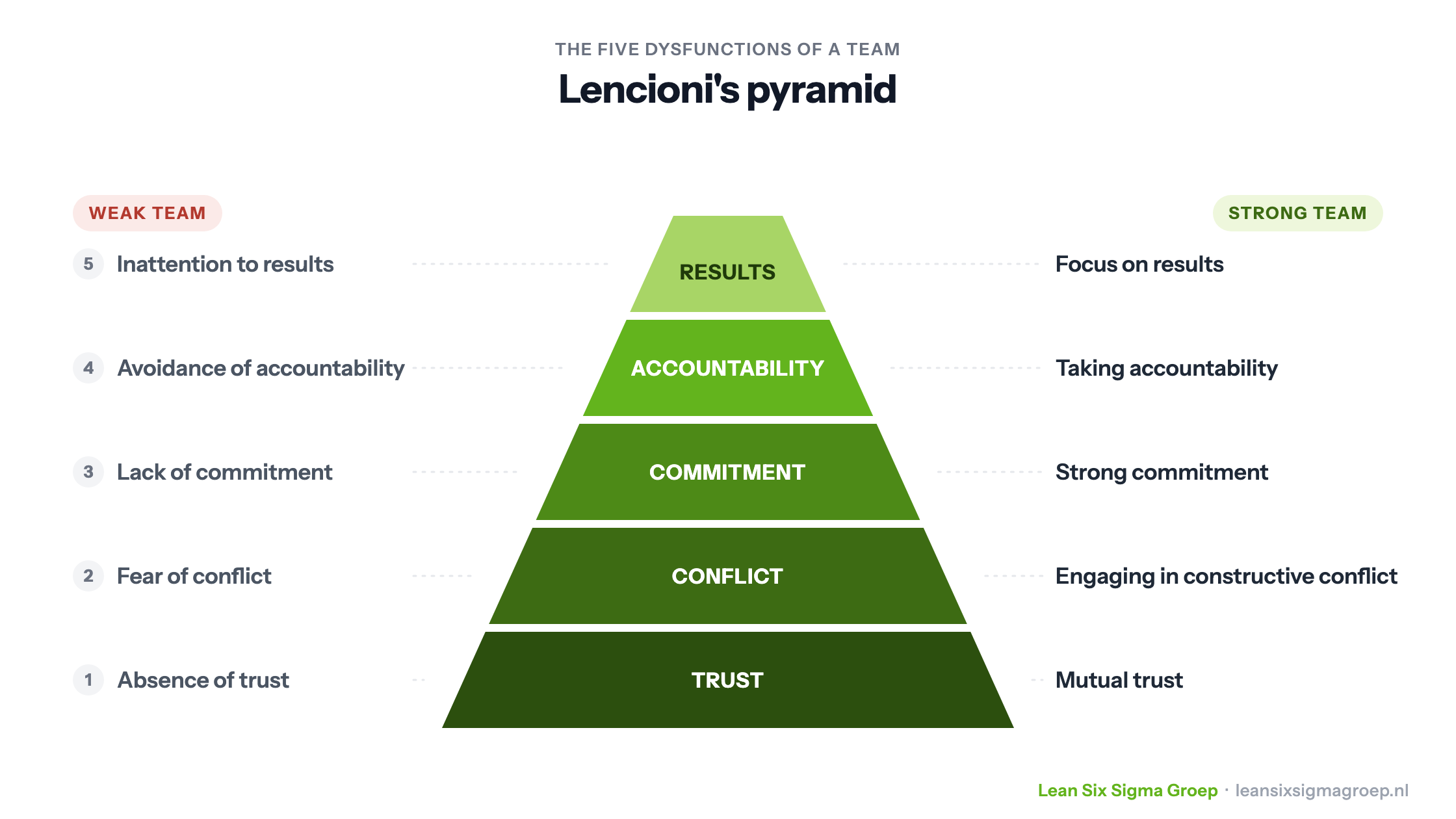
The five dysfunctions of a team
We describe each of the dysfunctions that belong to these layers: absence of trust (1), fear of conflict (2), lack of commitment (3), avoidance of accountability (4) and inattention to results (5).
1. Absence of trust
The fear of being vulnerable in front of team members prevents trust from being built within the team. Trust is the foundation of the model. If there is not enough of it, the team falls apart.
2. Fear of conflict
The desire to preserve artificial harmony stifles productive, ideological conflict. Team members who dare to engage in debate create a healthy dynamic.
3. Lack of commitment
The lack of clarity or buy-in prevents team members from making decisions they will stick to. When team members are sufficiently committed, a climate of clarity and support emerges.
4. Avoidance of accountability
The need to avoid interpersonal discomfort prevents team members from holding one another accountable for their behaviour and performance. At the individual level it comes down to this: everyone has their own responsibility for behaviour, attitude and results.
5. Inattention to results
The pursuit of individual goals and personal status erodes the focus on collective success. When the team’s focus is on results, everyone shares in the success together.
Improving your team with Lencioni’s pyramid
To improve your team and understand which level of dysfunction you are facing, ask yourself these simple questions:
• Do team members share their opinions openly and easily?
• Are team meetings engaging and productive?
• Does the team reach decisions quickly and avoid getting stuck on consensus?
• Do team members confront one another constructively about their shortcomings?
• Do team members put the interests of the team above their own?
Although no team is perfect and even the best teams sometimes struggle with one or more of these problems, the best organisations work continuously to make sure their answers are ‘yes’. If you answered ‘no’ to many of these questions, your team may need some work.
In the video below, Patrick Lencioni gives a concise description of the model:
This is one of the tools you learn to apply in the Green Belt training.
Coach your team to results
Want to learn how to encourage teams to perform at their best? We coach organisations in almost every sector on a wide variety of challenges. Through training, coaching and guidance we tackle your challenge and arrive at a fitting, pragmatic solution.
Being genuinely involved with you as an organisation matters to us. Every time, that results in a unique collaboration.
From theory to practice
Learn to apply this in practice
Topics like Lencioni’s pyramid are applied directly to an improvement project from your own organisation in the Green Belt training.
Next start dates
Lean Six Sigma Green Belt training →Not ready for a training yet?