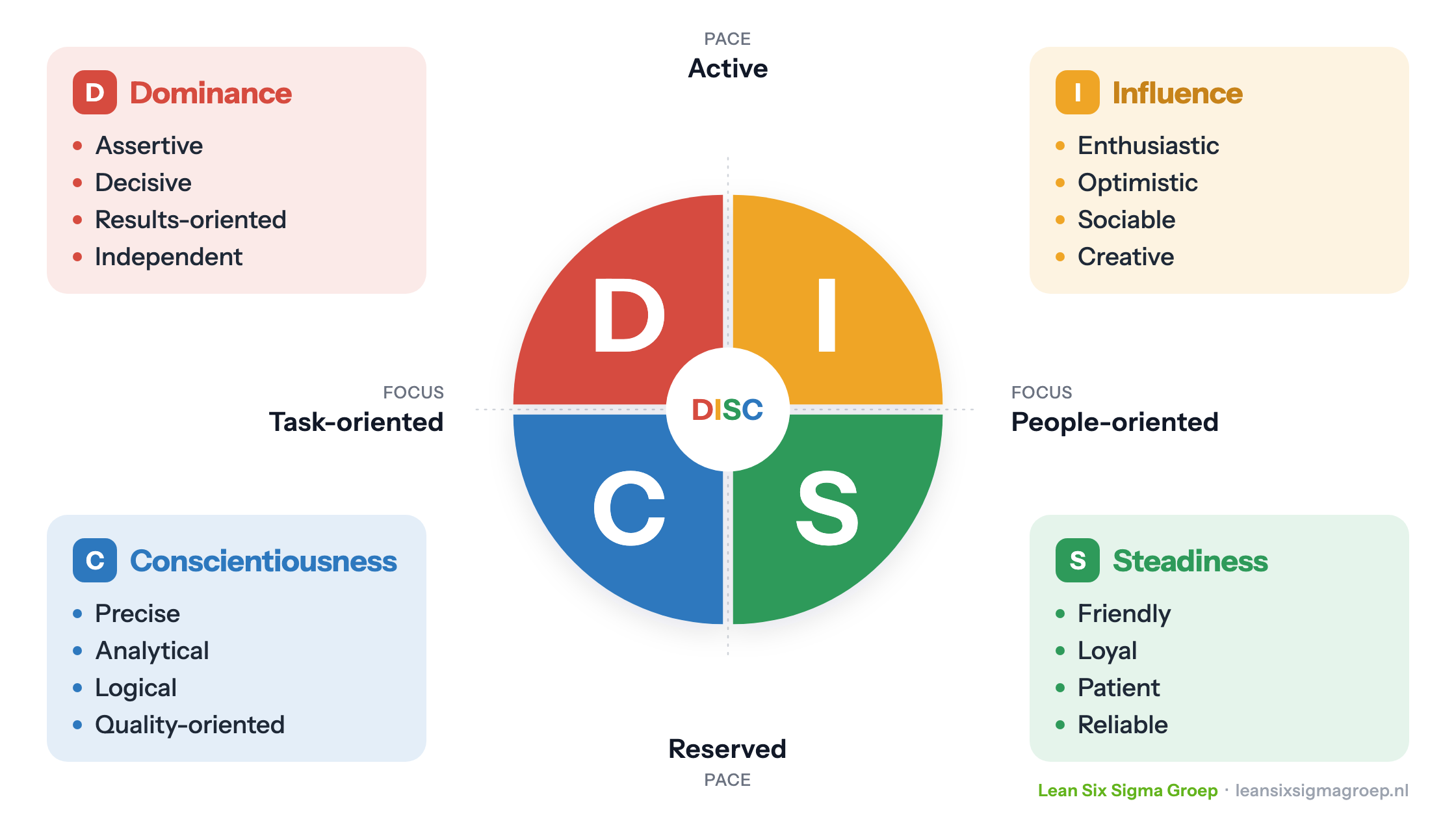
DISC is a model that describes four different behavioural styles and communication preferences: Dominance, Influence, Steadiness and Conscientiousness. Each style has its own colour: red, yellow, green or blue. So DISC is not about personality types: that would be about understanding the nature of an individual. DISC is about observable behaviour.
That suggests it should actually be very simple to observe how other people behave, and then draw conclusions from it. Funnily enough, that is exactly what many people do: they observe something, make a lot of assumptions along the way, and then interpret the behaviour completely wrongly.
We often see all kinds of strange behaviour emerging, or so we think, because we do not take the situation and the person involved sufficiently into account. We see the world as we are at that moment, and do not look at the other person and how they experience the situation.
That is why it is useful to work with a simple model you can refer to quickly. You can assess your own behaviour and that of the other person against a factual model. That lets you hold the situation up to the yardstick, make a diagnosis and look at how you can resolve it.
Below you will find an illustration that clearly shows how the model fits together.
The colour psychology behind red, yellow, green and blue
Let’s also take a look at the colours of the DISC model. We quickly associate colours with certain emotions; they can even influence our emotions. People sometimes feel stronger in clothing of a particular colour.
Certain colours are associated with events, and there are cultural differences in that too. Think of black as the traditional colour of mourning in the Western world, while in the Far East white carries that association as well. There is a whole psychology around it.
But what, according to colour psychology, do the DISC colours red, yellow, green and blue stand for?
Red: strength and warmth
The first colour, red, is experienced by people as intense, powerful and vibrant. People wearing something red often radiate strength. It is not unusual to see speakers in red jackets or ties.
Think also of brands that carry it in their logo, such as Red Bull and Coca-Cola, football clubs like Ajax and Feyenoord, and Belgium’s Red Devils. Beers and spirits often have red in their logo too; think of Campari and Duvel.
Yellow: happiness and fun
This colour stands for cheerfulness. It also symbolises optimism, friendship and wealth, but also spring, Easter and light. It is one of the papal colours, and you will also find it in the logos of IKEA and McDonald’s and of Dutch brands such as Zwitsal and Jumbo.
Green: nature and balance
The colour green stands for positivity and balance, but also for nature and growth. In logos, think of environmentally conscious organisations such as the FSC and various nature conservation bodies. Starbucks and political parties use it too, to make clear that harmony and naturalness matter to them.
Blue: calm and reliability
The colour blue symbolises wisdom and authority. Government bodies like to radiate authority and trust, which is why you see blue in the logos of the police and central government. Banks are fond of the colour too; think of Rabobank, for example.
Colours and behavioural styles in DISC
So why are colours chosen to characterise behaviour? The colours of the DISC behavioural styles stem from the emotions they evoke. That is why the DISC model is also often called the ‘colour personality’ test.
After a few years, people often no longer remember exactly which explanation went with which colour, but the colour itself they do not easily forget; through association it becomes an easy-to-remember language in its own right. Sometimes people even recall a particular person, a teammate or a customer for instance, when they think of a colour.
Improving communication together
DISC is very interesting to use in a team: together you develop a language of your own about behaviour. That language is about a colour, which keeps it factual, even light-hearted. “Gosh Frits, you’re being wonderfully red again” really does sound a lot better than “Frits, you’re forcing your own way through yet again”.
And that helps: in this way teams can more easily name what stands out in someone’s behaviour without the feedback always being painful, and more importantly, everyone also learns to see and name their own role in that behaviour.
After all, you yourself may well be the reason for red behaviour in someone else; good communication is something you do together, so improving communication is something you do together too.
EQ, DISC and effectiveness
That is why it is not just very interesting to know your own preferred behavioural style; it is essential. It teaches you what that style looks like to others, and how you can change and improve the situation yourself.
Because if you know yourself better, and understand better how you react to circumstances and to other people, you can better predict how effective a conversation or even a working relationship will be without actively working on it. Better still: you can actively decide to keep working on it.
DISC and EQ
According to various gurus, it is impossible not to have an influence on the circumstances. According to Daniel Goleman, author of the groundbreaking book Emotional Intelligence and the equally interesting Social Intelligence, the first step towards a higher EQ is knowing yourself; after that it is easier to look at how you can make your relationships with others more successful.
And people who have better relationships with others often feel better, which makes effective, successful relationships at work, but certainly in private life too, easier to achieve. And work, projects, teams and even marriages become more enjoyable. So how do we achieve emotional intelligence with DISC?
The test as a DIAGNOSIS
The DISC test is only one of many ways to gain insight into yourself. And like any other test, it is not necessarily a solution to your problem. Think of a CT scan or a blood test: neither is a solution, but a way of finding the cause of symptoms.
After that you can take targeted action to improve the situation. The same goes for a DISC test: it does not provide a solution, but a direction towards better communication.
DISC and trust in the team
Better communication is a must in teams that are still forming, for instance, but think also of Lean improvement programmes or transitions to Agile working; these not infrequently run aground early, or are less successful than they could have been, when communication is poor, when trust is absent and real feedback is therefore impossible.
In both Lean and Agile working, trust is essential. Without trust, and so without a safe environment in which to ask for support and to give and ask for feedback within the organisation, it is almost impossible to guide everyone through a change programme together.
There is simply no energy for it: it gets absorbed by irritation, heels dug into the sand and resentment.
That is why DISC training and the accompanying tests are often done as a team. DISC certainly adds value if you go through it on your own, but it stands or falls with what you do with it afterwards. When DISC is done as a team, you are working on a culture of openness and feedback.
Below you will find a short summary of what the different DISC behavioural types look like.
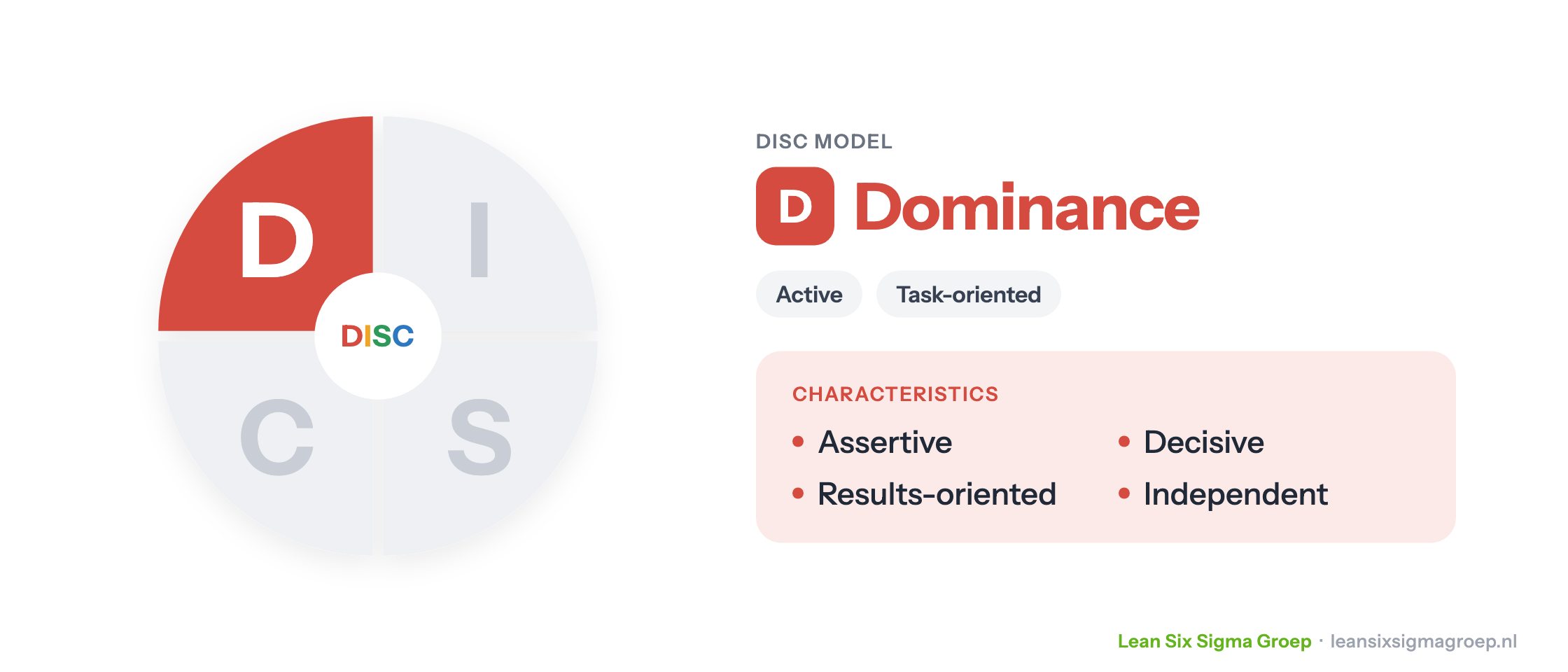
Red (Dominance)
- Characteristics: Red people are assertive, decisive, results-oriented and independent in their behaviour. They love challenges and do not shy away from risk or competition either. They cope well with change and problems.
- Pitfalls: Red people in a crisis can come across as dominant, impatient, aggressive or even insensitive. In that situation they can find it hard to listen and to work with others. Such behaviour can put people off, hurt and irritate: it can be too direct, critical and blunt.
- Tips: Red people can increase their effectiveness by taking more account of the feelings, needs and opinions of others. It often helps to give more appreciation, feedback and recognition to employees or colleagues. They can also try to bring more relaxation, balance and fun into their lives.
- Test results: If you score high on red, you have a strong preference for the red style. You are probably a driven, ambitious and self-assured person who likes to take the lead and get results. You cope well with pressure and challenges, but you need to be careful not to become too dominant, impatient or insensitive.
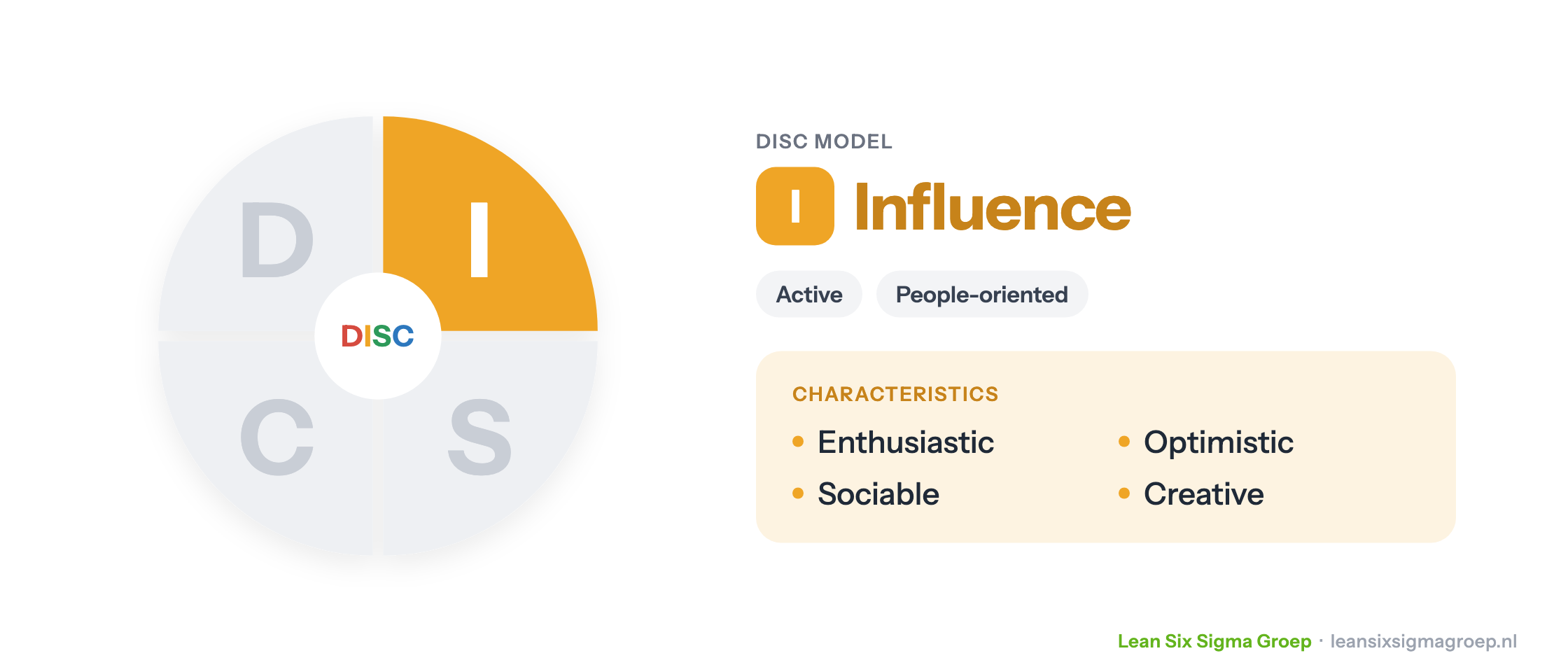
Yellow (Influence)
- Characteristics: People with a lot of yellow in their behaviour are enthusiastic, optimistic, sociable and creative. They love people, humour, variety and adventure. They are good with people and ideas.
- Pitfalls: In a crisis, people with a lot of yellow in their behaviour can come across as impulsive, chaotic, superficial or unrealistic. They attach less importance to details, planning, organisation and discipline. This can come across as erratic and unpredictable, which can cause confusion, anger, disappointment and frustration in others, among other things.
- Tips: Yellow people can increase their effectiveness by bringing more structure, focus and consistency to their work and lives. Giving more attention, care and responsibility to their tasks, commitments and relationships can help too. They can also try to develop more realism, level-headedness and critical thinking.
- Test results: A high score on yellow means you have a strong preference for the yellow style. You are probably a cheerful, energetic and spontaneous person who enjoys making contact and having fun. You are good with people and ideas, but you need to be careful not to become too impulsive, chaotic or unrealistic.
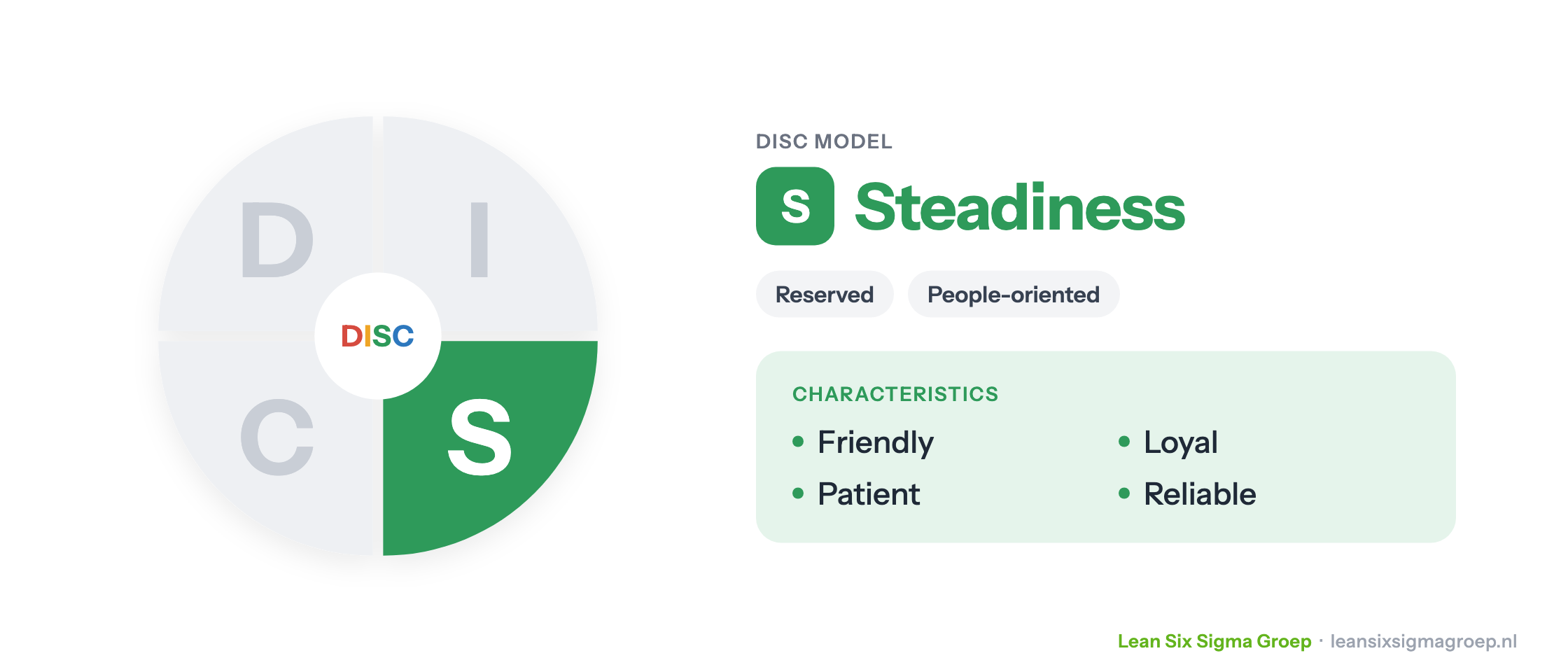
Green (Steadiness)
- Characteristics: People with a high score on green are friendly, loyal, patient and reliable in their behaviour. They love harmony, stability, security and collaboration. They cope well with routine and emotions.
- Pitfalls: Green people on a bad day can come across as too passive, dependent, compliant or insecure. They may then also appear to struggle with change, conflict, criticism or assertiveness. This shows in distinctive behaviour: they may avoid others, give in quickly or disappoint people with submissive and conflict-avoiding behaviour.
- Tips: Green people can increase their effectiveness by showing more initiative, self-confidence and assertiveness. They can also communicate more openly, honestly and directly about their wishes, boundaries and opinions. And they can try to seek more flexibility, variety and challenge in their work and lives.
- Test results: A high score on green means you have a strong preference for the green style. You are probably a warm, caring and cooperative person who likes to help and support. You cope well with routine and emotions, but you need to be careful not to become too passive, dependent or compliant.
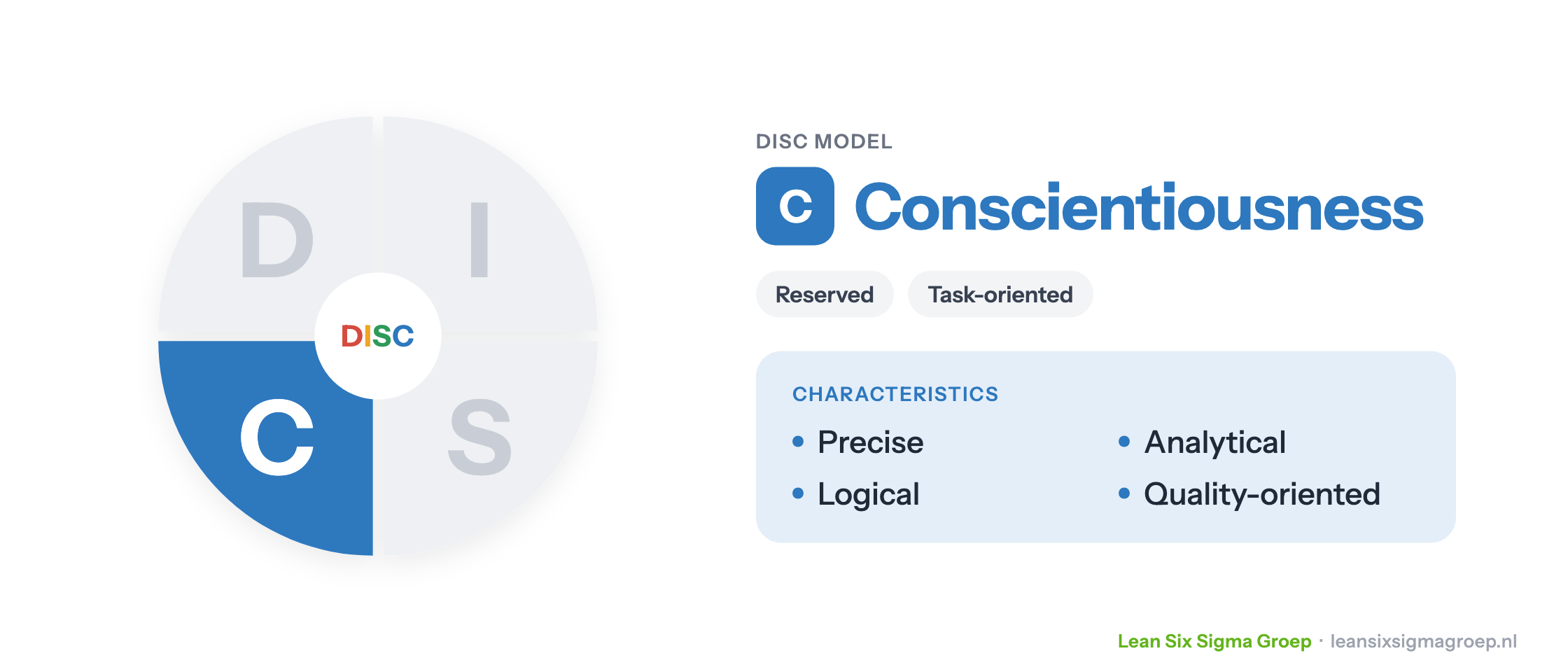
Blue (Conscientiousness)
- Characteristics: People with blue behaviour are precise, analytical, logical and quality-oriented. They love facts, figures, rules and procedures. They are good with information and systems.
- Pitfalls: Blue people under pressure can come across as perfectionist, critical, distant or rigid. They can also struggle with emotions, relationships, improvisation or spontaneity. They can irritate, intimidate or even bore others with formal and rigid behaviour.
- Tips: Blue people can increase their effectiveness by showing more relaxation, empathy and humour. They can also give and receive more appreciation, compliments and feedback. And they can try to show more openness, flexibility and creativity.
- Test results: A high score on blue means you have a strong preference for the blue style. You are probably a precise and professional person who likes to deliver quality and solve problems. You are good with information and systems, but you need to be careful not to become too perfectionist, critical or distant.
More than one colour
Everyone has a unique combination of the four behavioural styles: Dominance, Influence, Steadiness and Conscientiousness. Some people have a clear preference for one or two colours, while others are more evenly balanced across all four. Your DISC profile can change as you develop, learn and grow, but also depending on the environment you are in.
A DISC test.
The price of a DISC test can vary depending on the provider, the duration, the content and the reporting of the test. You can find a free DISC test here, for example. This test gives you a quick and simple indication of your DISC profile.
It can be a great way to have a good team conversation in which problems are looked at from a completely different angle. Teams know their own best examples, after all. And with good facilitation and coaching you can get a long way, for instance by using a DISC result as the basis for a retrospective.
A more precise (paid) DISC test can give you more information, insight and advice about your behaviour, strengths, development points and communication style.
What can you do with a DISC test?
What exactly you can do with the results of a DISC test depends on your goal and your situation. A DISC test can help you in many areas, for example to get to know yourself better, to boost your self-confidence and/or to make the most of your talents.
But as we said, the effect of a diagnosis depends on the treatment that follows. You only see an effect once you apply it in practice and check now and then whether you are making progress towards the goals you set yourself.
For that, you are best off seeing yourself through the eyes of others: so coach others and let yourself be coached, give feedback and receive it, in order to keep improving the (team) situation and keep adapting it to ever-changing circumstances.
As a Green Belt, Black Belt or Agile coach, leader or team member you can get a lot out of this when you really need the team, in constantly changing circumstances. Because the world keeps turning, and change never stops.
Want to know more? Call us or email us. We are happy to help.