
The Rose of Leary is a model that gives insight into interaction patterns: your behaviour influences the behaviour of the other person, and vice versa. Action and reaction, in other words.
The model, also known as Leary’s interpersonal circle or interpersonal circumplex, grew out of research into interpersonal relationships carried out by Timothy Leary in the 1950s.
There are plenty of models that give you insight into the different characters you may be communicating with. Think of the four characters of DISC, the nine personalities of the Enneagram, Belbin’s nine team roles or the sixteen personality types of the MBTI test based on Carl Jung.
The Rose of Leary gives you a different kind of insight: what are the different types of behaviour you can display, and what influence does that behaviour then have on others?
According to Leary, it is not so much about the players as about the game of interaction.
Why is the Rose of Leary used?
The model shows that in many cases the reaction of others is predictable and can be influenced. By gaining insight into your own behaviour and how it affects others, you can communicate more consciously.
The Rose of Leary can be used effectively in situations where communication is difficult, or when you want to encourage specific behaviour in others.
How does the Rose of Leary work?
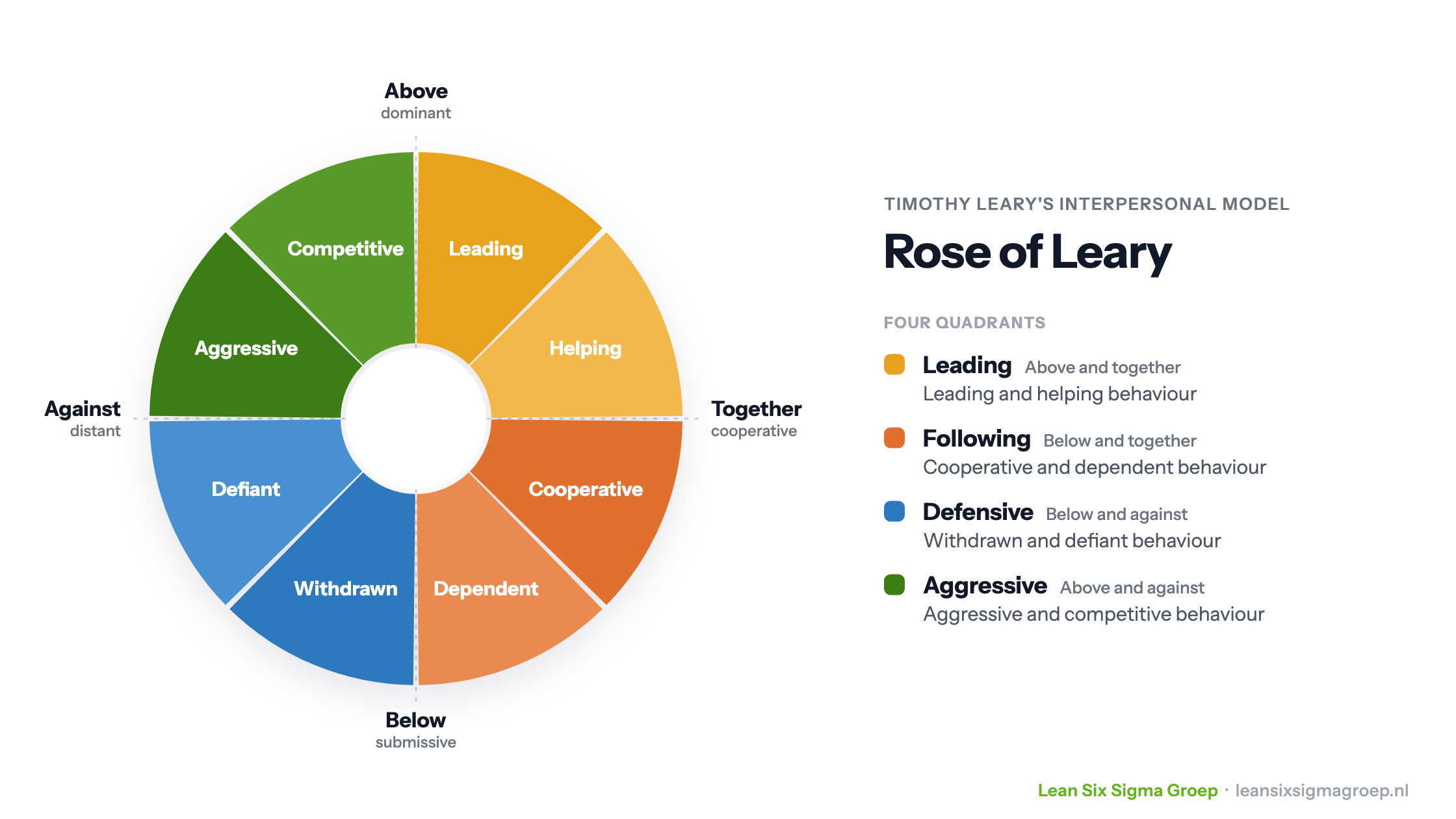
The Rose of Leary works with four quadrants, spread over two dimensions.
Dimension #1 is Dominance versus submission: do you behave Above, or Below? This dimension runs vertically through the rose.
At the top we place dominant behaviour, such as wanting to exercise control, power, competition and so on.
At the bottom we place submissive behaviour: accepting someone else’s control and avoiding conflict.
Dimension #2 is Togetherness versus opposition: do you behave Against, or Together? This dimension runs horizontally through the rose.
On the left of the model we place withdrawn or distant behaviour, such as avoiding emotional involvement. The person then comes across as cool and indifferent. Against, in other words.
On the right we place cooperative or harmonious behaviour. This behaviour shows a willingness to support others and to listen to them. Together.
By drawing the rose with the two dimensions running through it, four quadrants appear:
| Top right | Leading |
| Bottom right | Following |
| Bottom left | Defensive |
| Top left | Aggressive |
The eight types of behaviour
To add a little more nuance, Leary chose to split each quadrant in two, giving eight distinct types of behaviour.
Going clockwise, you get the full picture of the following behavioural styles:
| Above, Together | Leading behaviour |
| Together, Above | Helping behaviour |
| Together, Below | Cooperative behaviour |
| Below, Together | Dependent behaviour |
| Below, Against | Withdrawn behaviour |
| Against, Below | Defiant behaviour |
| Against, Above | Aggressive behaviour |
| Above, Against | Competitive behaviour |
This is one of the tools you learn to apply in the Green Belt training.
How to use the Rose of Leary
Leary stated that behaviour on the horizontal axis (Against vs Together) triggers a symmetrical reaction: together behaviour invites together behaviour, and against behaviour invites against behaviour.
On the vertical axis (Above vs Below) we often see the opposite reaction: above behaviour invites below behaviour, and below behaviour invites above behaviour.
To use the Rose of Leary effectively, keep the model and the effect of your own behaviour in mind while you interact with others. That allows you to analyse both your own behaviour and that of the other person, and to adjust it where needed.
If you notice, for example, that someone is displaying against behaviour, you can deliberately display together behaviour and bring that person along towards together behaviour as well.
Do you want one of your team members to take a more dominant stance? You can achieve that by taking a slightly more following stance yourself during the conversation.
Do you have any questions about the Rose of Leary and how to use it effectively after reading this article? Feel free to contact us.
The Rose of Leary is part of our Black Belt training. Would you like to know more? Click here for the Black Belt training.
Behavioural patterns and team dynamics
Explore the interaction patterns of the Rose of Leary in the video below and unravel the model. Understand how behavioural patterns shape communication and relationships within teams, and how you can use that knowledge to encourage positive interactions.
From theory to practice
Learn to apply this in practice
Topics like Rose of Leary are applied directly to an improvement project from your own organisation in the Green Belt training.
Next start dates
Lean Six Sigma Green Belt training →Not ready for a training yet?