
Why is an implementation plan essential?
An implementation plan is more than a step-by-step plan. It is a strategic document that makes sure everyone involved knows exactly what needs to happen, by whom, when and how. Without an implementation plan, you run the risk that:
- Time and resources are wasted: energy goes into a project that delivers no lasting results.
- Stakeholders are left disappointed: expectations are not met, which can lead to resistance to future initiatives.
- Engagement declines: teams and employees lose confidence in improvement projects.
What are the key components of an implementation plan?
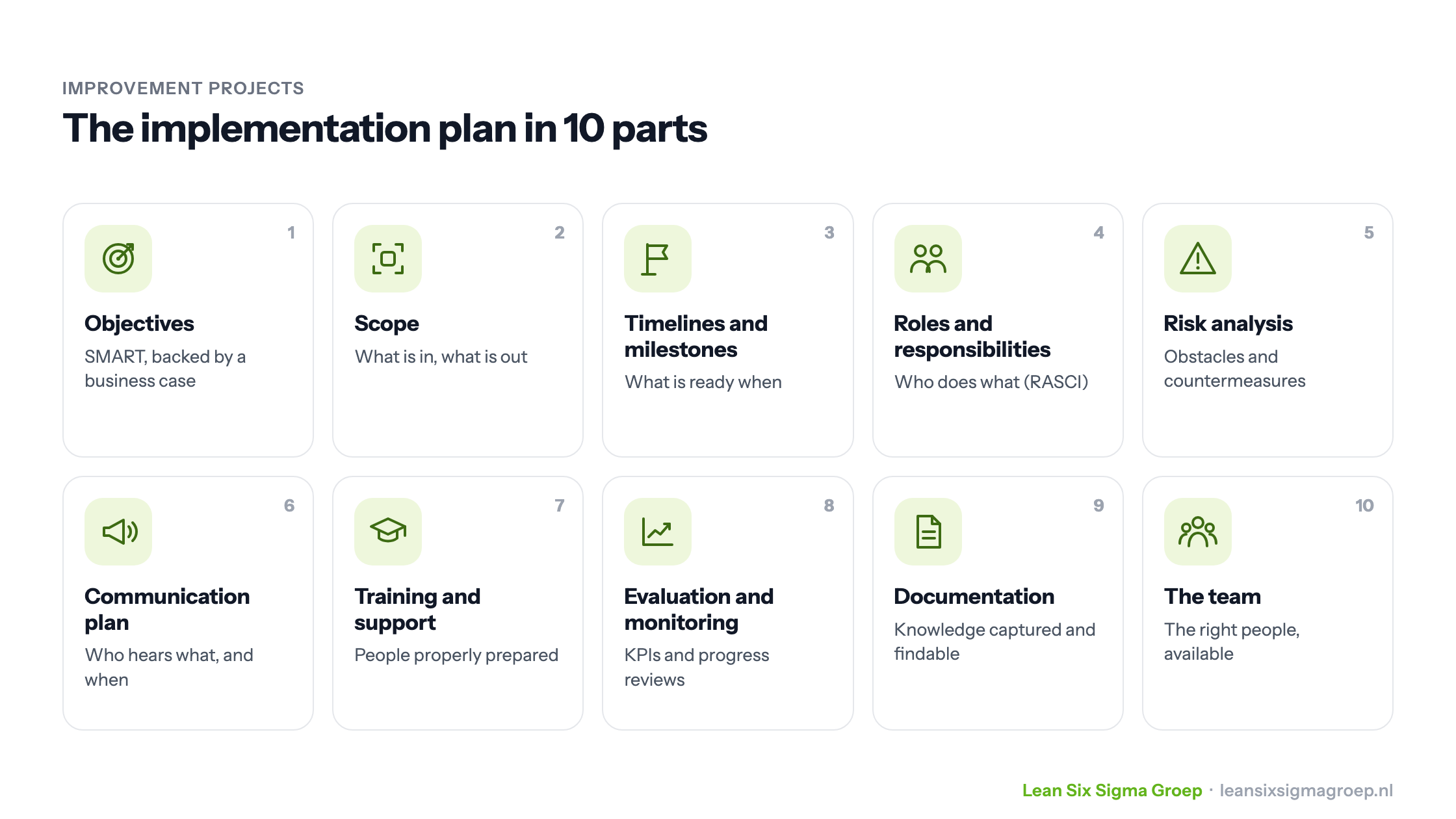
A strong implementation plan consists of a number of essential components that together set a clear course and enable effective execution. These are the most important elements:
This is one of the tools you learn to apply in the Green Belt training.
1. Objectives
Define clearly what you want to achieve with the project. Make sure these objectives:
- Are Specific, Measurable, Acceptable, Realistic and Time-bound (SMART).
- Tie in with the original project goals, for example from an A3 methodology.
- Are backed by a business case that makes the benefits for the organisation clear.
2. Scope
Determine the scope of the project:
- What falls within the project, and what does not?
- Which departments, processes or systems are involved?
- Who are the stakeholders, and what is their role in the project?
3. Timelines and milestones
Draw up a detailed schedule with milestones. Describe:
- What needs to be ready at what point.
- Which steps are needed to get there.
- How success is defined and assessed.
Choose an approach that suits your project, such as an agile way of working with sprints or a more traditional waterfall approach.
4. Roles and responsibilities
State clearly who is responsible for which parts of the project. A RASCI matrix can help make sure everyone knows what is expected of them.
5. Risk analysis and mitigating actions
Identify potential obstacles and draw up plans to minimise them. Think, for example, of:
- Operational risks, such as a lack of time or capacity problems.
- Technical challenges that could delay the project.
Use tools such as FMEA to map risks in a structured way.
6. Communication plan
Effective communication is crucial to implementation. Make sure that:
- All stakeholders know what is expected of them.
- Information is shared in the right way and at the right time.
- Differences in language and culture are taken into account, for example in international teams.
7. Training and support
For a successful implementation, employees need to be well prepared. This means:
- Offering relevant training.
- Adapting and updating manuals and other documentation.
- Removing redundant documents or processes to prevent new waste.
8. Evaluation and monitoring
An implementation is never ‘finished’. Make sure you evaluate and monitor continuously:
- Set up a structure for regular progress reviews.
- Define performance indicators (KPIs) to measure success.
- Make progress visual, for example with dashboards or status overviews.
9. Documentation
Make sure all relevant information, such as process documentation, training materials and reports, is stored in a structured way. This prevents knowledge from being lost and makes it easier to implement improvements in the future.
10. Team composition
The implementation team plays a crucial role. Make sure that:
- The right people with the necessary skills are involved.
- Team members’ availability is properly coordinated.
- Team dynamics are strengthened through clear communication and shared goals.
Practical tips for a successful implementation plan
- Start with a clear problem statement and objectives.
- Use tools such as the A3 method or a RASCI matrix to create structure.
- Make sure the plan is flexible enough to be adjusted during implementation.
- Communicate regularly and keep stakeholders informed of progress.
- Monitor and evaluate continuously, so you can adjust course in good time.
Get the most out of your Lean project
A good implementation plan is the key to successful and sustainable improvement projects. With clear objectives, a structured approach and effective communication, you make sure your project succeeds not just on paper, but in practice too.
Do you want to make sure your Lean or DMAIC project is not only implemented successfully, but also delivers lasting results? Then get in touch with us. Our experts will gladly help you draw up an implementation plan that fits your organisation and goals. Contact us at [email protected]