SCAMPER is a creativity technique that helps you come up with new ideas by looking at an existing product, service or process from seven angles. Bob Eberle developed the technique in 1971, building on the checklist of Alex Osborn, the inventor of brainstorming. SCAMPER is still popular, because it is simple and quickly produces many ideas.
What is SCAMPER?
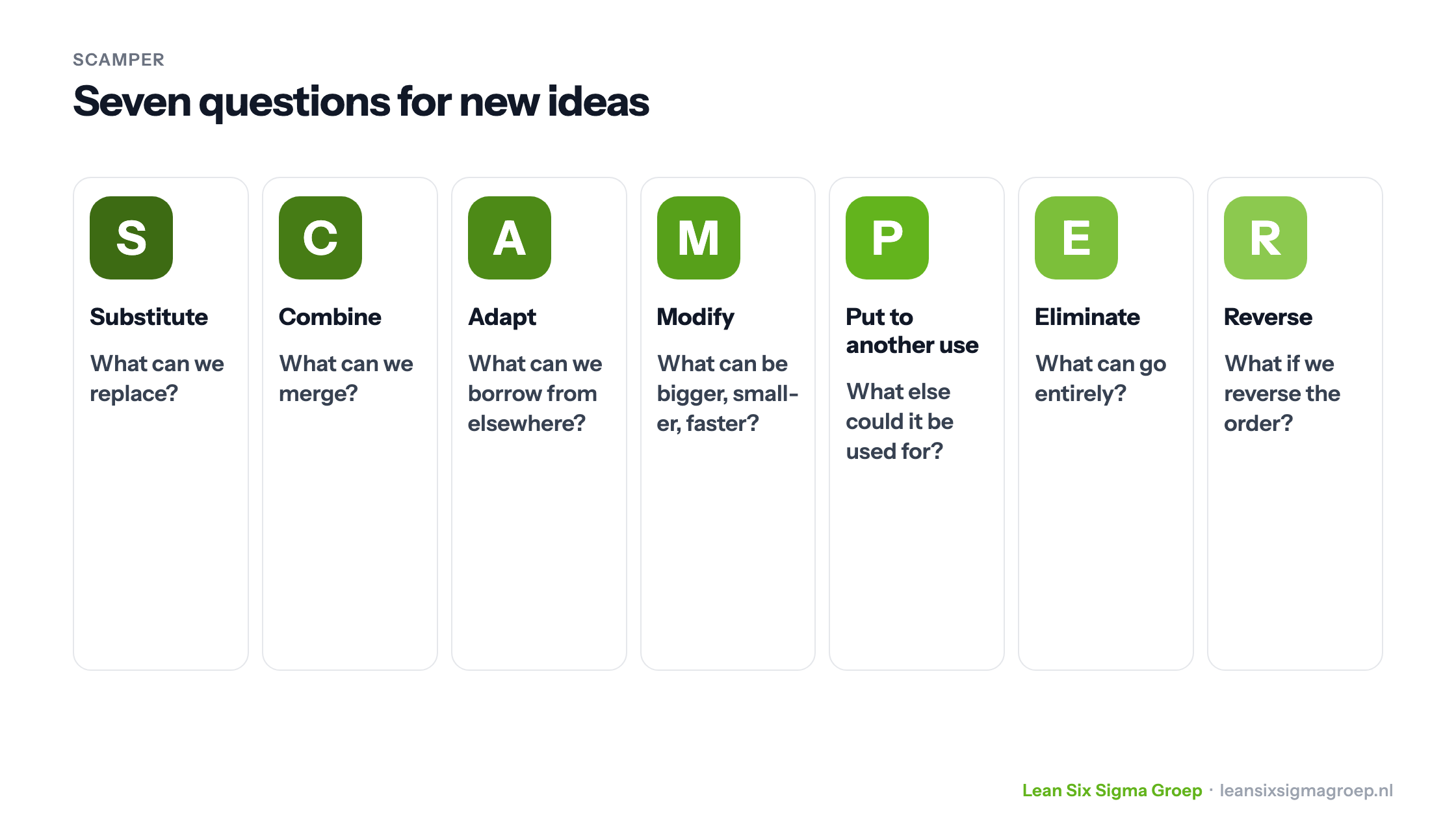
SCAMPER stands for Substitute, Combine, Adapt, Modify, Put to another use, Eliminate and Reverse. Each letter is a question you ask about what exists now, as shown in the image at the top of this article. In Lean Six Sigma projects, SCAMPER is mainly used in the Improve phase, to come up with solutions and make processes more efficient.
The seven questions
Substitute
Can we replace something? This can be about materials, process steps, systems or people. For example: transporting goods over long distances by train instead of by truck.
Combine
Can we merge two or more things? For example combining two process steps, so work doesn’t wait between two departments and flow improves.
Adapt
What can we borrow from elsewhere? How do other departments, other sectors or even nature solve a similar problem, and can we copy that? Velcro, for example, was inspired by burrs that stuck to a dog’s coat.
Modify
What happens if we make something bigger, smaller, faster, slower, more or less frequent? For example producing in smaller batches, or cutting a form in half.
Put to another use
Can we use something for a purpose other than originally intended? Waste material that becomes a raw material for another product, or data you already collect that is also useful for planning.
Eliminate
What can go entirely? A feature nobody uses, or a check that adds little but causes a lot of waiting.
Reverse
What if we reverse the order, or do something the other way round? Many companies now deliver first and only send the invoice afterwards, because that is nicer for the customer.
Example: the expense claim process
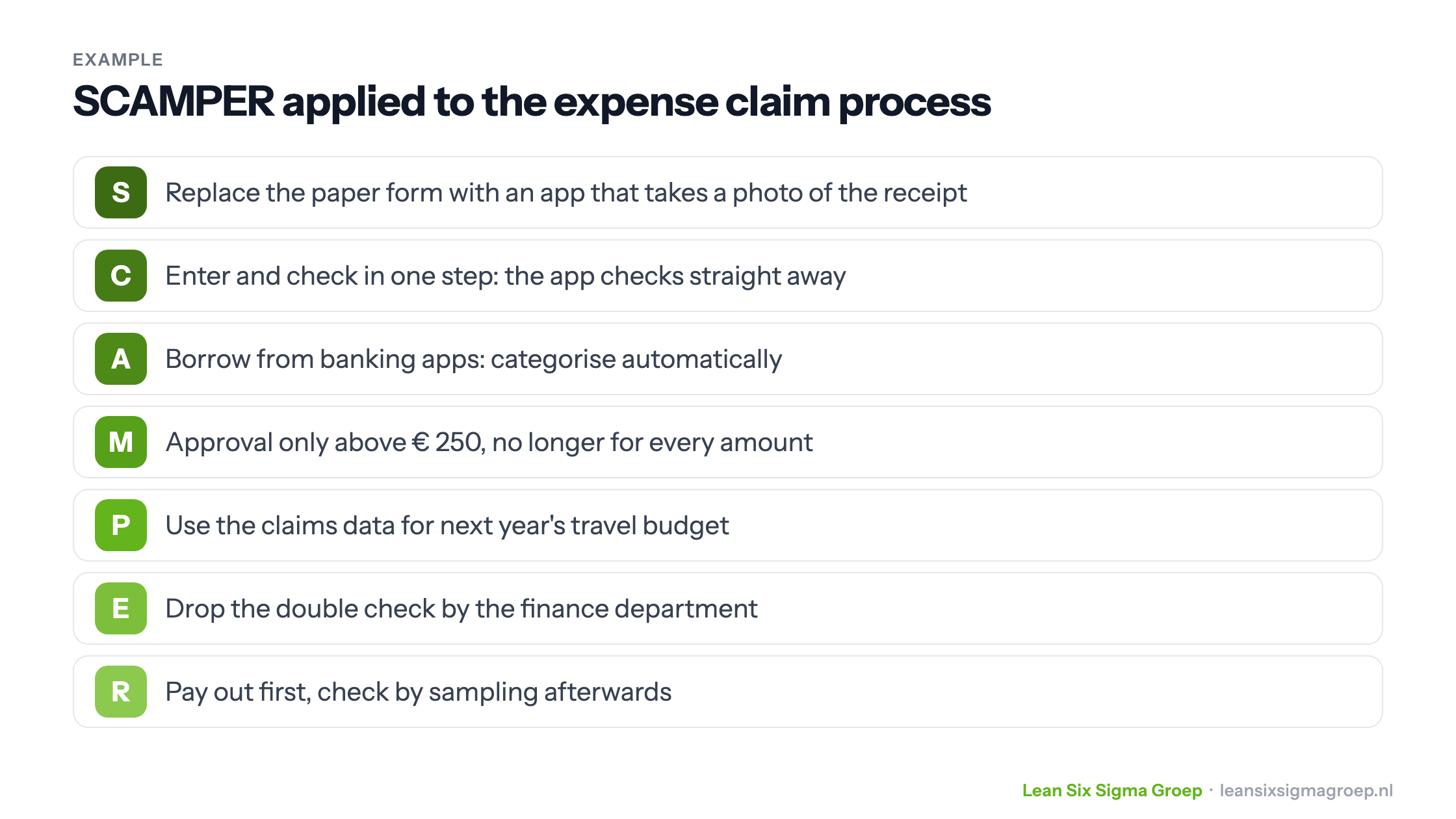
Below you can see how a team uses SCAMPER to come up with ideas to make claiming expenses faster and simpler.
This is one of the tools you learn to apply in the Green Belt training.
How to use SCAMPER
- Choose the subject: a product, service or process step, and state the problem clearly.
- Go through the seven questions, preferably with a team of people who know the process. Take a few minutes per question.
- Write down every idea, including the odd ones. Judging comes later.
- Choose the best ideas, for example with an Impact Effort Matrix, and test them in a pilot.
Not every question produces something for every subject, and that is fine. SCAMPER is above all a tool to break out of fixed thinking patterns.
The video with this article explains the seven angles once more.
From theory to practice
Learn to apply this in practice
Topics like SCAMPER are applied directly to an improvement project from your own organisation in the Green Belt training.
Next start dates
Lean Six Sigma Green Belt training →Not ready for a training yet?