
What is the 8D problem solving process?
The 8D problem solving process, also known as Eight Disciplines, is a structured method designed to help organisations solve complex problems. The process consists of eight disciplines that are worked through step by step to tackle the problem and find lasting solutions.
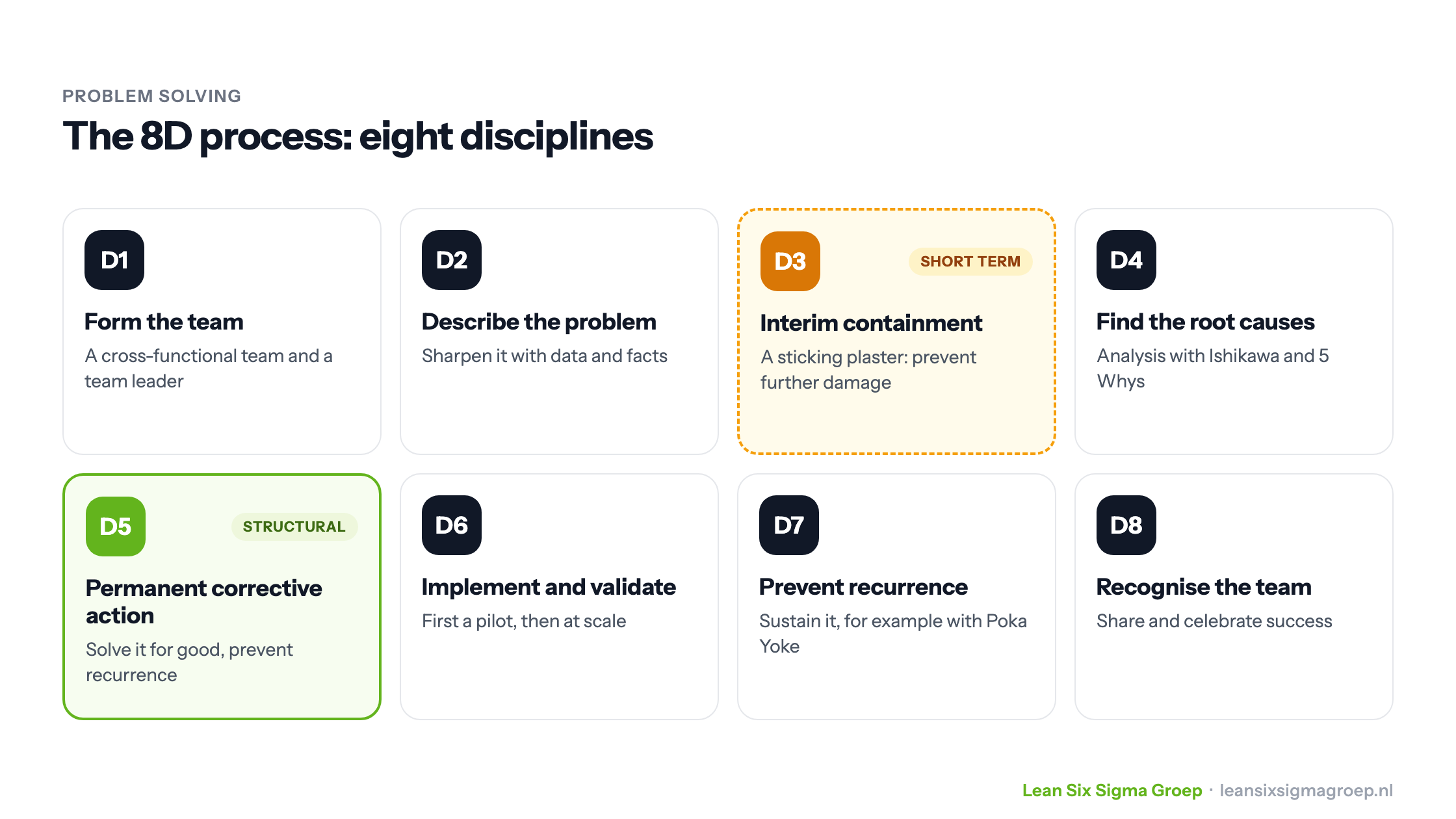
The 8 Disciplines of the 8D process:
D1: Form the team
To get started on solving the problem, a cross-functional team is put together with knowledge and experience of the problem area. A team leader is also appointed to coordinate the process.
D2: Describe the problem
There is always a trigger for starting to solve a problem. That doesn’t mean the problem itself is immediately clear, let alone what its impact is. In this step, the problem definition is sharpened, often on the basis of relevant data and facts about the problem.
D3: Develop interim containment actions
The third discipline focuses on solving the problem in the short term. A sticking plaster is applied to prevent further damage. These are usually not lasting solutions.
Think of shutting down a production line, or processing files by hand instead of digitally because of a bug in the system.
D4: Identify the root causes
Identifying the causes is an important step towards solving the problem for good. This step involves a thorough analysis to uncover the underlying causes of the problem. Tools such as Ishikawa diagrams and 5 Whys can help here.
D5: Develop permanent corrective actions
Once the causes have been identified, permanent solutions can be developed. Lasting solutions are created to solve the problem and prevent it from happening again. In this step, a brainstorm with the team, possibly joined by other experts from the shop floor, can lead to solutions.
D6: Implement and validate the corrective actions
Once a solution has been developed, it can be tested in a pilot. This verifies how effective the solution really is. If the tested solution proves a success, it can be rolled out on a larger scale.
D7: Prevent recurrence
To stop performance from slipping back at some point after implementation, attention turns to sustaining the improvement. Measures are taken to prevent the problem from occurring again, for example by applying Poka Yoke.
D8: Recognise the team
Finally, time is taken to acknowledge the team’s efforts and the successful solution to the problem. After all, successes deserve to be shared and celebrated. The team is put in the spotlight, for example with a special lunch or a team outing.
This is one of the tools you learn to apply in the Green Belt training.
Why is the 8D process effective?
The 8D problem solving process is effective because it offers a structured approach to solving complex problems. By focusing on causes and prevention, the process helps organisations find lasting solutions and stop problems from coming back. With the 8D process, teams can tackle problems effectively and contribute to continuous improvement within the organisation.
Conclusion:
The 8D problem solving process is a powerful tool for organisations to tackle and solve complex problems effectively. With a structured approach and the right commitment from the team, organisations can find lasting solutions and prevent problems from recurring. With the help of practical examples and clear steps, organisations can apply the 8D process with confidence for successful problem solving.