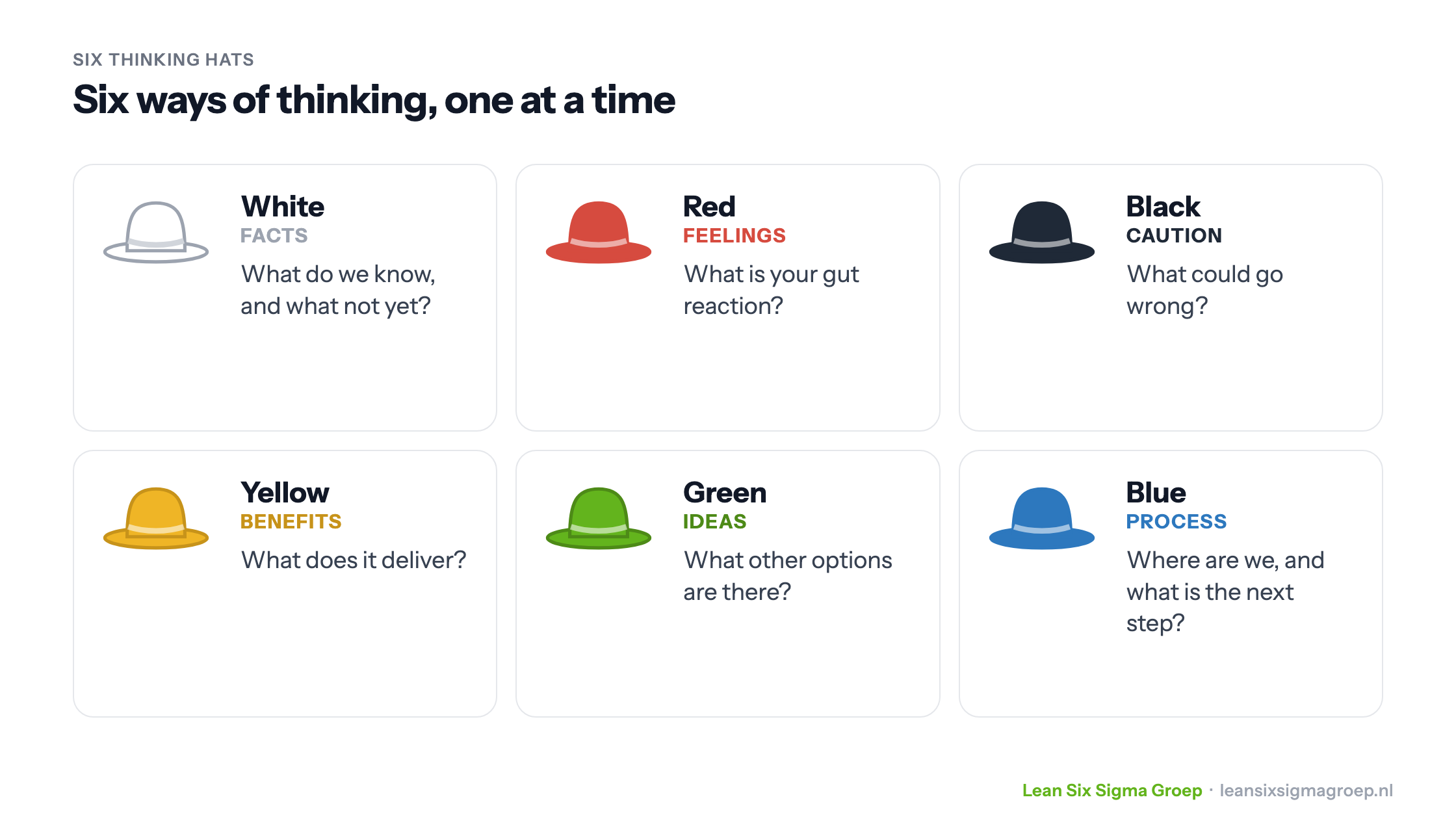
Six Thinking Hats is a method by Edward de Bono for looking at a question or problem from six perspectives in a structured way: facts, feelings, caution, benefits, ideas and process. The essence is that the group always thinks together in one way, instead of arguing in different directions at once.
Who was Edward de Bono?
Edward de Bono (1933-2021) was a Maltese physician and psychologist. He wrote dozens of books on thinking and coined the term lateral thinking: approaching problems from an unexpected angle. He described the six thinking hats in 1985 in his book Six Thinking Hats.
He called the idea behind it parallel thinking. In an ordinary discussion one person defends an idea while another lists the risks and a third is still looking for the facts. Everyone thinks in a different direction and the conversation becomes a fight. With the thinking hats, the whole group looks in the same direction at the same time.
The six hats
Each hat stands for a way of thinking, as shown in the image at the top of this article:
- White, facts: what information do we have, what is missing, and how do we get it? Without opinions.
- Red, feelings: intuition and emotion, without having to justify them. What is your first reaction?
- Black, caution: looking critically. What could go wrong, and why might it not work? With arguments.
- Yellow, benefits: looking optimistically. What does it deliver, and why would it work? Also with arguments.
- Green, ideas: creative thinking. New possibilities, alternatives and variations, without judging them right away.
- Blue, process: thinking about the thinking. What is the goal, which hat is next, and what is the conclusion? Usually the facilitator wears this hat.
How a session works
A session starts and ends with the blue hat. First you agree on the goal together: what problem do we want to solve, or what question are we looking to answer? Have each participant state the goal in their own words: then you know everyone has the same thing in mind.
Then the whole group always puts on the same hat, in an order that suits the goal. Below is an example for solving a problem.
This is one of the tools you learn to apply in the Green Belt training.
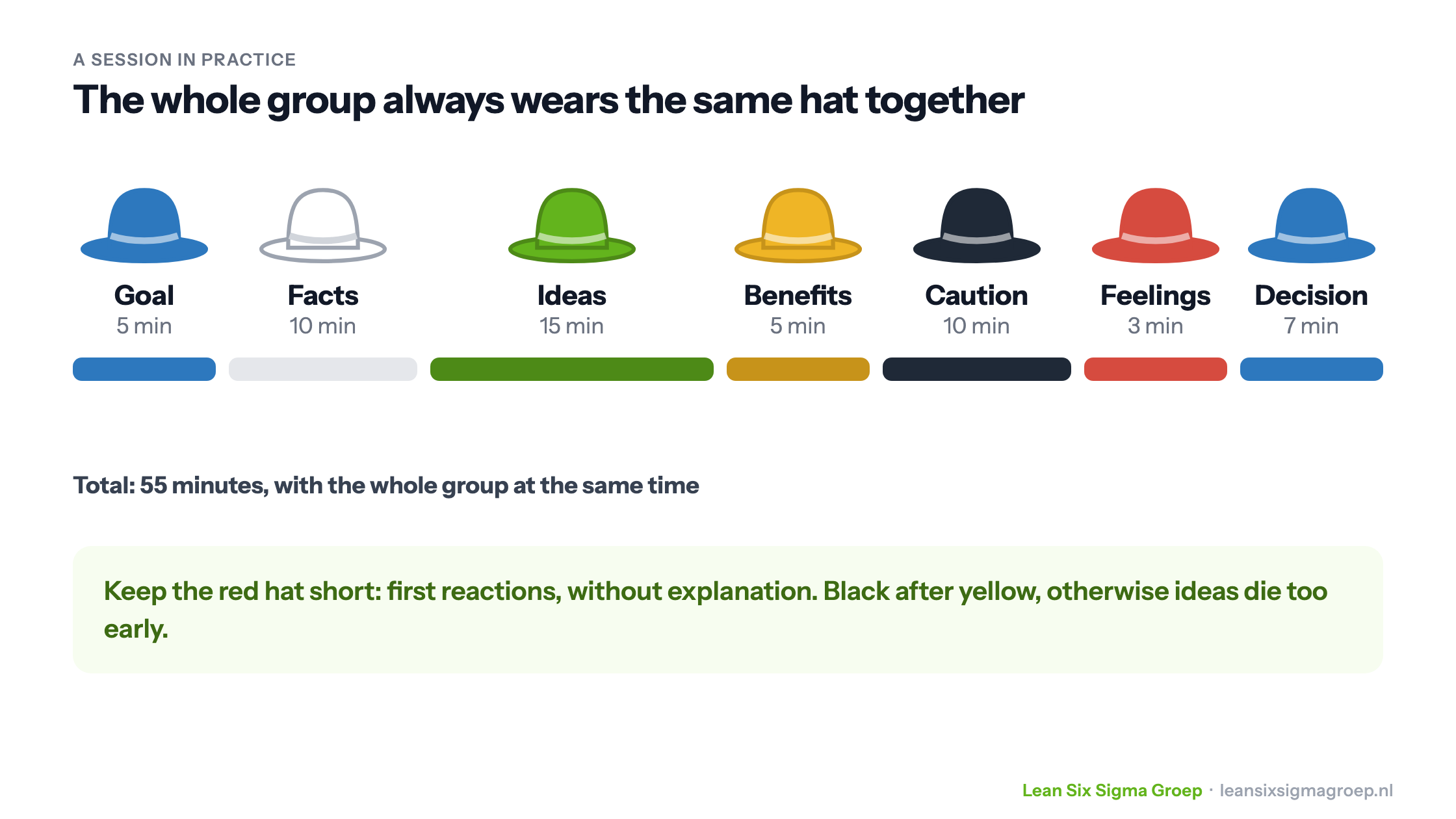
Agree a fixed time per hat and stick to it. A few tips:
- Keep the red hat short: first reactions only, without explanation or discussion.
- Put the black hat after the yellow and green ones. Otherwise ideas die before they have had a chance.
- Anyone who wants to say something that belongs to another hat saves it until that hat’s turn.
- Close with the blue hat: what have we decided, and what is the next step?
A popular variant is to give each participant their own hat for the whole session. That can help people play a different role for once, for example giving the eternal critic the yellow hat. But it is not how De Bono intended the method: everyone is then thinking in a different direction again.
An example from practice
An operational department had structural backlogs: more than two thousand customer queries were waiting for an answer, and however hard the team worked, including overtime, it could not catch up. Two colleagues organised a brainstorm with the six thinking hats, in the evening and away from the office. The goal was clear in advance: come up with solutions to the backlog. Attendance was voluntary, and everyone came.
The atmosphere stayed relaxed, while at the same time people thought very seriously and from every perspective about solutions. The three best ideas went to the office the next day. The problem wasn’t solved in one go, but things got a little better every day. And the colours of the hats kept coming back in conversations.
Six Thinking Hats in Lean Six Sigma
In a Lean Six Sigma project the thinking hats are especially useful in two phases of DMAIC. In Analyse they help you look broadly at possible causes, for example alongside an Ishikawa diagram. In Improve they help you come up with solutions and assess them. Together with SCAMPER and Design Thinking, it is one of the best-known techniques for looking at a problem more creatively.