
What is the A3 method?
A3 is not just a paper size you can select on the photocopier. It is also a powerful, structured method for solving problems and improving processes. What makes A3 unique is that it summarises complex information in a visual, clear way, so that everyone involved keeps the same focus and progress is recorded clearly.
The method originated at Toyota, where people were looking for an approach that not only solves problems but also helps employees develop by drawing on their problem-solving ability. The result was a visual, structured process that sits at the heart of Lean methodologies.
A3 combines an overview of the current condition, the targets and the planned actions on a single page, and is widely recognised as a practical tool for getting teams to work together effectively.
How does the A3 method work?
The A3 method revolves around a standardised way of working, inspired by Deming’s well-known PDCA cycle (Plan, Do, Check, Act) and the DMAIC structure (Define, Measure, Analyse, Improve, Control) from Lean Six Sigma.
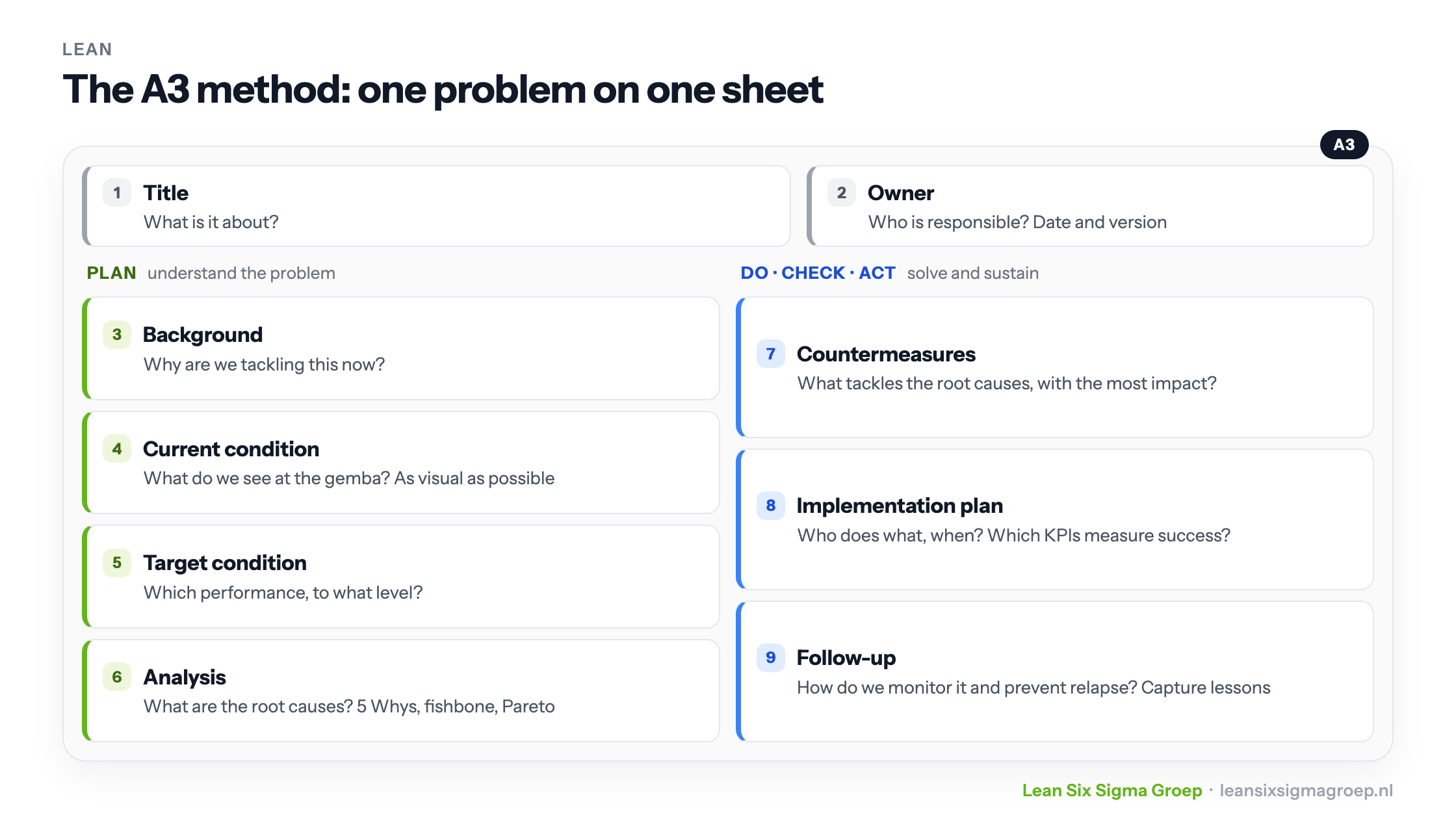
Although the exact content of an A3 can vary from one organisation to another, it usually contains the following elements:
This is one of the tools you learn to apply in the Green Belt training.
- Title
- What is this project about?
- Which improvement or change do you want to achieve?
- Owner
- Who is responsible for the project?
- Also state the date and version of the document, so that everyone works from the same version.
- Background
- Why is this problem being tackled now?
- What are the strategic, operational or organisational reasons for it?
- Current condition (As-Is)
- What is the current state of affairs?
- Make this as visual as possible with drawings, tables or floor plans, based on data collected at the gemba (the shop floor).
- Write a clear problem statement and make the problem tangible for everyone involved.
- Target condition (To-Be)
- Which performance needs to improve, and to what level?
- Make sure the gap between the current condition and the target condition is clearly visible.
- Analysis
- What are the causes of the problem?
- Use techniques such as the 5 Whys, fishbone diagrams, Pareto analysis or process analysis trees for this root cause analysis.
- Proposed countermeasures
- Which actions need to be taken to reach the target condition?
- Which countermeasures address the root causes and have the greatest impact?
- Implementation plan
- How are you going to carry out the countermeasures?
- Draw up a timeline with the key actions and name who is responsible.
- Which performance indicators (KPIs) will be used to measure success?
- Follow-up
- How will progress be followed up and monitored?
- Who discusses what, and when?
- Which risks remain during or after the project, and how will you prevent performance from slipping back?
- Make sure lessons learned are recorded and shared.
What are the benefits of the A3 method?
- Visual simplicity: Everything on one page creates focus and a shared understanding among everyone involved.
- Structure: It provides a standardised approach for analysing and solving problems systematically.
- Collaboration: It helps teams get on the same page by presenting information clearly and clarifying roles and responsibilities.
- Flexibility: Although the core elements are fixed, the content can be adapted to the specific needs of an organisation or project.
Practical applications of A3 within Lean
The A3 method is not only used in industry and business, but can also be applied in personal and social contexts. For example:
- In organisations: For process improvement, project management and strategic change.
- In teams: For solving operational problems and improving collaboration.
- Personal use: For planning major life changes or structuring personal goals.
A warning: you will never look at projects the same way again!
Curious what the A3 approach could do for you or your organisation? Many professionals and teams have achieved impressive results with A3, from more efficient processes to better collaboration.
Contact us at [email protected] and discover how the A3 method can help you too!