A Design Sprint is a five-day approach to solving a challenge and testing the solution with customers straight away. A small team works on that one challenge for a whole week, builds a prototype and has it tried out on Friday. That tells you whether an idea works before you have invested much time and money in it.
Where does it come from?
The Design Sprint was developed around 2010 by Jake Knapp at Google, and then refined at Google Ventures, where it was used with dozens of start-ups. In 2016 Knapp, John Zeratsky and Braden Kowitz described the approach in their book Sprint. Since then organisations of all kinds have used it, not only for apps and websites, but also for services, processes and campaigns.
The five days
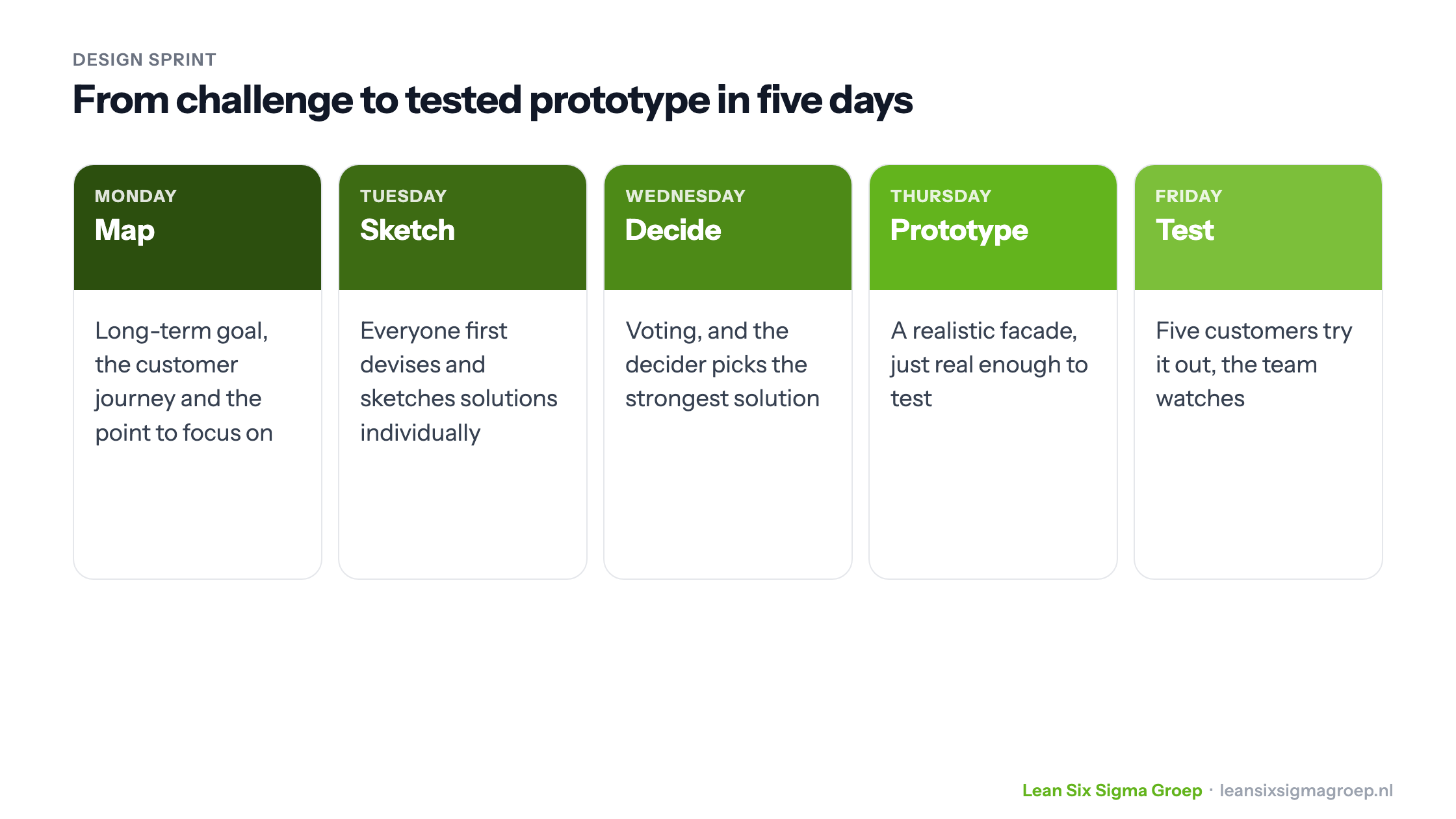
Each day has a fixed goal, as shown in the image at the top of this article:
- Monday, map: the team sets the long-term goal, maps the customer journey, talks to experts and chooses the point the sprint will focus on.
- Tuesday, sketch: everyone looks for inspiration and then first sketches a solution on their own, in silence. That produces more and better ideas than an ordinary brainstorm.
- Wednesday, decide: the team reviews the sketches, votes with stickers, and the decider chooses. The team then makes a storyboard for the prototype.
- Thursday, prototype: the team builds a realistic facade, just real enough for customers to react to. Not a working product, but a convincing front.
- Friday, test: five customers from the target group try the prototype in one-to-one interviews, while the rest of the team watches. Five turns out to be enough: after that mostly the same reactions come back.
After Friday you know what works and what doesn’t. Sometimes the outcome is a clear yes, sometimes a clear no. Both save months of work.
What do you need?
A Design Sprint requires a team freed up for a week, with a few fixed roles.
This is one of the tools you learn to apply in the Green Belt training.
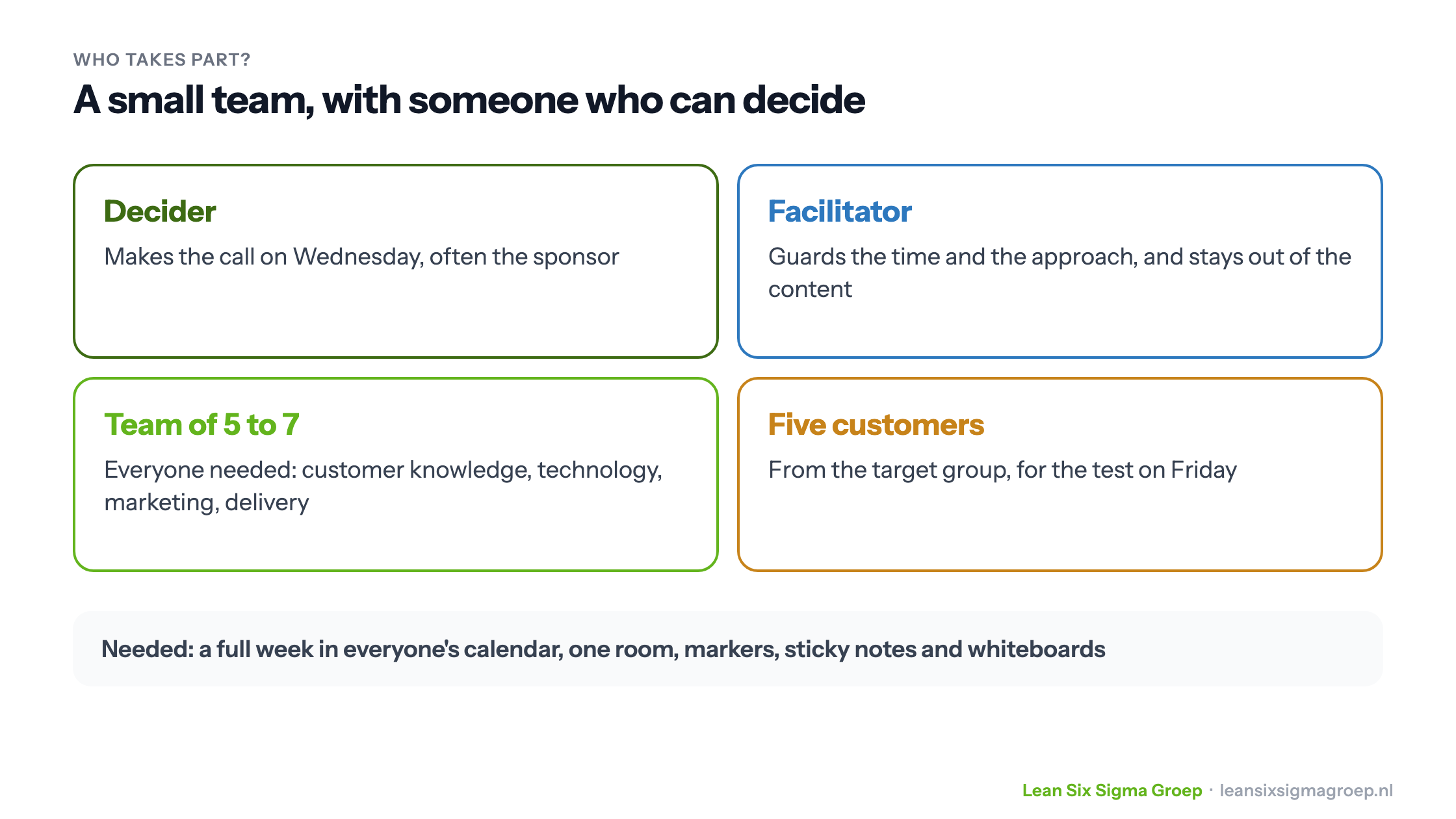
- A decider: someone who is allowed to choose, often the sponsor. Without a decider, Wednesday’s choice gets stuck.
- A facilitator: guards the time and the approach, and stays out of the content.
- A team of five to seven people with all the knowledge needed: about the customer, technology, marketing and delivery.
- A full week in everyone’s calendar. The team works only on the sprint. A good tip: phones and laptops stay outside the room, except for building the prototype.
- One room with whiteboards, markers and sticky notes.
Design Sprint and Design Thinking
The Design Sprint resembles Design Thinking, with the phases empathise, define, ideate, prototype and test. The difference: Design Thinking is a broad way of thinking with countless techniques, which also helps you find out which problem you should actually solve. The Design Sprint is a fixed plan with fixed techniques, and assumes a problem that is already clear.
That is also where it often goes wrong: teams using a Design Sprint to decide which problem to solve. So start with a sharply defined challenge.
Why it works
- The user comes first. The whole week is aimed at the customer, and on Friday you get their direct reaction.
- All perspectives at the table. Everyone needed spends a week together. That breaks through working in separate departments.
- Focus. Five days forces the team to make choices and reach something concrete.
- Fast learning. You find out in a week whether an idea works, instead of after months of development.
Other ways to look at a problem creatively are SCAMPER and the Six Thinking Hats.