What is the 5 Whys method?
The 5 Whys method was originally developed by Sakichi Toyoda, one of the founders of Toyota. It is a technique used within Lean Manufacturing, but the principle can be applied in all kinds of sectors. Put simply, the method suggests that you ask the question “Why?” five times, so that you cut through the symptoms and find the cause of a problem.
For example:
Problem: The machine suddenly stops working.
- Why did the machine stop? → Because the fuse has blown.
- Why did the fuse blow? → Because the machine was overloaded.
- Why was the machine overloaded? → Because there were too many products on the conveyor belt.
- Why were there too many products on the conveyor belt? → Because the sensor that counts the products was faulty.
- Why was the sensor faulty? → Because the sensor needed maintenance that had not been carried out.
As you can see, asking “Why?” five times brings you to the underlying cause: poor maintenance. Instead of simply replacing the fuse and solving the problem for the time being, the 5 Whys method makes sure you tackle the real cause, so that the problem does not come back.
Why five times?
You may now be wondering: why exactly five times? Five is not a magic number; it is based on practical experience. After five questions you have usually got well beneath the surface and actually reached the root of the problem. Sometimes three times “Why?” is enough, while other situations may call for six or seven. The idea is to keep asking until you can no longer find answers that lead to a deeper underlying cause.
How do you apply the 5 Whys method effectively?
The strength of the 5 Whys method lies in its simplicity, but how effective it is depends on a few important factors. Here are some tips for applying the method well:
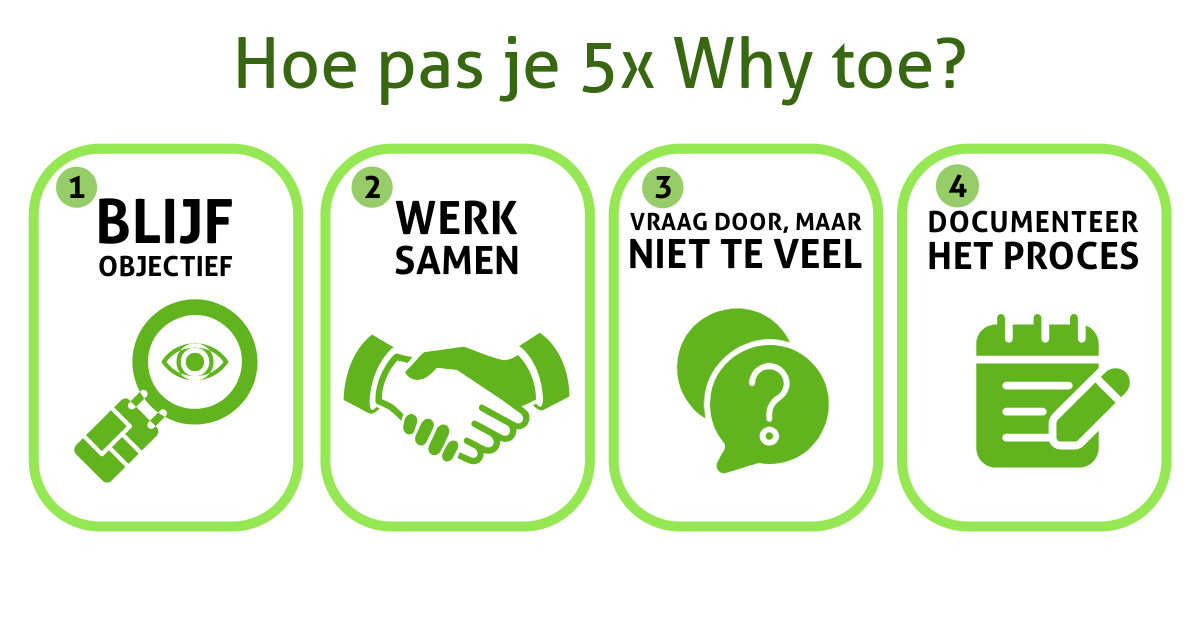
- Stay objective: it is crucial that you remain objective and base the answers on facts, not on opinions or assumptions. Once you start speculating, you lose sight of the real causes.
- Work together: it is often useful to do the 5 Whys exercise as a team. Different people bring different insights, and that can help you reach the heart of the problem faster.
- Keep asking, but not too much: it is important to keep probing, but make sure you do not get stuck asking question after question. The goal is to get to the core, not to go on endlessly.
- Document the process: as you ask the questions, keep a careful record of the answers you get. That makes it easier to look back later at the decisions you took and to evaluate progress.
The link with DMAIC
DMAIC (Define, Measure, Analyse, Improve, Control) is a structured methodology within Six Sigma that is used to improve processes. The 5 Whys method can play a valuable role here. In the Define phase, 5 Whys helps to sharpen the problem definition by gaining deeper insight. In the Analyse phase, it supports the identification of root causes, so that the right improvements can be made.
How do 5 Whys and the fishbone diagram work together?
The fishbone diagram, also known as the Ishikawa or cause-and-effect diagram, is a powerful tool for problem solving and process improvement. It helps teams map the causes of a problem in a structured way by analysing different categories. The standard categories in a fishbone diagram are:
- People: problems caused by human error, lack of training or insufficient motivation.
- Methods: problems caused by inefficient or unclear working methods and procedures.
- Materials: quality problems caused by defective or inadequate raw materials.
- Machines: technical faults and failing equipment.
- Environment: external factors such as temperature, humidity or regulation.
- Measurements: incorrect or inconsistent measurement methods that lead to errors.
The 5 Whys method is an effective complement to the fishbone diagram. By combining the two methods, organisations can not only identify symptoms but also tackle the underlying systemic causes.

Conclusion
The 5 Whys method is a simple but effective technique for uncovering the causes of problems. It takes patience and collaboration, but it helps organisations and teams cut through the symptoms and tackle the real causes of problems. By applying this method regularly, you can not only eliminate recurring problems but also learn from mistakes and make improvements at a deeper level.
So the next time you are faced with a problem, ask yourself the question five times: Why? You will be surprised how often the solution lies a lot deeper than you first thought. Want to know more about 5 Whys? Our training courses pay a great deal of attention to it: in the Define and Analyse phases of the Green Belt training, when looking at the customer demand in the Orange Belt training, and in the Six Sigma block of the Black Belt training.