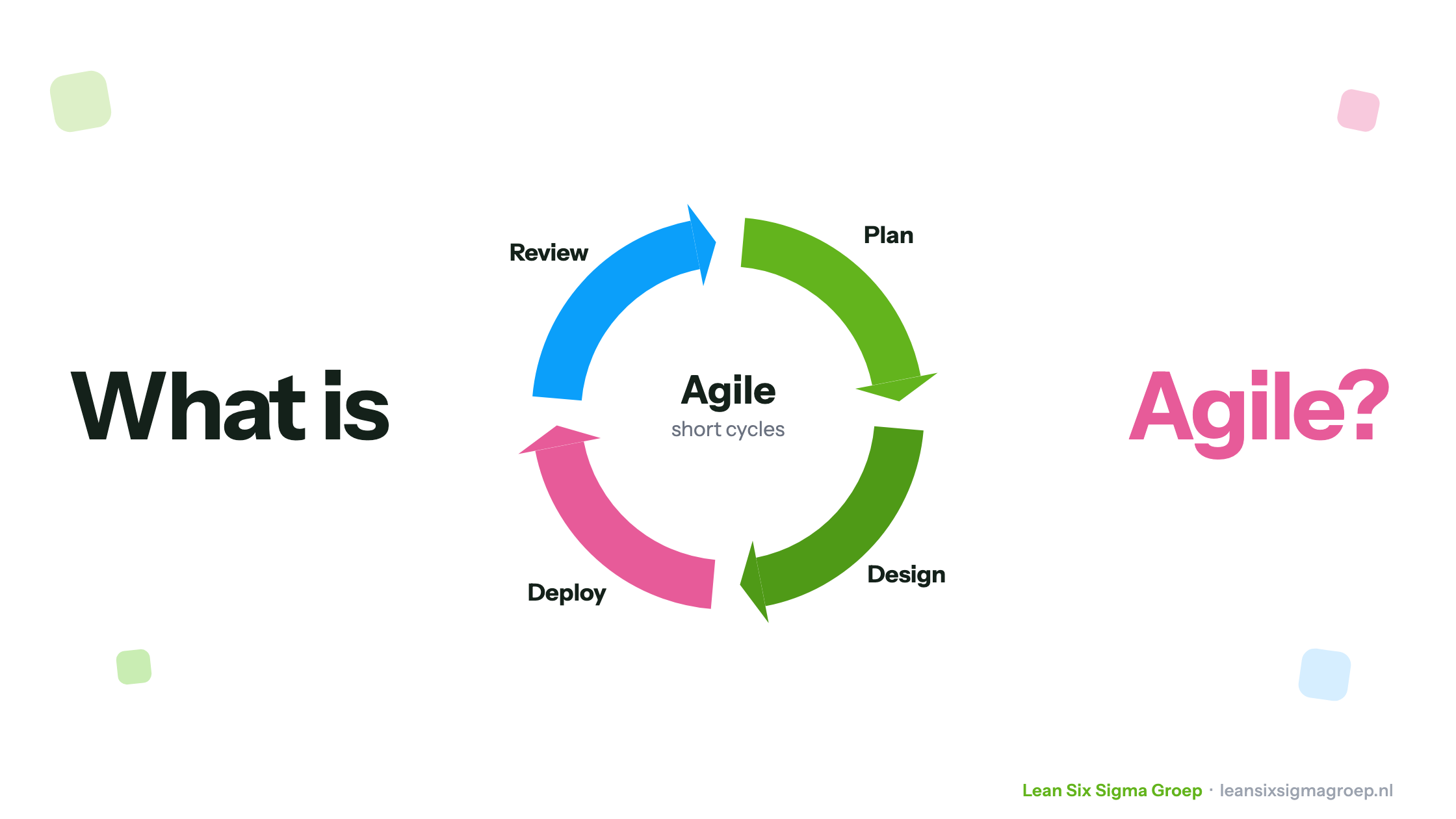
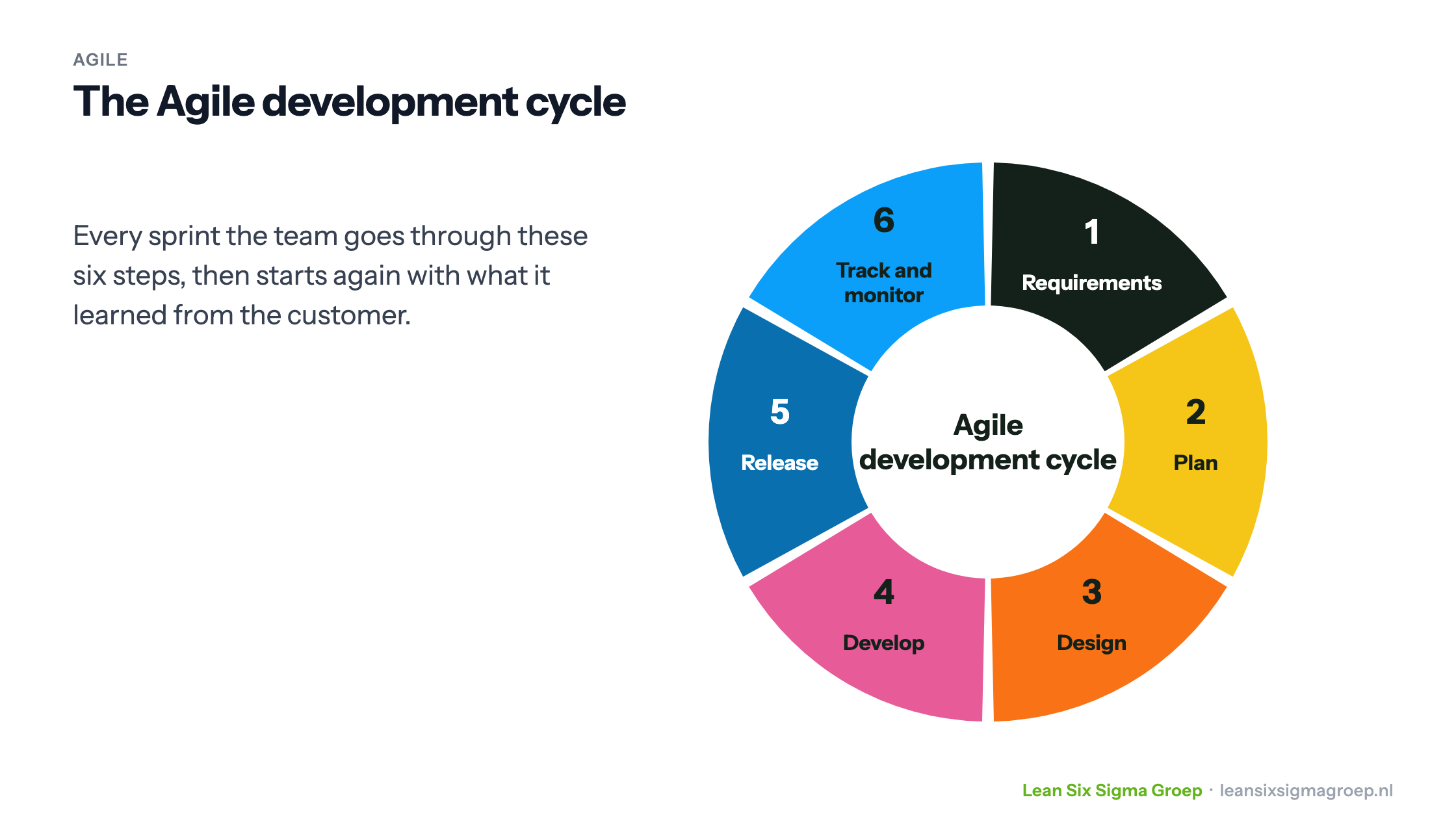
The term originally comes from IT, where it stands for developing software in short sprints (iterations). At the end of every sprint, which lasts two to four weeks, working software is delivered. The customer gives feedback on it and the developers adjust the software accordingly. This way the software is tested in practice quickly and delivers more value to the customer.
In the Lean Six Sigma Green Belt training you learn to apply Agile and Scrum in your own team.
In 2001 a group of seventeen software developers drew up the Agile Manifesto. The document of only 68 words and the 12 principles behind it give guidelines for building software effectively. Since then the approach has proven its value in many other sectors too. That is why you can often replace the word “software” with “product”.
The Agile way of working
The essential difference between the traditional way of developing and the Agile way is that Agile puts four core values first:
| Agile values | over |
|---|---|
| Individuals and interactions | processes and tools |
| Working products | comprehensive documentation |
| Customer collaboration | contract negotiation |
| Responding to change | following a plan |
Twelve principles are derived from these values. Every decision meets all of them. That is why we say: the decision making process matters!
The 12 Agile principles
If you read the principles more broadly, for products rather than software only, you can phrase them like this:
- Our highest priority is to satisfy the customer through early and continuous delivery of valuable products.
- Welcome changing requirements, even late in development. Agile processes harness change for the customer’s competitive advantage.
- Deliver working products frequently, from every couple of weeks to every couple of months.
- People from the operational, tactical and strategic level work together daily throughout the project.
- Build projects around motivated people. Give them the environment and support they need, and trust them to get the job done.
- The most efficient and effective way to convey information to and within a team is a face to face conversation.
- A working product is the primary measure of progress.
- Agile processes promote a sustainable pace of development.
- Continuous attention to quality and good design enhances agility.
- Simplicity, the art of maximising the amount of work not done, is essential.
- The best products, requirements and designs emerge from self-organising teams.
- At regular intervals the team reflects on how to become more effective, and adjusts its behaviour accordingly.
What are the benefits of Agile?
These are five important benefits:
- High product quality: testing is part of the work from the start. The product is checked regularly during development, so changes are easy to make and problems surface early.
- Higher customer satisfaction: the customer is involved throughout, so you can be sure they get what they want.
- Better control of the project: through sprint meetings, transparency and tools such as Jira.
- Lower risk: because you work in short cycles, a project can hardly fail completely.
- Faster return on investment: Agile development is iterative. Features are delivered step by step, so the benefits arrive while the product is still being developed.

Scrum, Kanban and other methods
There are several ways to apply the principles in an organisation. A few examples of methods:
- Scrum is the most widely used team-based Agile method. It has been around for more than twenty years and has proven itself in practice.
- Kanban comes from manufacturing: Toyota applied it in 1953. It is about making the flow of work in a process visible.
- To scale Agile to many teams there are frameworks such as SAFe and the Spotify model, with Squads, Tribes, Chapters and Guilds. That model became known in 2012 through an article on how Spotify organised its teams.
Getting started with Agile
Which business challenges does your organisation face? How large is it, and how is it organised?
Considering an Agile approach is the first step towards lasting success. Agile is not a new phenomenon, but it is a condition for responding to the needs of customers and the market. Organisations that apply no form of Agile at all fall behind.
Still not entirely clear? Watch this video about Product Ownership in a nutshell.
From theory to practice
Learn to apply this in practice
Topics like gile are applied directly to an improvement project from your own organisation in the Green Belt training.
Next start dates
Lean Six Sigma Green Belt training →Not ready for a training yet?